Luisa de Álvarez de Toledo
1915-1990
An under recognized pioneer of psychedelic therapy in 1950s Argentina
Luisa Agusta Rebeca Gambier de Alvarez de Toledo (1915-1990) was an influential Argentine doctor and psychoanalyst who played a key role in the development of psychoanalysis in Argentina and Uruguay. Known as ‘Rebe’ to her friends, she was an early member of the Argentine Psychoanalytic Association (APA) and served in various leadership positions within the organization from the 1950s through the early 1970s.
Alvarez de Toledo made significant contributions to psychoanalytic theory and technique. Her 1954 paper "The Analysis of ‘Associating,’ ‘Interpreting,' and ‘Words’" [published in Spanish as “El Análisis del ‘Asociar’, del ‘Interpretar’ y de ‘Las Palabras’”] explored the central role of language in psychoanalysis and had a lasting impact on the field. In the late 1950s and early 1960s, she pioneered the use of both ayahuasca and LSD in psychedelic therapy. Working with a group of Argentine colleagues based in Buenos Aires, Alvarez de Toledo developed an innovative approach that combined psychedelics with talk therapy and group sessions in a comfortable, non-clinical environment.
Though this research was cut short due to changes in drug laws in the 1960s, it stands as an important early example of psychedelic-assisted psychotherapy.
📖 Primary source: “Psychoanalysis and LSD-25: Foundations for a Combined Therapeutic Technique” (1957)
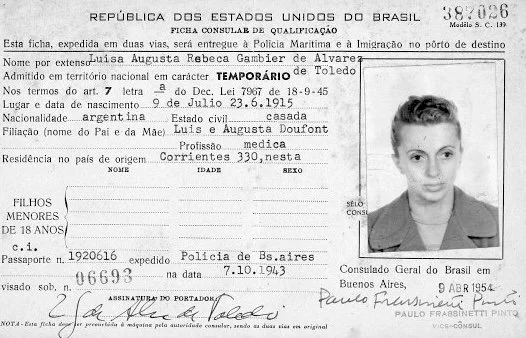
Undated passport photo via this site.
-
• de Toledo, Luisa G. de Álvarez. "El análisis del “asociar”, del “interpretar” y de las “palabras”: actualización de las fantasías inconscientes y logro de una mayor integración del yo por medio del análisis." In Los Pioneros del Psicoanálisis en Sudamérica, pp. 325-365. Routledge, 2020 (originally published in 1953).
• Grinberg, León, María Langer, Emilio Rodrigué, Luisa G. de Alvarez de Toledo, Lygia Alcantara Amaral, Judith Teixeira Carvallo de Andreucci, Luis L. Basombrío et al. "El grupo psicológico en la terapéutica: enseñanza e investigación." In El grupo psicológico en la terapéutica: enseñanza e investigación, pp. 322-322. 1959.
-
TK
-
• Zoë Dubus, "LSD and Ayahuasca in Argentina: The Pioneering Work of a Psychoanalyst in the 1950s," Chacruna, May 3, 2023
• Spanish translation of the above in Chacruna Latinoam´erica.
• Navarro de Lopez, Sheila and Federico Flegenheimer. "Introduction to the Life and Work of Luisa de Alvarez de Toledo (1915–1990)." In The Pioneers of Psychoanalysis in South America, 1st ed., 5. Routledge, 2014. https://doi.org/10.4324/9781315754789.
“The action of LSD 25 leads the patient to a state of prenatal regression, in which they have oceanic experiences of identity with the analyst (with the mother), with the cosmos, feeling at the peak of omnipotence; beyond time and space...
These omnipotent experiences express the opposite; the absolute dependence of the fetus in relation to the mother; an uncontrollable world that creates and sustains it.”