1955: “Experimental Compound MER 17 (Frenquel) and LSD-25”
Authors: Dr. Harold Fabing
Date: 1955
Source: The National Archives, via Archive.org
Historical Overview
Produced in 1955 by the Wm. S. Merrell Company, this medical demonstration film documents the clinical research of Dr. Howard D. Fabing, a neurologist and psychiatrist based at Christ Hospital in Cincinnati, Ohio. The film illustrates the effects of the experimental compound MER-17 (generically known as azacyclonol and marketed as Frenquel) as a potential "blocking agent" against drug-induced psychosis. The footage centers on a series of experiments conducted in November and December of 1954 featuring "Ronnie," a 22-year-old psychology graduate student. In the film, Ronnie acts as a "healthy normal" control subject, ingesting 100 micrograms (gamma) of LSD-25 to induce a temporary psychotic state. The narrative structure contrasts an unmedicated LSD session—characterized by Ronnie’s reported paranoia, dissociation, and confusion—with subsequent sessions where MER-17 is administered either prophylactically or intravenously to abort the psychedelic effects.
The "Model Psychosis" Era
Dr. Fabing’s work represents a quintessential example of the "psychotomimetic" paradigm that dominated psychedelic research in the 1950s. during this period, substances like LSD and mescaline were primarily utilized by the psychiatric establishment to create a "model psychosis"—a temporary, reversible state believed to mimic the symptoms of schizophrenia. Researchers operated under the hypothesis that if a chemical antagonist could be found to block the effects of LSD, it might serve as a cure for endogenous schizophrenia. MER-17 was an isomer of Meratran (pipradrol), a stimulant Fabing had previously researched; unlike its parent compound, MER-17 was investigated for its specific ability to diminish hallucinations and dissociation without acting as a sedative. The film highlights the close relationship between academic researchers and pharmaceutical companies of the era, as well as the casual, pre-prohibition clinical environment where graduate students frequently served as test subjects.
While the film presents MER-17 as a breakthrough "anti-confusion" drug with the capacity to dramatically reverse LSD intoxication, the medication’s long-term clinical trajectory was less successful. Although azacyclonol was approved by the FDA and briefly used in psychiatric settings, it eventually fell out of favor due to inconsistent efficacy in large-scale trials, particularly when compared to the emerging class of powerful neuroleptics like chlorpromazine (Thorazine).
I believe this is an extremely interesting and useful primary source not just for historians of pharmacy and psychedelics, but also for anyone interested in mid-century American film, television, masculinity, and the scientific gaze. The film captures the vocabulary used to describe the psychedelic experience prior to the countercultural movement of the 1960s—framing the trip as "mass confusion" and "dissociation" rather than a mystical or recreational event. But beyond the words, there is a remarkable story told by the body language, posture, and visual vocabulary of the film itself.
The whole thing is worth watching — you can view it via the link below.
— Benjamin Breen (2025)
full transcript
[SCENE: Introduction and Titles]
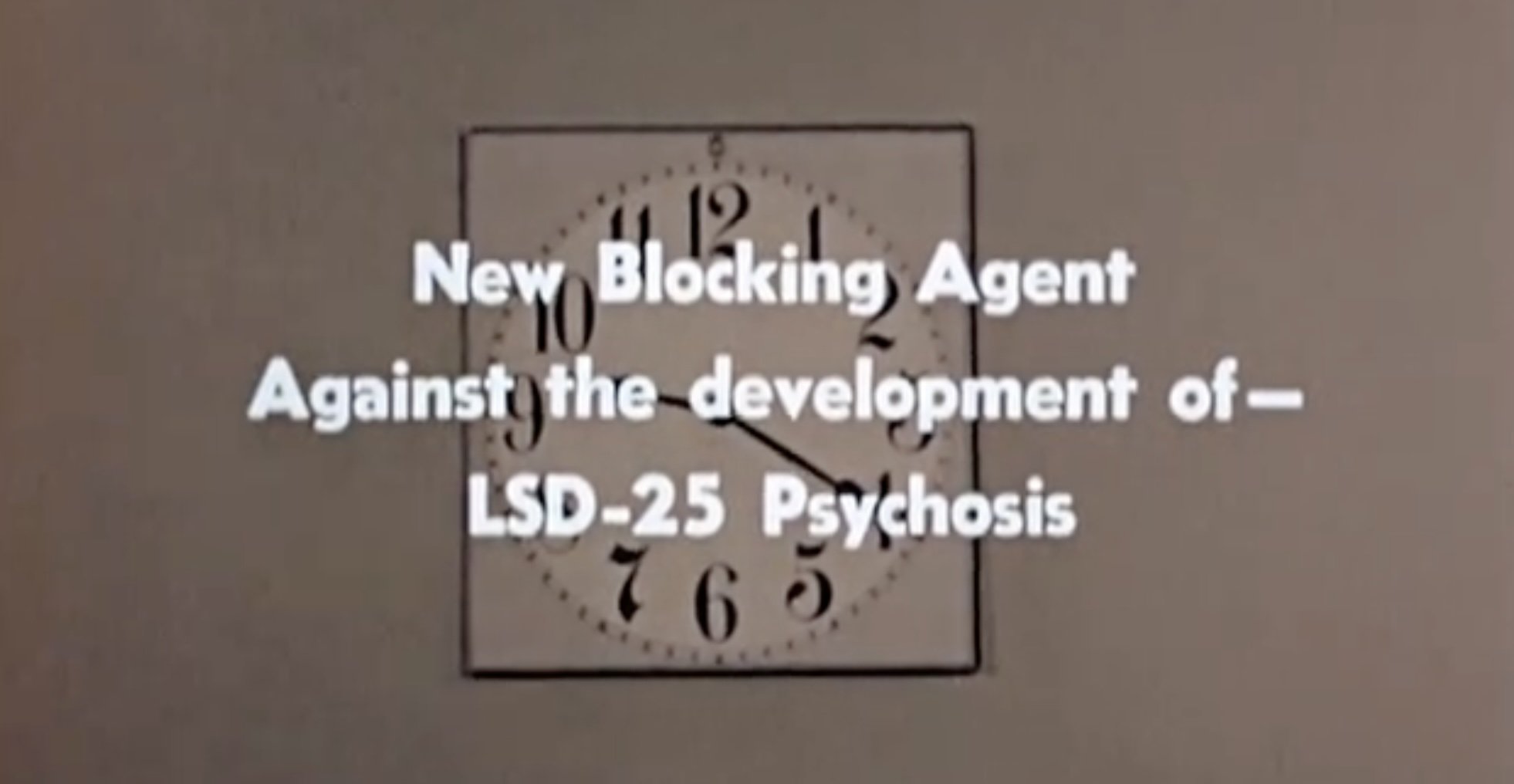
Dr. Fabing: The object of this presentation is to demonstrate the effect of MER-17, a new blocking agent against the development of LSD-25 psychosis. We have used two healthy graduate students in psychology as subjects, but time permits us to show only one.
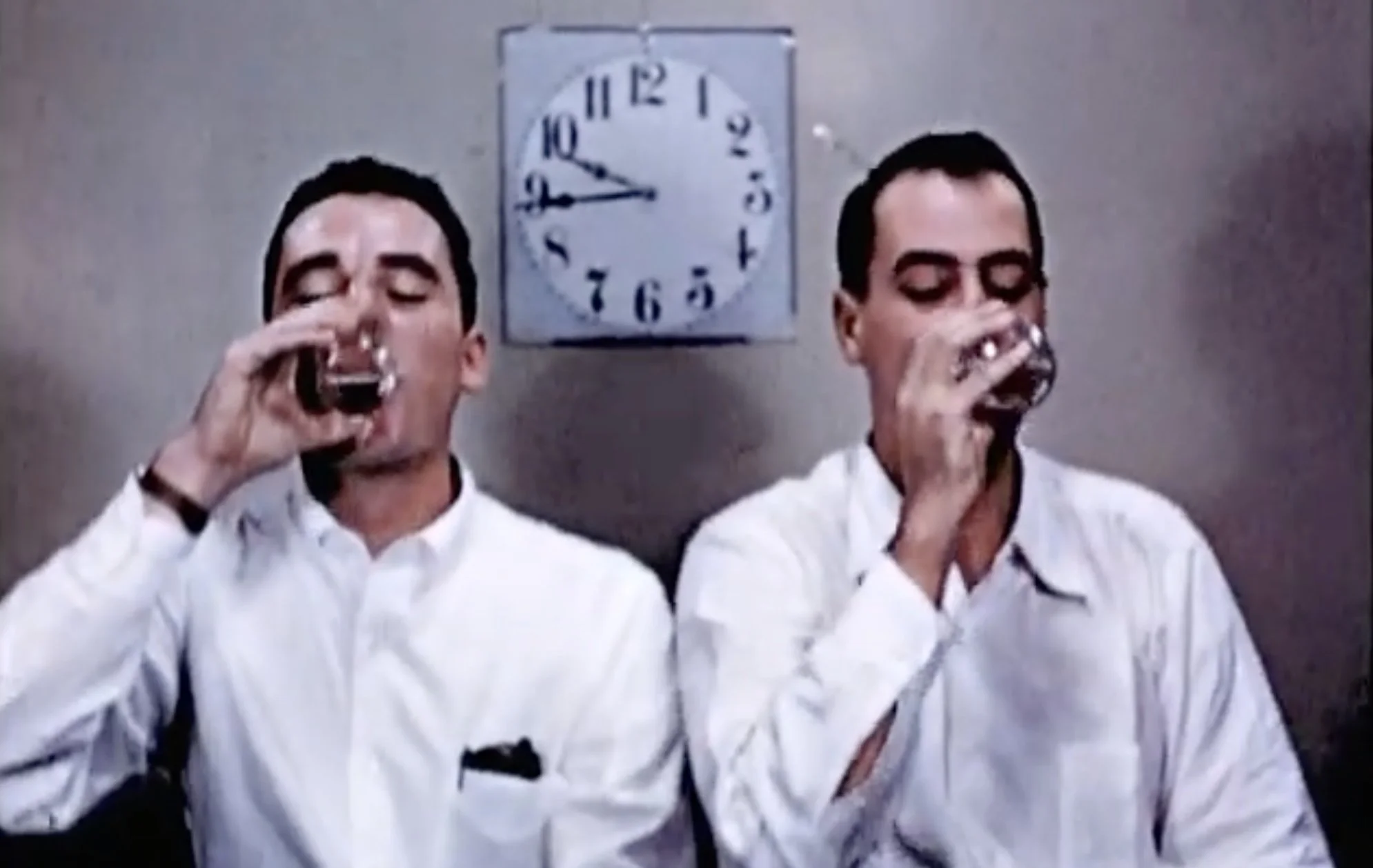
On the first experimental day, Ronnie, aged 22 and weighing 75 kg, was given 100 gamma [micrograms] of LSD-25 in distilled water orally. This is a very small quantity of LSD-25, but all investigators report that it is enough to produce a temporary psychotic dissociation state in any healthy adult.
The scene which follows shows what happened to Ronnie after he drank the LSD-25 solution. And if you will follow the clock, you will be able to note time intervals accurately.
[SCENE: First Experiment - LSD-25 Only]
Dr. Fabing: Now, how do you feel after an hour?
Ronnie: Uh, like I... should be getting sick. Uh, it's uh... but it's different in that I'm not. I mean, I’d be sick by this time if I were going to. I feel almost a nausea. Almost.
Dr. Fabing: Anything else?
Ronnie: Dryness of throat. But I... it feels as though if I did take a drink or something, well, I wouldn't keep it. So, that's... and there is a... I have to maintain my attention. It's an effort to... to, well, talk to you right now, for instance. Reality is leaving.
Dr. Fabing: Well, you were talking to Ronnie... Ron, a while ago we separated you and Dick. Do you have any idea why we did that?
Ronnie: Uh, no. It's uh... yes, I do. You just separated us to see how we would react.
Dr. Fabing: You felt though that we were separating you to see how you alone reacted, and you felt that we were watching you. Is that right or wrong?
Ronnie: No, I... um... you haven't been watching me on video...
Dr. Fabing: You don't think we're trying to pull anything on you?
Ronnie: No.
Dr. Fabing: (Addressing the camera/audience) Well, why did you assume that particular line of inquiry with Ronnie about the separation of the two boys? Because I felt at the time of separation that Ronnie did have some very real paranoid feelings and felt as though we separated the two of them so we could spy on Ronnie alone. And yet, when he sat down before the camera, he didn't voice any of those paranoid ideas. No, I think it's interesting that he was able to mobilize his defenses and to deny that he did have those feelings at the time. I feel that they were really there, and I think he did show other evidences of paranoid feelings.
Dr. Fabing: (To Ronnie) Ron, you look tired. Are you?
Ronnie: Yeah.
Dr. Fabing: Have you got anything particular to report to me?
Ronnie: No.
Dr. Fabing: Uh, do you feel slowed up?
Ronnie: Decidedly.
Dr. Fabing: How is your mood? Are you happy?
Ronnie: No.
Dr. Fabing: You feel gay?
Ronnie: No. No emotion.
Dr. Fabing: Does it seem like you've been here a great long time?
Ronnie: I've lost all time perception. It's probably sometime in the afternoon, is all I can tell you.
Dr. Fabing: Have you had any visual phenomena or any auditory phenomena?
Ronnie: I... in on the couch there I... was nothing that I can describe. There were... there were a lot of colors and things taking shapes.
Dr. Fabing: And were they geometric patterns or were they just sort of like a batik, sort of run together or what?
Ronnie: Um, I'm sorry, what... what were you...
Dr. Fabing: You forgot what I asked you?
Ronnie: Uh, oh the uh... auditory... visual things. Uh, yeah, were geometric in shape.
Dr. Fabing: Is there anything you'd like to do right now?
Ronnie: No.
Dr. Fabing: If you had Aladdin's lamp and could do anything in the world you wanted to right now, what would you like to do?
Ronnie: Uh, get rid of this nervousness and... apprehensive.
Dr. Fabing: Do you feel as though you're in contact with this situation, us and people around?
Ronnie: I don't move.
Dr. Fabing: Ronnie, have you been sleeping for the last few minutes?
Ronnie: Um, not exactly.
Dr. Fabing: You've been lying down on bed.
Ronnie: Yeah.
Dr. Fabing: Were you thinking about anything in particular?
Ronnie: ...
Dr. Fabing: What did I ask you, Ron?
Ronnie: Um, you asked me if I were thinking about anything.
Dr. Fabing: Are you... wide [awake]?
Ronnie: No, I don't think so.
Dr. Fabing: You've been lying down, you haven't been talking. If I ask you how you felt, could you describe the way you feel?
Ronnie: ...
Dr. Fabing: What did I ask?
Ronnie: ...

Dr. Fabing: Well? Yeah, what did I ask you?
Ronnie: Um... how I tell you something... I could you answer.
Dr. Fabing: I feel all right. It's been 6 hours since you took that drink. Are you still feeling badly?
Ronnie: Yeah.
Dr. Fabing: Uh, do you know where you are?
Ronnie: Yeah.
Dr. Fabing: Where are you?
Ronnie: Christ Hospital.
Dr. Fabing: Has your mind been on anything in particular? Have you been thinking about anything in particular? Do you feel depressed?
Ronnie: No.
Dr. Fabing: Do you feel elated?
Ronnie: No.
Dr. Fabing: Have you been seeing anything by way of colors or have you been hearing anything unusual?
Ronnie: No.
Dr. Fabing: If I were to ask you how you felt, could you tell me?
Ronnie: I guess I... am... say it... depressed.
Dr. Fabing: What sort of mental activity are you going through?
Ronnie: Confusion.
Dr. Fabing: Well, Ron, you said that you thought the sun was in the wrong position when you looked out the window.
Ronnie: Yeah, I... I lost uh, time perception.
Dr. Fabing: You think that you're clearing at all or are you still quite muddled?
Ronnie: I don't think in the last 15 minutes anything has... has been improved.
Dr. Fabing: Are you anxious? Are you fearful? Are you worried?
Ronnie: I'm awfully nervous.
Dr. Fabing: Mm-hm. What would you classify your mood as?
Ronnie: My mood? Uh... apprehensive.
Dr. Fabing: You know about what?
Ronnie: No.
Dr. Fabing: What has your mental content been uh, lately? Do you know what you've been thinking about?
Ronnie: Just trying to keep uh... things... true situations. Trying to uh, be aware of it. Trying to stay in contact with reality.
Dr. Fabing: Have you felt a waxing and waning with reality?
Ronnie: Uh, well sometimes I've been confused about which is reality and which isn't. I mean, what little situations... uh, I was aware of noises for instance that uh, may have been to annoy me and may not have been. And rather than... than investigate, I... I just sort of let them go.
Dr. Fabing: Can you describe to us uh, how this thing was uh, some hours back when you were in the middle of it?
Ronnie: Just mass confusion is all. Uh... a... uh... that's... that's it, confusion.
Dr. Fabing: Would you say it was pleasant or unpleasant?
Ronnie: Uh, I wasn't aware at the time of any pleasantness or unpleasantness. And uh, and I'm still not. Uh, I... I'm not aware of any pleasantness or unpleasantness. I... am emotionless about it.
Dr. Fabing: Well Ronnie, do you think the picture showed the whole story of your LSD-25 experience?
Ronnie: Not by a long shot.
Dr. Fabing: The day after the experiment you wrote out something about it. Would you mind reading a part of it?
Ronnie: Not at all. (Reading) "I had very little by way of visual hallucinations, but what I consider the important thing... that, well, what's a word to describe it? Dissociated, plagued, pounded, weighed? All three are inadequate to describe the horrible state I was in, all of them put together. Perhaps the central thing was suspicion and fear that you would find out about me, or perhaps think things that were not true. My overwhelming concern became: Are they doing this to find out how I'll act? Are they deliberately rattling that damn paper to make me angry? On and on and on this way. And as was no doubt obvious, I decided to do as little as possible so I wouldn't make any mistakes. It was my confusion, the fact that I had to study the situation, to be careful, that, shall I say, wrecked me up."
Dr. Fabing: I believe that there was still a trace of this suspiciousness when we took you home that night. Would you mind telling us about the television experience?
Ronnie: It's hard to believe, but I joined the family to look at television in the living room, and I'll be damned if it wasn't talking in loaded phrases too. That made my reason take another step toward control, and I felt better.
Dr. Fabing: Well, thank you very much, Ronnie. This essentially paranoid type of reaction pattern has been described repeatedly by investigators of LSD-25 psychosis.
[SCENE: The Lecture / Explanation of MER-17]
Dr. Fabing: During the next week, Ronnie was given a 5 milligram tablet of our new blocking agent twice daily, and one final tablet on the morning of the second experimental day.
Our clinical experience with Meratran convinced us that this compound was quite different from any other central nervous system stimulants that we had known before, and we were interested in the effect of some of its isomers. When the nitrogen atom is moved from the alpha to the gamma position, an entirely new compound results pharmacologically. And it is this gamma isomer of Meratran which we have used as a blocking agent against LSD-25 psychosis. We were led to its use because of some dramatic though inconsistent results we had obtained when we used it on patients with schizophrenia.
And now, let us return to Ronnie and the second experimental day.
[SCENE: Second Experiment - LSD-25 + MER-17 Pre-treatment]
Dr. Fabing: Good morning to you.
Ronnie: Morning.
Dr. Fabing: I believe you've been taking one 5 milligram tablet of this compound twice daily throughout the last week.
Ronnie: I have.
Dr. Fabing: And you took one this morning.
Ronnie: Yes.
Dr. Fabing: All right, now here we are with 1/10 of a milligram of LSD in distilled water. So down the hatch.
(Ronnie drinks)
Dr. Fabing: Ron, does it seem to be a half an hour since you took the LSD?
Ronnie: Yes sir.
Dr. Fabing: Have you got anything to report to us in this first half hour?
Ronnie: Nothing.
Dr. Fabing: Uh, it's been an hour since you've taken LSD. What can you report?
Ronnie: Well, now I can definitely tell that I have taken it. Uh, but uh, my thoughts seem to be in good shape so far.
Dr. Fabing: Well Ronnie, it's been an hour and a half since you took the LSD and I've noticed an increasing restlessness in you.
Ronnie: Extreme restlessness. But my thoughts are in good control. I mean, I'm much more confident at this time than I was before.
Dr. Fabing: It's been two hours now since you taken the LSD. Does it seem that that's right?
Ronnie: Yeah, yeah that's...
Dr. Fabing: And there... there's been no distortion of time sense?
Ronnie: No. Of the passage of time.
Dr. Fabing: Well, let's ask you first how your body feels.
Ronnie: It feels fine. There's no uh... no sensations uh, one way or the other.
Dr. Fabing: Now you've been restless. You did a lot of pacing for a while and then you lay down for a while.
Ronnie: Yeah.
Dr. Fabing: Now what can we find out about your mental processes? Have you had any feeling of drifting in and out of the world of reality at all?
Ronnie: Well, uh, no. No I haven't.
Dr. Fabing: It's now 2 and 1/2 hours since you took the LSD. Does that seem right to you?
Ronnie: Yes, it's about right.
Dr. Fabing: And there has been no alteration and distortion of your sense of time?
Ronnie: No, I don't think so.
Dr. Fabing: As much transpired in the last half hour as far as you're concerned?
Ronnie: Well... nothing one way or the other, no.
Dr. Fabing: Now uh, last week you had the very uncomfortable feeling that all of us were indulging in double talk. Uh, is there any of that feeling in you now?
Ronnie: None whatsoever. I... I uh... I think that'd be a sort of a dissociative feeling that I don't have now.
Dr. Fabing: Uh, anything new to report to me at this time?
Ronnie: I don't think there's anything new. It's uh... there's uh, been no real change, I don't think, that I'm aware of.
Dr. Fabing: At uh, three hours last week, I asked you that if you had Aladdin's lamp and could get your most desired wish... you said that you would wish that something could be done to get rid of the nervousness that you had. Would you answer in the same way today?
Ronnie: I'm not sure. I... I uh... I think I'd be more aware of the possibility of such an offer today than I was...
Dr. Fabing: Ronnie, what time does it seem to be?
Ronnie: It's uh, somewhere I'd say uh... about 3:30, 4:00. Something like that.
Dr. Fabing: Now um, in the last half hour we've been sort of having a general discussion on philosophic things, the pitfalls and scientific methods and so on. You seem to be sort of...
Ronnie: I'm with you. I... I followed your conversation.
Dr. Fabing: If you could do exactly what you wanted to do right now, uh, would you be doing anything different than you're doing?
Ronnie: Well I uh... I could be home, if that's what you mean. I could uh, probably be doing something a little more enjoyable.
Dr. Fabing: You know what would be enjoyable in your thinking right now?
Ronnie: I don't know. Being out in... outside. Seems like a nice day out.
Dr. Fabing: All right. We're now at the 5 and 1/2 hour after taking LSD period. You're just telling me outside that this is nothing like it was last week.
Ronnie: It is nothing like it was last week. There... there are some of the same symptoms, and it seems that it... it was ready to happen but it uh, just didn't. It doesn't... I mean uh, when I went to uh, lie down uh, last Saturday, I could have easily sort of been swallowed up. And I was trying to do it uh, then... just now. Just now. And uh, it just didn't happen. That's all.
Dr. Fabing: You said that last week when you lay down and closed your eyes, uh, something closed over your mind.
Ronnie: That's right.
Dr. Fabing: But you can't find that today try as you will. Ronnie, you wrote out your experience after the second episode too. Would you mind reading us part of it?
Ronnie: Not at all. (Reading) "It was quite similar yet it was so very very different. For the first time, my mind began racing and becoming tangled and eventually swallowing me up despite my efforts. The second time my efforts to fight it off were successful. In one sentence I think it might be summed up rather adequately by saying it was a fight both times, but the second time I won."
Dr. Fabing: Well, thank you very much.
[SCENE: Lecture / Q&A]
Dr. Fabing: There are probably many questions that you wish answered about this work.
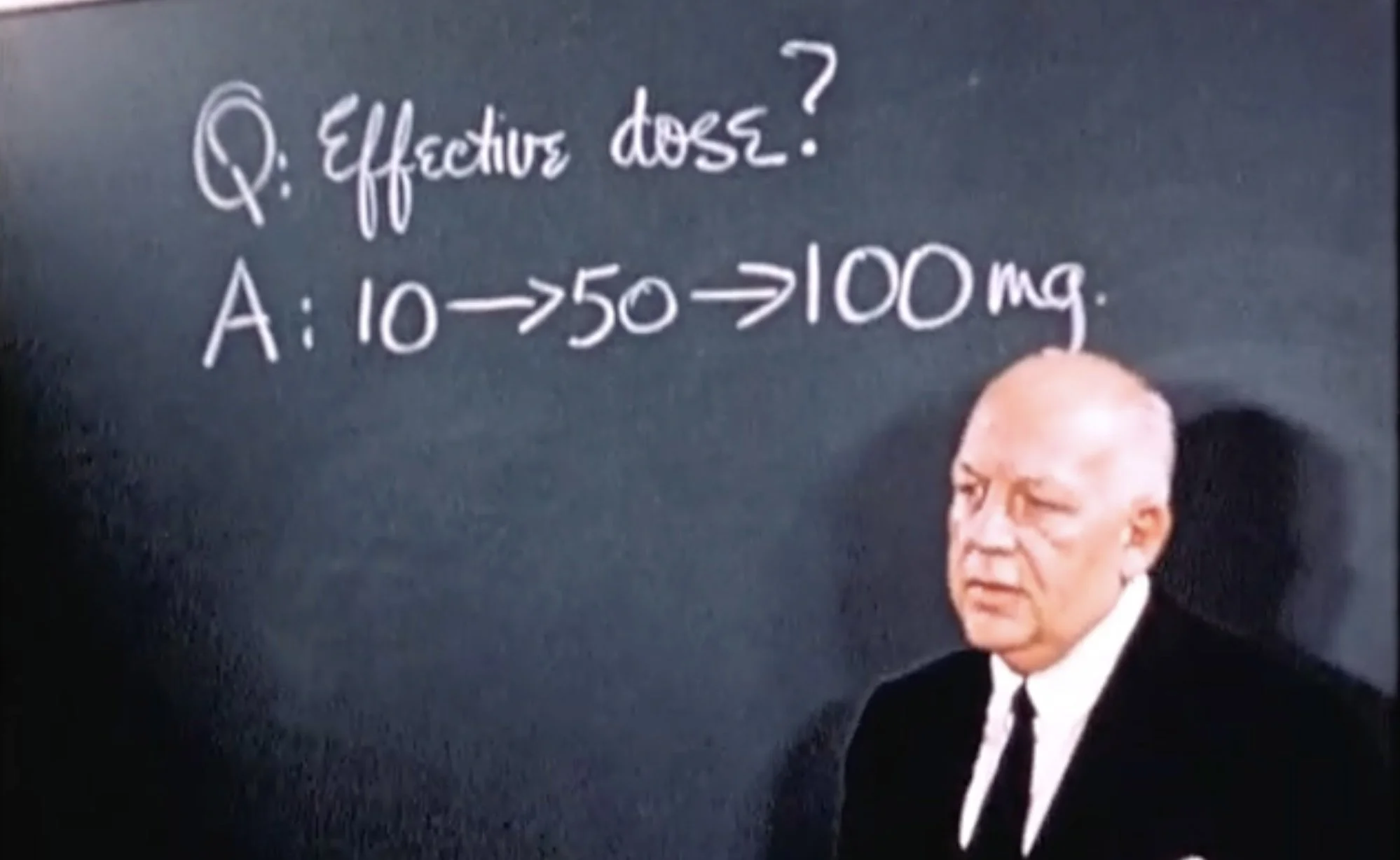
Audience Member 1: Dr. Fabing, what dosage of the blocking agent have you found to be effective?
Dr. Fabing: We have ranged from 10 to 15 to 20 to 30, 50 and 100 mg. There are individual differences. In the lower ranges, the blocking is not necessarily complete, but in the higher ranges it is so invariably.
Audience Member 2: Have you done this on any more subjects, Dr. Fabing?
Dr. Fabing: Yes, eight so far in a double-blind study, and the blocking effect was consistent.
Audience Member 3: Is a week of pre-treatment necessary in all cases?
Dr. Fabing: No, sir. We have already discovered that two days of pre-treatment suffices, and our guess is that it can be shortened even more.
Audience Member 4: Did you say that this drug has clinical application?
Dr. Fabing: Well, time will tell. But we have been quite impressed with our clinical results so far in some cases of acute schizophrenia, some cases of alcoholic hallucinosis, some senile hallucinatory states, and even a few cases of chronic schizophrenia. They represent about 60 cases in all. And furthermore, we are continuing our experimental work with hallucinogenic drugs such as mescaline, cannabis, adrenochrome, etc. Are there any other questions?
Audience Member 5: Yes. Can MER-17 be used intravenously?
Dr. Fabing: Yes, and it's very interesting too.
[SCENE: Third Experiment - LSD-25 Rescue with Intravenous MER-17]
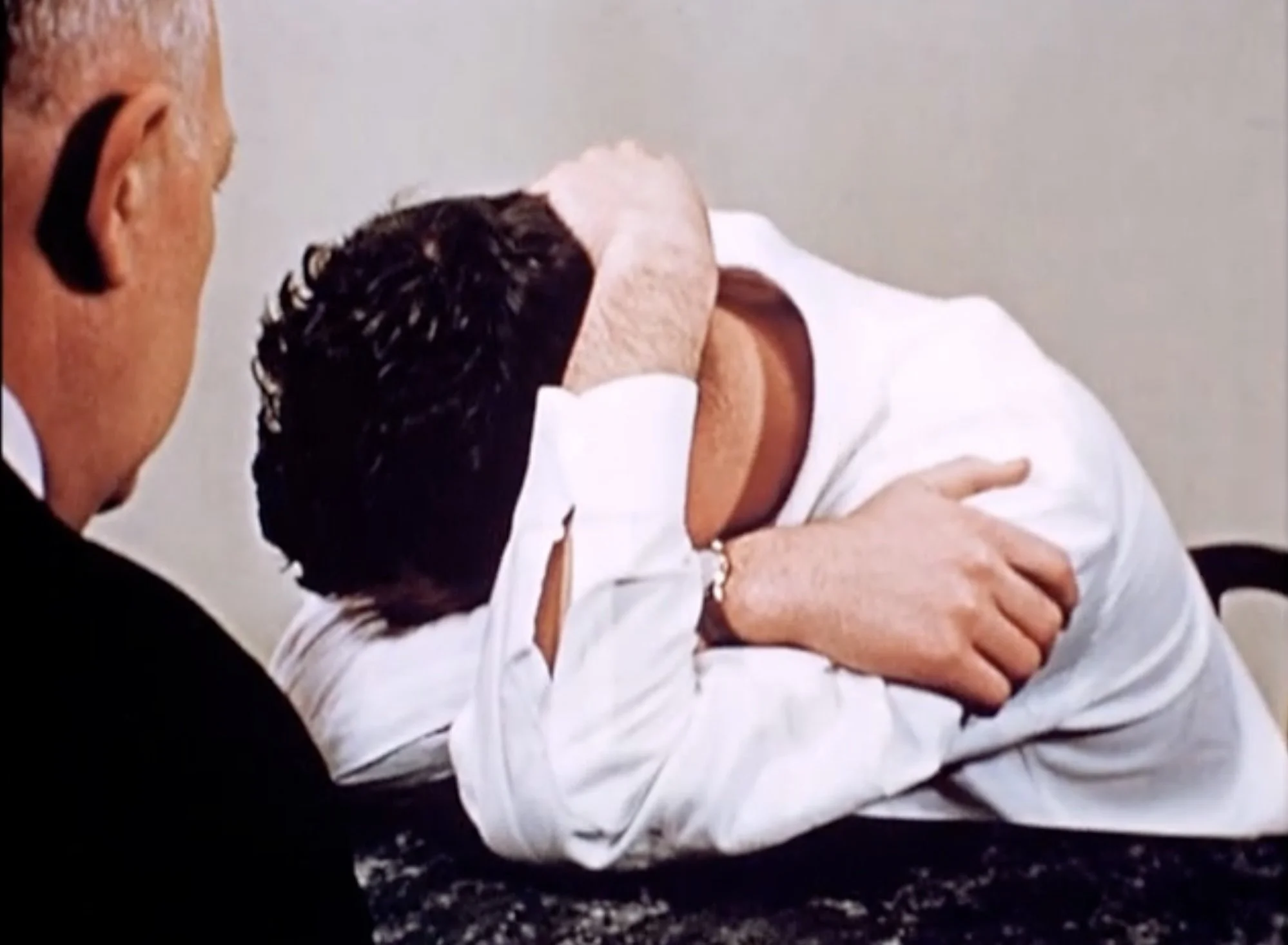
Dr. Fabing: On December the 18th, 1954, Ronnie drank a second 100 gamma of LSD-25 without protection. 4 and 1/2 hours later he was in an almost catatonic state. At that time 10 mg of MER-17 was given intravenously and repeated in 15 minutes. This brought about a complete cessation and dissolution of his LSD-25 psychosis. Look at the picture.
Dr. Fabing: (To Ronnie) I'm right here. Do you feel that you're very close to us in your thinking?
Ronnie: No... no.
Dr. Fabing: Can you tell me anything about what you have been thinking about? Is it too painful to talk about? Ron, how long does it seem to have been since you took the LSD?
Ronnie: Um... couple hours I guess.
Dr. Fabing: Are you upset?
Ronnie: No.
Dr. Fabing: Are you muddled?
Ronnie: Yeah.
Dr. Fabing: Can you tell me anything about your thinking now?
Ronnie: ...
Dr. Fabing: Ron? Can you tell me anything about your thinking now?
Ronnie: I don't understand.
Dr. Fabing: How do you feel?
Ronnie: All right.
Dr. Fabing: Does anything make much sense to you now?
Ronnie: No.
Dr. Fabing: What seems to be the matter?
Ronnie: Nothing.
Dr. Fabing: Can you think? Can you tell me what's going on inside of your head?
Ronnie: ...
Dr. Fabing: Ronnie, are you frightened? Are you fearful?
Ronnie: Yes.
Dr. Fabing: Ron, we're going to give you an injection to see whether it makes you feel any better. I don't suppose you taste anything do you?
Ronnie: ...
Dr. Fabing: Do you feel anything? All right now, about 3 minutes since you took the injection. What can you say about things now?
Ronnie: I don't know...
Dr. Fabing: Do things feel any... seem any clearer to you?
Ronnie: They do. I don't know why.
Dr. Fabing: Can you elaborate on that in any way?
Ronnie: I'm just not as confused.
Dr. Fabing: Now Ron, it's been about 12 minutes since we gave you your injection. Uh, you just said that you feel like you have reality in your grasp and it's waxing and waning.
Ronnie: Okay.
Dr. Fabing: Can you tell me anything more about that?
Ronnie: Maybe I said it's just a reorganization or a... getting things in place again.
Dr. Fabing: Is it a pleasant uh, comeback as it were, or is it disturbing to get things reorganized properly?
Ronnie: No, it's... the more I can, the more it's better.
Dr. Fabing: Bill, we're giving you a second injection about 17 minutes after the first one. (To Ronnie) How are you feeling now?
Ronnie: Um... like I'm waking up from the fever.
Dr. Fabing: Or is... is a pleasant feeling to be waking up from a fever like this?
Ronnie: Well, it's pleasant to be back, I guess.
Dr. Fabing: Bill, is there any change in his blood pressure?
Dr. Bill Hillard: No, his blood pressure and pulse remain essentially the same.
Dr. Fabing: Ronnie, it's been 30 minutes since we gave you the first injection and 15 minutes since we gave you the second one. Now let's try to say how you feel now. I know it's hard.
Ronnie: Well, I haven't... I haven't yet a foundation from which I can speak. I... um...
Dr. Fabing: Do you think you feel differently than you did 30 minutes ago when you walked into this room?
Ronnie: Yes, I guess I do. Very much so.
Dr. Fabing: Now Ronnie, it's been an hour since we gave you your first intravenous injection. I believe things have sort of come back into their proper perspective for you, haven't they?
Ronnie: I think so.
Dr. Fabing: You know, when you were under the LSD you wanted to be in that room alone. You were fearful that uh, there might be some sort of an invasion of your privacy and your integrity. Isn't that right?
Ronnie: Um...
Dr. Fabing: And now that's all cleared up and you've got things straightened away, is that right?
Ronnie: I'm no longer anxiety [ridden] about it.
Dr. Fabing: Mm-hm. Uh, are you your normal self now?
Ronnie: Yes, as nearly as I can tell I am.
Ronnie: (Narrating/Reading final report) You will probably be interested in my uh, subjective reaction to this last experiment. The first and third experiments were similar of course. Complete and insoluble confusion and anxiety reigned, and the knowledge that its cause was a drug was my sole and small reassurance.
One hallucination was that of lying flat on a slowly revolving cloudlike object. There were other similar objects all around, touching gently and revolving in gear. I just rolled slowly down into the depths of this arrangement. Another one I recall is that of a flower bed type of pattern, or perhaps a purposeless pinball machine with the lights arranged in rows and columns. The lights, or flowers, were growing then bursting in irregular fashion—one at the left, then at the center, and so on.
Next occurred the phenomenon that has happened both times I lost, and perhaps I've neglected to mention it previously. Things seemed to clear up and I felt sane, yet I knew I wasn't. I seemed to wake up to a new world. The same situation, same people and environment, and yet everything—that is, my mental state, my life—had been altered. I was a stranger in this world. I could no longer speak to anyone as a person. And that was my state when I was given the shot: bewildered, confused, afraid to say a word till I could be sure of which world I was in.
I realized that what happened to me in those few minutes after the injection has a tremendous significance. Because of this realization I have worked it over often since then, but God help me, I can't tell you a thing. It just happened. There was no crescendo, no fitting together of the pieces, no breaking through the surface. All of a sudden I found myself willing to cooperate, able to follow conversation more easily, just less anxiety ridden. I don't know how or why. I'm sorry, but that's all I can report.