1965: Allen Ginsberg DIScusses lsd with dr. Joe K. Adams
Authors: Joe K. Adams, Allen Ginsberg, and Peter Orlovsky
Date: December 12, 1965
Source: Box 120, Reel 1, “1965 Dec 12. Side A: Conversation with Joe Adams (Saturday evening and acid test),” Allen Ginsberg papers, Stanford University (transcribed by Benjamin Breen from an MP3 provided by Stanford for research purposes)
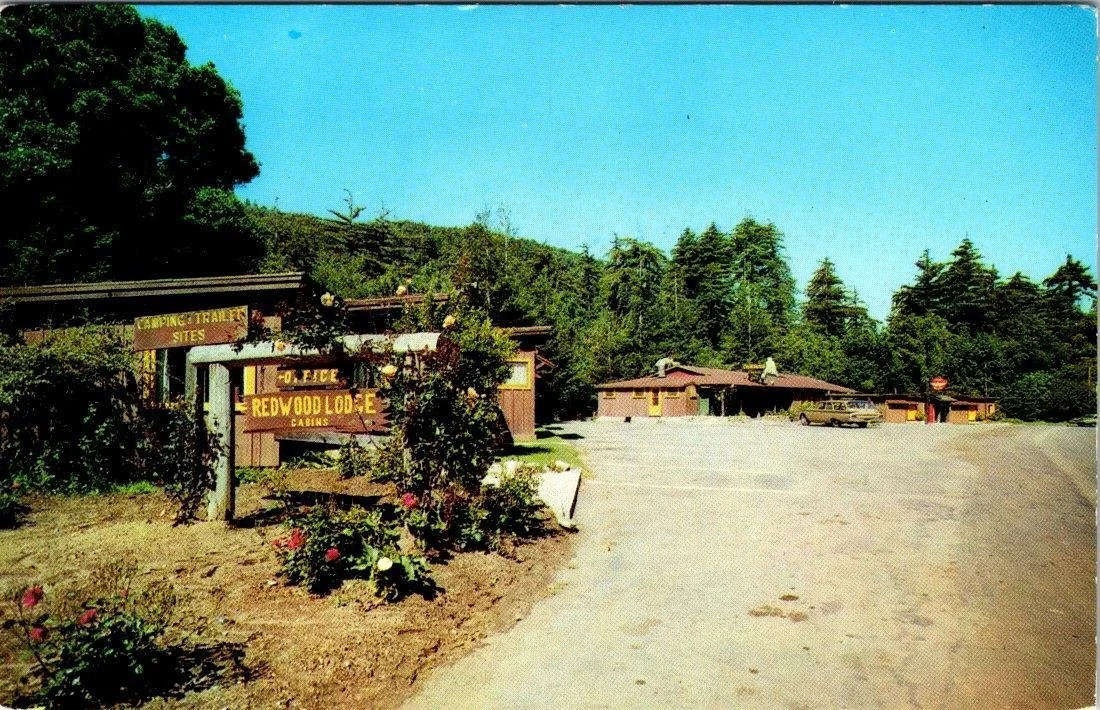
By 1965, when this recording was made, Joe K. Adams was living in Big Sur, managing the Redwood Lodge campground (pictured above) and contributing to the nascent Esalen community.
historical Overview
This is a 1965 audio recording made by Allen Ginsberg on his Uher portable tape recorder, which he had recently bought (apparently with $500 given to him by Bob Dylan, whose concert in San Jose Ginsberg had recored the previous evening). The tone of the discussion is lighthearted and casual; it is clear that Ginsberg and Orlovsky (Ginsberg’s longtime life partner) are friendly with Joe K. Adams and feel comfortable with him. At the same time, however, it also deals with traumatic events and documents a critical juncture in the history of psychedelic science. In the aftermath of an LSD trip late in 1960, Adams had experienced a months-long manic episode (he describes it as being "high as a kite for months"). Here, he describes delusions involving Cold War paranoia—believing the hospital staff during his involuntary institutionalization were operating on "Russian and US shifts,” for instance.
The Texas-born psychologist Joe K. Adams was a former chair of the Bryn Mawr College Psychology Department, Stanford academic, and a key researcher at the Mental Research Institute (MRI) in Palo Alto. Adams serves here as a bridge between the psychedelic science of the 1950s and the emerging counterculture.
There are many interesting clues here for further research. For instance, the tape transcript below contains Adams’ references to Dr. Charles Savage (a former naval psychiatrist who worked on both Project CHATTER and the MRI psychedelic therapy trials) and Dr. Karl Bowman, longtime director of the Langley Porter Institute in San Francisco. Savage was a pioneer in using LSD to treat depression and alcoholism; his presence in the conversation — not long after discussion of Ginsberg’s suspicion that the MRI’s psychedelic research was “involved with the Korean War somehow” — is a demonstration of the complex entanglements between military and civilian psychedelic research in the 1950s. The tape is also a fascinating early example of how the 1960s counterculture was beginning to rethink those entanglements. For instance, Adams discusses the harassment of Dr. Karl Bowman, who had been lead author of the 1944 "LaGuardia Committee Report" (The Marijuana Problem in the City of New York), which contradicted claims that cannabis was inherently dangerous. Adams’ revelation that Bowman was being "hounded" by agents foreshadowed the War on Drugs that would emerge as a Nixonian political objective in the late 1960s.
What I find most interesting about this tape, though, is the inversion of the doctor-patient dynamic. In 1959, Joe K. Adams had been a Stanford psychiatrist administering an experimental compound to a 32-year-old Allen Ginsberg in a clinical setting; Adams had even, apparently made tape recordings of Ginsberg’s trip. By the time of this recording in 1965, however, it is Adams who is being recorded by his former patient — as Adams describes his final break with the field of psychiatry as well as a break with the fabric of reality itself.
– Benjamin Breen (December, 2025)
partial TRANSCRIPT of the tape
[start of tape]
JOE K. ADAMS: Oh, it's recording now, huh?
ALLEN GINSBERG: Yeah.
ADAMS: Oh, I see.
GINSBERG: — they said he was bugged by the police. [laughs]
ADAMS: Now, where is this made?
GINSBERG: West Germany
ADAMS: Martel? I never heard of it.
GINSBERG: That's, I guess, a Los Angeles Company — an American distributor.
ADAMS: Oh, I see. So the, actually the manufacturer's name is your… Huh. Well, so, now, how can you tell, you know, whether it's recording or not? By this?
GINSBERG: Well, I have the recording —.
ADAMS: Whether It'S actually picking up now.
GINSBERG: Yes, if I. But if I turn it a little bit louder and keep talking, then it'll go all the way too far. So I have to keep it down below the zero to keep it at the proper temperature, the proper level sound.
ADAMS: Can we, Ccn we play back now?
PETER ORLOVSKY: Bob Dylan gave Allen $500 to buy it.
ADAMS: Bob Dylan gave —?
[jumping forward now to 29:32 of the tape, where the conversation moves from cannabis laws to psychedelics]
ADAMS: It is legal in India? What other countries?
GINSBERG: It’s sort of half legal in Morocco.
GINSBERG: The World Health Organization [indecipherable]. That they made it illegal and … [indecipherable] You say that it's mainly it was made illegal in North Africa largely because of his activities [indecipherable]… Actually the whole marijuana menace is his intervention at that one time —
ADAMS: Really? Well, when did he start?
GINSBERG: [indecipherable] Hoover and FDR [indecipherable].
ADAMS: So he's the one that built up all the hullabaloo in New York City and stuff about the marijuana menace. [Note: the tape is very indistinct here but given the context, they appear to be discussing Harry J. Anslinger]. Did you tell me that that report the LaGuardia Commission was going to be reprinted?
GINSBERG: It's on sale.
ADAMS: Oh, it is?
GINSBERG: It's reprinted by a local lawyer here.
ORLOVSKY: Yeah. Paperback.
ADAMS: Oh, really? I must get a copy.
GINSBERG: He also has a whole bunch of reprints of a whole bunch of legal — His legal briefs on the subject Challenging the constitutionality of the law which he quotes an enormous amount of — [indecipherable] He reprinted that which he uses as material. There's a book coming out by Bob Farrell, called the marijuana papers… [indecipherable] A lot… [indecipherable] Bowman.
ADAMS: Oh, Karl Bowman, yeah.
GINSBERG: He was one of the major people that worked on this.
ADAMS: I know he was. Yeah.
GINSBERG: Did you ever meet him?
ADAMS: No —
GINSBERG: What's his story?
ADAMS: — but, uh, you know, Charles Savage, who was on our project told me that Bowman told him that he had been hounded, ever since that report.
GINSBERG: By who?
ADAMS: Oh, by the agents. He'd been harassed. And so far I don't think he's ever written — I mean, I don't know, but I thought that was extremely interesting.
ORLOVSKY: Harassed in what way?
ADAMS: I don't know, but sort of the way you were, maybe. Oh, there, there are ways. There are always ways of being harassed by groups of law enforcement agencies.
GINSBERG: Who was he?
ADAMS: Well, this was Charles Savage… he’s a very distinguished psychoanalyst. He was on our project in Palo Alto [the Mental Research Institute. He's now, he's now in the East, New Jersey.
GINSBERG: You know him well?
ADAMS: Yes, I knew him pretty well. Savage, he was one of the pioneers in this country with LSD. He's a tremendously learned person. He knows so much about biochemistry. He knows, I think, uh Savage was the person that I felt knew the most about the history of LSD in this country and in Germany too, and the whole picture of the biochemistry and so forth.
GINSBERG: What did he think about it?
ADAMS: Well,he was, uh, he felt that it was potentially a tremendous boon. But — he drew early in our research, he drew a curve that I thought was very interesting. That so often you get this tremendous improvement in the person and then there's a gradual [decline?]. The person comes back to maybe a little bit above what he was before. See, I think, I think this is because of society. Society does not allow you to be…. fully human. [35:00] And I, of course, I told you after my own reaction, this was my reaction that now I was free and I was healthy and — here were these, sort of, zombie like people who were not allowing me to be fully human and fully healthy. Of course I was high. I was just high as a kite for months.
GINSBERG: What were you on?
ADAMS: Nothing. I wasn't taking anything. And I was such a pain in the neck to so many people. And the people who had known me were just appalled. But some people who hadn't known me before thought I was a lot of fun. I was very different from the way I am now. This was before I blew up and had to go to the hospital. I was, oh, I was doing all kinds of things, but I wasn't doing much work in the sense of [chuckles], you know, careful, methodical research. This was, ah — do you remember when you took LSD?
GINSBERG: Yeah.
ADAMS: When?
GINSBERG: ‘59.
ADAMS: Oh I know, but I mean, you remember what month?
GINSBERG: It was in July. July.
ADAMS: Well, see, it was in January [of 1960] that I had my reaction. And I was high. For Months. Many months. Yeah it was the following January. You were in the east at that time. It was too bad, you know, I could have talked to you because I'm sure you would have been very interested in changing me. You could have had a lot of, you know, a lot of fun talk. I think you would have enjoyed the…
GINSBERG: You might have scared me [laughs]
ADAMS: … enjoyed that flow.
GINSBERG: What were you talking mainly about?
ADAMS: Oh, [chuckles] I would sit down and I'd write long letters to, you know, important people. I kept trying to get through to very important people. And I had all kinds of solutions for everything. Some of them are, you know, I did have something, but it was so… scattered. Of course, I've written since. I've written and had them published. But my writing is as much, of course, toned down [from] the sort of thing I was writing.
GINSBERG: What made you get [placed] in the asylum?
ADAMS: Well I told you, I blew — I really went completely berserk. I was, I was really crazy. And, uh, I took my clothes off and started running down the driveway.
GINSBERG: Here?
ADAMS: No, no. It was in Menlo Park
GINSBERG: Oh in Menlo Park?! [laughs]
ADAMS: A nice, nice suburban neighborhood, and I was intercepted by a psychiatrist who my wife had called.
GINSBERG: Which one?
ADAMS: Well, the one I had seen. See, when I Was — I was forced into psychotherapy when I was in this manic-y, elated phase.
GINSBERG: How did he [handle it]?
ADAMS: And, well, he got me back in the house and then he left me alone. And then three uniformed men came and tied me down on a stretcher and carried me out and put me in an ambulance. And the ambulance had a siren and it took me to the mental hospital. It was very dramatic. And there were the neighbors standing around watching. I told you this!
GINSBERG: [Indecipherable] Karma chakra, psychiatry. It's like the acme of the image going wrong.
ADAMS: And, you know, I thought maybe I had died and this was what it was like to die. You died and you really did keep on living. And this was hell. Then I thought, God — I had to be tied down for almost wo weeks.
ORLOVSKY: Why?
ADAMS: I hallucinated. I barked like a dog and tried to chew the restraining straps. I chewed them half in two. So I was — oh, they said I was the craziest patient that ever had there.
ORLOVSKY: What finally happened to you? Came down?
ADAMS: Well, eventually, you know, I passed through that phase. And then, of course, I knew how to get out of the hospital —
ORLOVSKY: How?
ADAMS: I was just very nicely cooperative.
[40:00]
ORLOVSKY: You told them what they wanted to hear?
ADAMS: Well, I was, I don't know that I did that, but I just behaved myself, see? And this is the way to get out of mental institutions. No matter how you've been treated: just behave Yourself. [reflective] But I… I tried to escape there. I ran out, ran out and tried to climb over a fence and I yelled out, this is not a hospital. Two aids ran out and brought me back.
GINSBERG: So you yelled this is not a hospital [indecipherable]
ADAMS: [laughing] Well, see, I thought that there were two shifts of aids. And I thought there was a US shift and a Russian shift.
[GINSBERG laughs]
ADAMS: It was a big experiment of some kind. And I was a guinea and the whole place, I thought the whole place had microphones in it. And, oh, well… it was very complex.
GINSBERG [interested]: What led you up to that? You know, very oddly, when the first time I took LSD with you, I suspected that you were a Russian agent.
[ADAMS laughs]
GINSBERG: Remember? Remember that I mentioned that? That I thought it was a Russian plot?
ADAMS: No… no, I didn't remember that. Thats – huh.
GINSBERG: Or I knew it was involved with Korean War somehow.
ADAMS: But Peter, you know, he thought that it had something to do with Hitler. You know that there was a button that might be pressed, and the whole world would be bombed. You remember? You said, you know, you said while you were under the drug. You said, hey, this has a lot to do with life, doesn't it? Or something like that. This is real life. And then you told me you had this Hitler fantasy. But —
ORLOVSKY: I remember when I went out to go to the bathroom, from that soundproof room, on my way to the bathroom I passed a lab, where they had a lot of people working with test tubes and stuff. And they had my stomach in there already, you know, I was just going to the bathroom and when I urinated, left the bathroom, it was all going back through the laboratory [laughing] … Back into the laboratory to work on.
GINSBERG: But how do you ever build up things on the [indecipherable]
ADAMS: How did I?
GINSBERG: My mother… had that. Where she got that or how.
ADAMS: Well, I don't know. I, I, I think that when you, you know, when you're in a condition where you can't, you just, you can't, you can't control your thoughts and you can't check things out. You can't think at all logically. It's just strictly an impression of the moment. Then, of course, anything that you've ever heard of can become part of the way you see things.
GINSBERG: What knocks out the faculty?
ADAMS: Well, I don't know. I have just, it seems to me that we have somehow we each have a cognitive structure. When you break that up and it's so catastrophic, you start so much going that it just goes on and on. It's like, you know, it's like an electrical network that somehow gets all bound up. It has to run its course — and, uh, you can be in states where you're strictly at the mercy of your momentary feelings, what appears at the moment. So if someone looks the way maybe you think a Russian spy looks, well, then as far as you're concerned, he is a Russian spy. Okay? [chuckling]
ORLOVSKY: Is there any way, any way to combat this? Once you recognize it when it happens?
ADAMS: Well oh yes, if you're ever in such a state, you'll know it, as it’s —
ORLOVSKY: Is there any way to combat It?
ADAMS: — it’s so different from your previous states of consciousness?
ORLOVSKY: Is there any way to combat it, to recognize these illusions?
ADAMS: Well, I think that I — I mean, I know what I would do iif I were in that condition again. I'd try to get somebody who would just come and just stay with me and let the thing run its course and just see that nothing bad happened.
ORLOVSKY: The Tibetan book of the deck keeps saying that you should realize that all these emanations come from your own head and that if — under LSD, I've had those hallucinations of policemen and been paranoid. I've always told myself that this is all my own.
ADAMS: Yeah, well, sure, it's all your own, but you still, unless you, you know, if you're in that Condition, you do need somebody around.
ORLOVSKY: Well, that's why think of a guru. They tell you to think of a Guru, of the Buddhas, the Compassionate Buddha. And think of that image in your head and retain that.
ADAMS: See, it's a lot more disturbing when you haven't taken a drug. If you're taking a drug that's supposed to do something like that to you, then you can always console yourself with the thought. Well, this is a drug. But if you haven't taken any drug and this happens, then how do you know you're still there when it will wear off?
ORLOVSKY: Was it like LSD?
ADAMS: Oh, it's wilder. Well, the sort of thing. Oh, Lord. I just. I had. When I was tied down, I was hallucinating and I had these archetypal figures. There was an old face, a kind of rubbery like face, but ancient thing with a beak like a bird. Then there was a thing like a tiger. I described these to Gerald Heard, he said, you know, you're the first person who described the three archetypes that you're supposed to have. I've forgotten what he — how he identified them, but I didn't know that these were three you were supposed to have.
ORLOVSKY: Do you take LSD now after that thing?
ADAMS: No, no, but I, Well, the main reason I don't is just that I don't you know, I'm so concerned about Redwood Lodge — doing what I have to do. But certainly I might take LSD again.
[excerpt ends at 47:15]