1954: Margaret Mead’s LSD Memo
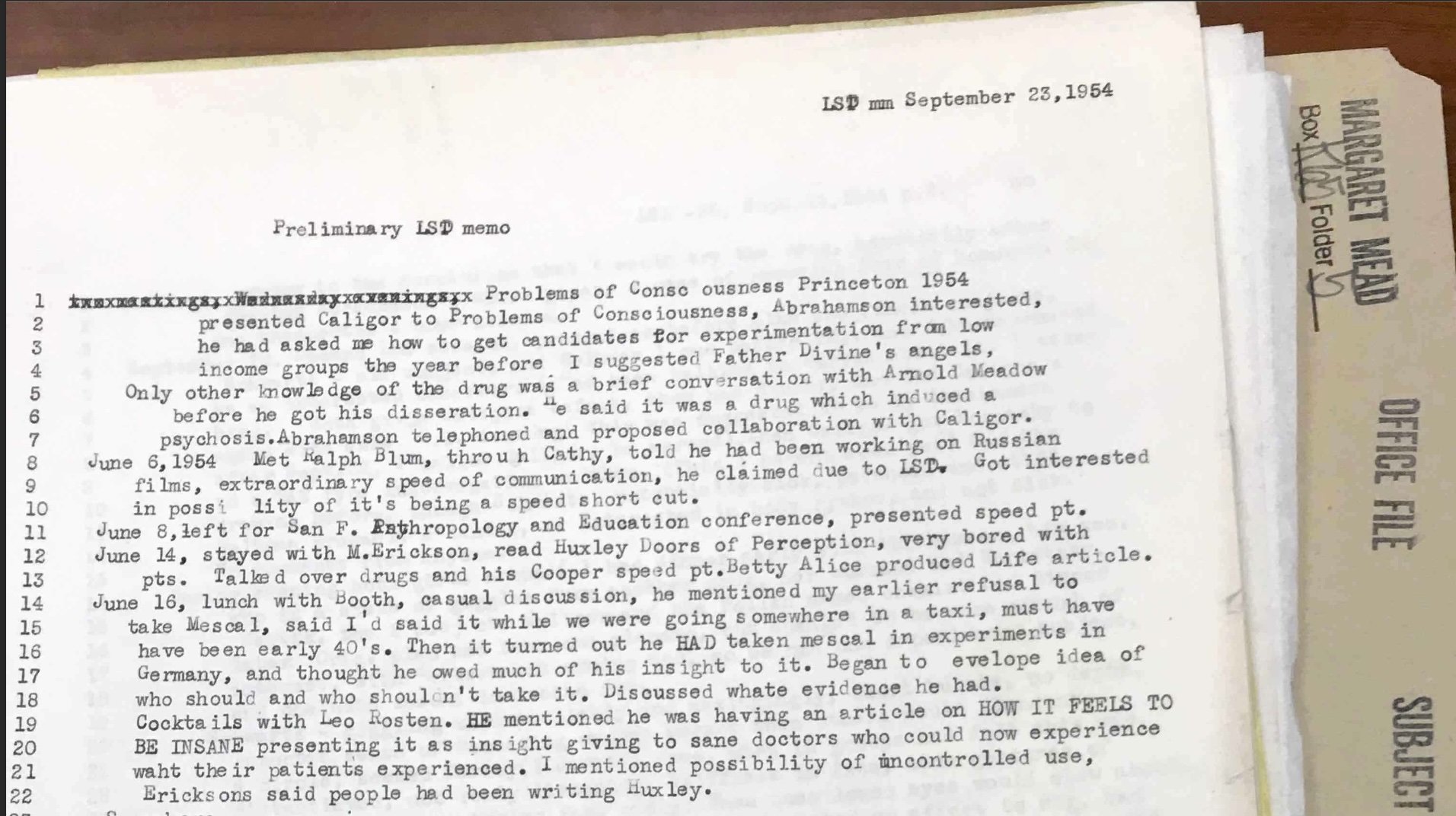
For a detailed reader’s guide for this important but somewhat cryptic historical primary source relating to Margaret Mead’s interest in psychedelic therapy in the 1950s, scroll to the bottom of this page.
Author: Margaret Mead
Date: September 23-24, 1954
Source: Library of Congress, Manuscript Division, Margaret Mead Papers and South Pacific Ethnographic Archives, Box K65, Folder 5.
📕 For more on Margaret Mead , see her Biography page.
Complete transcription
LSD mm September 23
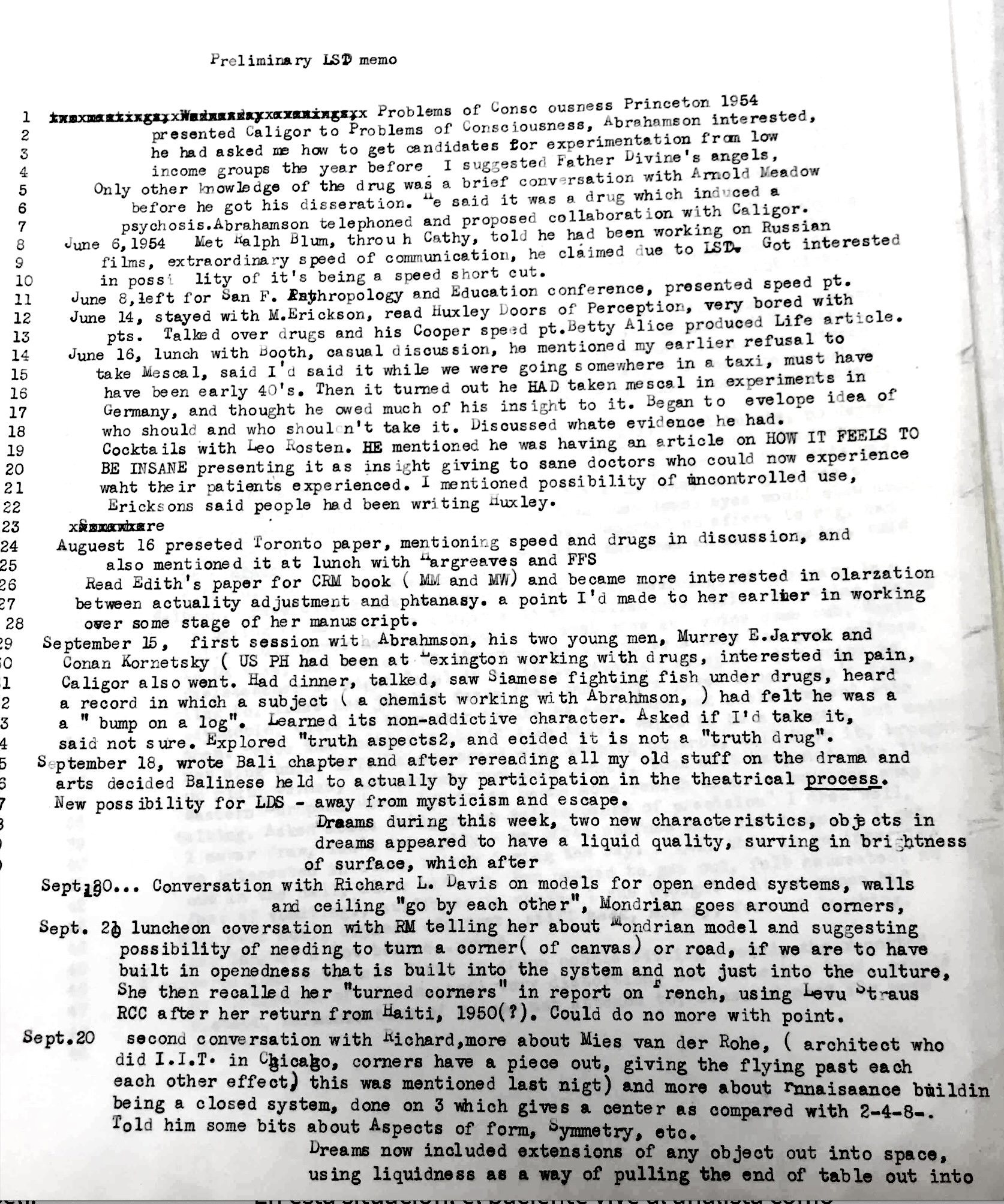
Preliminary LSD Memo
Wednesday evening Problems of Consc[i]ousness Princeton 1954
2 presented Caligor to Problems of Conciousness, Abrahamson [Harold Abramson] interested,
3 he had asked me how to get candidates for experimentation from low
4 income groups the year before. I suggested Father Divine’s angels,
5 Only other knowledge of the drug was a brief conversation with Arnold Meadow
6 before he got his dissertation, he said it was a drug which induced
7 psychosis. Abrahamson telephoned and proposed collaboration with Caligor.
8 June 6, 1954 Met Ralph Blum, thru’ Cathy, told he he‘d been working on Russian
9 films, extraordinary speed of communication, he claimed due to LSD — Got interested
10 in poss’ ility of it’s being a speed + short cut.
11 June 8, left for San F. E.thropology and Education conference, presented speed pt.
12 June 14, stayed with W. Erickson, read Huxley Doors of Perception, very bored with
13 pts. Talked over drugs and his Cooper speed pt. Betty Alice produced Life article.
14 June 16, lunch with Booth, casual discussion, he mentioned my earlier refusal t’o
15 take Mescal, said I’d said it while we were going somewhere in a taxi, must have
16 he‘n in early 40’s. Then it turned out he HAD taken mescal in experiments in
17 Germany, and thought he owed much of his insight to it. Began to evelope idea of
18 who should and who shouldn’t take it. Discussed what evidence he had.
19 Cocktails with Leo Rosten. He mentioned he was having an article on HOW IT FEELS TO
20 BE INSANE presenting it as insight giving to sane doctors who could now experience
21 what their patients experienced. I mentioned possibility of uncontrolled use,
22 Eriksons said people had been writing Huxley.
23 xxxxxxxxx
24 August 16 presented Toronto paper, mentioning sped and drugs in discussion, and
25 also mentioned it at lunch with Hargreaves and FPS
26 Read Edith’s paper for CML book (MM and MW) and became more interested in clorization
27 between actuality of adjustment and phantasay. A point I’d made to her earlier in working
28 over some of her manuscript.
29 September 15, first session with Abrahamson, his two young men, Murrey E. Jarow and
30 Conan Kornetsky (US PH) had been at Lexington working with drug s, interested in pain,
31 Caligor also went. Had dinner, talked, saw Siamese fighting fish under drugs, heard
32 a record in which a subje t (a chemist working w’th Abram hsom), had felt he was a
33 “bump on a log”. Le rned it is non-addictive character. Asked if I’d take it,
34 not sure. Explored truth aspoets,and ecided it is not a “truth drug”.
35 September 18, wrote Bali chapter and after rereading all my old stuff on the dram and
36 arts decided Balinese h ld to actually by participation in the theatrical process.
37 New possibility for LDS - away from mysticism and escape.
38 Dreams during this week, two new characteristics, obj cts in
39 dreams appeared to have a liquid quality, surving in bright ness
40 of surface, which after
41 Sept 20... Conversation with Richard L. Davis on models for open ended systems, walls
42 and ceiling “go by each other”. Mondrian goes around corners,
43 Sept. 26 luncheon conversation with RM telling her about Mondrian model and suggesting
44 possibility of needing to turn a corner (of canvas) or road, if we are to have
45 built in openness that is built into the system and not just into the culture,
46 She then recalled her “turned corners” in report on French, using Lévy Brteus
47 RCC after her return from Haiti, 1950(?). Could do no more with point.
48 Sept. 20 second conversation with Richard, more about Mies van der Rohe, (architect who
49 did I.I.T. in Chicago, corners have a piece out, giving the flying past each
50 each other effect) this was mentioned last nig t) and more about Tnn asanene btdilin
51 being a closed system, done on 3 which gives 3 center as compared with 2-4-8-.
52 Told him some bits about Aspects of Form, Symmetry, etc.
53 Dreams now included extentions of any object out into space,
54 using liquidness as a way of pulling the end of table out into
[end of page 1]
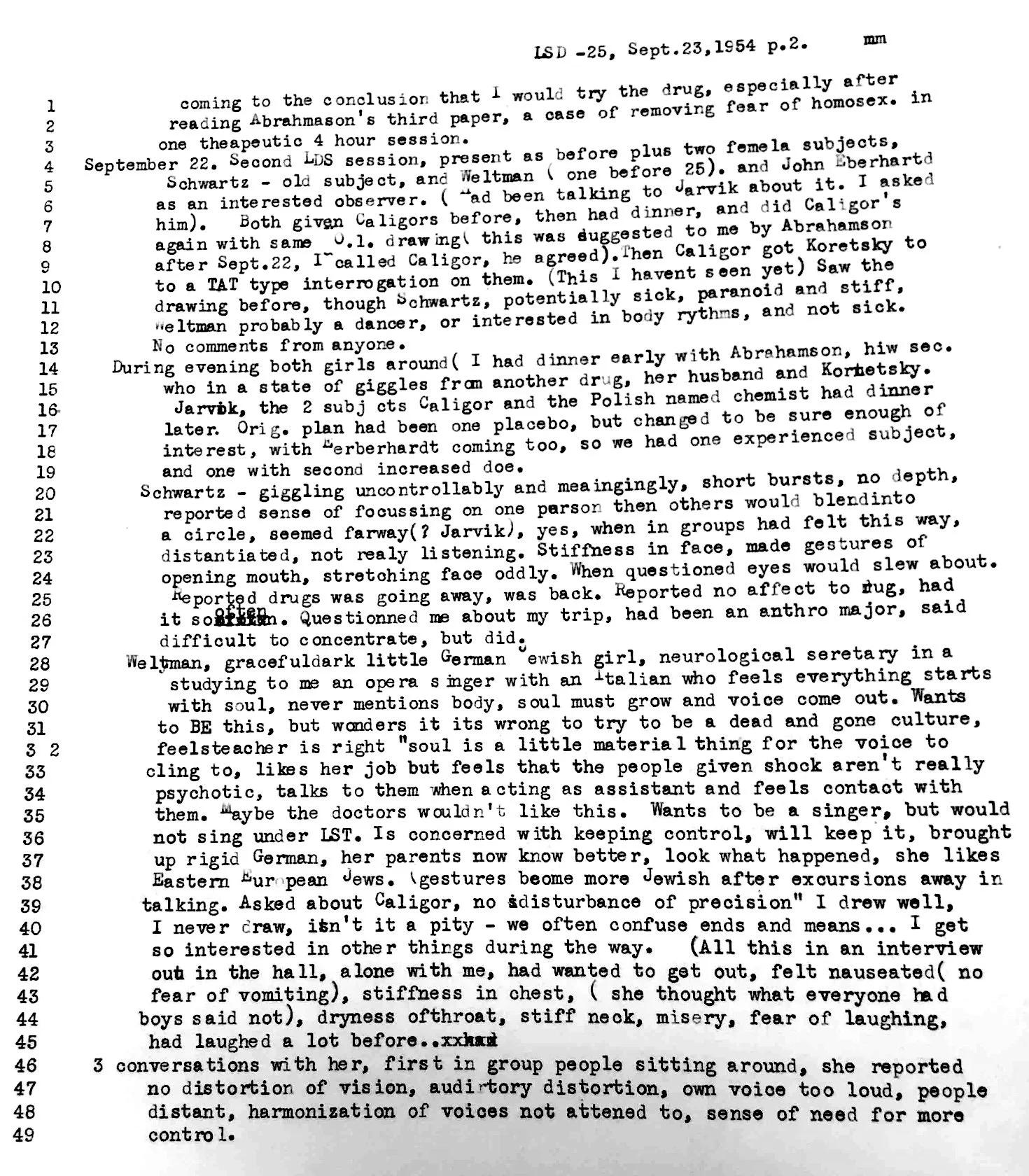
LSD -25, Sept.23,1954 p.2. mm
1 coming to the conclusion that I would try the drug, especially after
2 reading Abrahamson’s third paper, a case of removing fear of homosexuals in
3 one theapeutic 4 hour session.
4 September 22. Second LSD session, present as before plus two female subje cts,
5 Schwartz - old subject, and Weltman (one before 25). and John Berberhardt
6 as an interested observer. I’d been talking to Jarvik about it. I asked
7 him. Both given Caligors before, then had dinner, and I’d Caligor d
8 again with same. ( L. drawing of this was suggested to me by Abrahamson
9 after Sept.22 , I called Caligor, he agreed). Then Caligor got Kornetsky
10 to a TAT type interrogation on them. (This I haven’t seen yet) Saw the
11 drawing before, though Schwartz, potentially sick, paranoid and stuffy.
12 Weltman probably a dancer, or interested in body ryhms, and not sick.
13 No comments from anyone.
14 During evening both girls around (I had dinner early with Abrahamson, hw sec.
15 who in a state of giggles from another drug, her husband and Kornetsky.
16 Jarvik, the 2 subje ts Caligor and the Polish named chemist had dinner
17 later. Orig. plan had been one placebo, but changed to be sure enough of
18 interest with Berberhardt coming too, so we had one experienced subject,
19 and one with second increased dose.
20 Schwartz - giggling uncontrollably and meaningfully, short bursts, no depth,
21 reported sense of focussing on one person then others would blend into
22 a circle, seemed farway( Jarvik), yes, when in groups had felt this way,
23 distantiated, not really listening. Stiffness in face, made gestures of
24 opening mouth, stretching face odaly. When questioned eyes would slew about.
25 Reported drug was going away, was back. Reported no affect to drug, had
26 it soften. Questioned me about my trip, had been an anthro major, said
27 difficult to concentrate, but did.
28 Weltman, gracefull dark little German Jewish girl, neurological secretary in a
29 study gave to me an opera singer with an Italian who feels everything starts
30 with soul, never mentions body, soul must grow and voice come out. Wants
31 to BE this, but wonders it it’s wrong to try to be a dead and gone culture,
32 feels she her is right "soul is a little material thing for the voice to
33 cling to, likes her job but feels that the people given soocho aren’t really
34 psychotic, talks to them when acting as assistant and feels contact with
35 them..why the doctors wouldn’t like this. Wants to be a singer, but would
36 not sing under LST. Is concerned with keeping control, will keep it, brought
37 up rigid German, her parents now know better, look what happened, she likes
38 Eastern Eur pean Jews, gestures become more Jewish after excursions away in
39 talking. Asked about Caligor, no disturbance of precision" I drew well,
40 He never craw, isn’t it a pity - we often confuse ends and means. I get
41 so interested in one thing during the way (All this in an interview
42 out in the hall, alone with me, had wanted to get out, felt nauseated (no
43 fear of vomiting), stiffness in chest, ( she thought what everyone h d
44 boys said not), dryness ofthroat, stiff neck, misery, fear or laughing,
45 had laughed a lot before..xxxxxx
46 3 conversations with her, first in group people sitting around, she reported
47 no distortion of vision, audi tory distortion, own voice too loud, people
48 distant, harmonization of voices not attended to, sense of need for more
49 control.
[end of page 2]
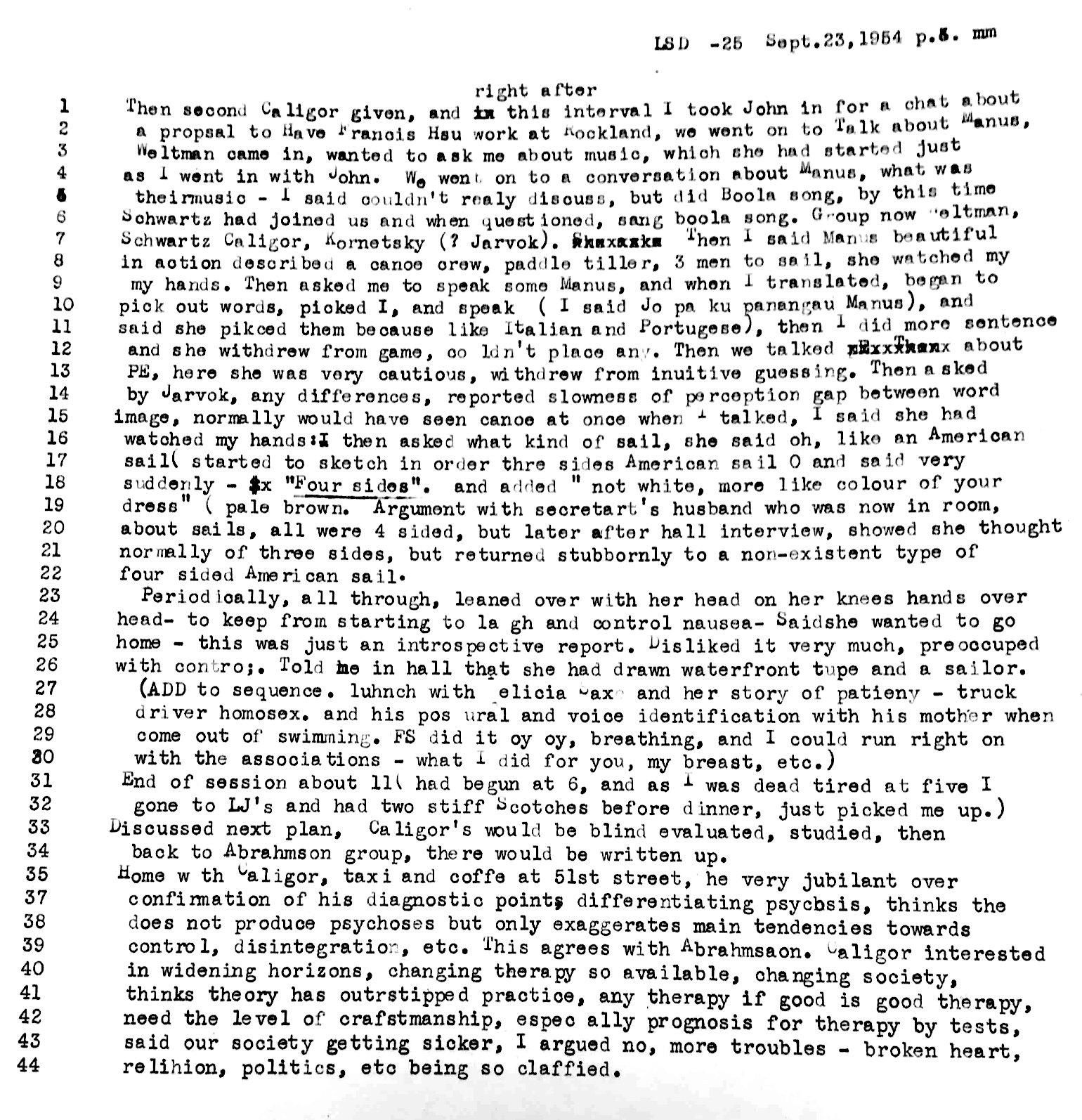
LSD -25 Sept.23,1954 p.3. mm
1 right after
2 Then second Caligor given, and in this interval I took John in for a chat about
3 a proposal to le François Hu work at Rockland, we went on to talk about Manus,
4 Weltman came in, wanted to ask me about music, which she had started just
5 as I went in with John.. We went on to a conversation about Manus, what was
6 their music - I said I couldn’t really discus_e, but did a Boola song. By this time
7 Schwartz had joined us and wh en questioned, sang books long. Group now Weltman,
8 Schwartz Caligor, Kornetsky (? Jarvok). xxxxxxxx Then I said Manus beautiful
9 in action, described a canoe crew, paddle tiller, & men to sail, she watched my
10 my hands. Then asked me to speak some Manus, and when I translated, she said
11 pick out words, picked I, and speak (I said do pa k! in panaman Manus),
12 said she picked them because like Italian and Portuguese), then I did more sentence
13 and she withdrew from scene, so I dn’t place any. Then we talked xxxxthan about
14 PE, here she was very cautious, withdrew from intuitive guesses. Then asked
15 by Jarvok, any differences, reported slowness of perception gap between word
16 image, normally would have seen canoe at once when I talked, I said she had
17 watched my hands: then he asked what kind of sail, she said oh, like an American
18 sail started to sketch in order three sides American sail 0 and said very
19 suddenly - 4x * “Four sides”. and added “not white, more like colour of your
20 dress” pale brown. Argument with secretary’s husband who was now in room,
21 about sails, all were 4 sided, but later after hall interview, showed she thought
22 normally of three sides, but returned stubbornly to a non-existent type of
23 four sided American sail.
24 Periodically, all through, leaned over with her head on her knees hands over
25 head-to keep from starting to le gh and control nausea. Seemed wanted to go
26 home- this was just an introspective report. Disliked it very much, preoccupied
27 with control. Told me in hall that she had drawn waterfront type and a sailor.
28 (ADD to sequence- lunch with elicia bax and her story of patiency - truck
29 driver homosexual. and his pos ural and voice identification with his mother when
30 come out of swimming. FS did it oy oy, breathing, and I could run right on
31 with the associations - what i did for you, my breast, etc.)
32 End of session about ll he’d begun at 6, and as I was dead tired a five I
33 gone to LJ’ and had two stiff Scotches before dinner, just picked me up.)
34 Discussed next plan, Caligor’s would be blind evaluated, studied, then
35 back to Abrhamson group, the we would be written up.
36 Home w’th Caligor, taxi and coffe at 51st street, he very jubilant over
37 confirmation of his diagnostic point, differentiating psychics, thinks the
38 does not produce psychoses but only exaggerates main tendencies towards
39 control , disintegration, etc. This agrees with Abrahamson. Caligor interested
40 in widening horizons, changing therapy so available, changing society.
41 thinks the oy has outstripped practice, any therapy if good is good therapy,
42 needs the level of craftmanship, espec ally prognosis for therpay by tress
43 said our society getting sicker, I argued no, more troubles - broken hearts,
44 rehirion, politic s, etc being so clafied.
[end of page 3]
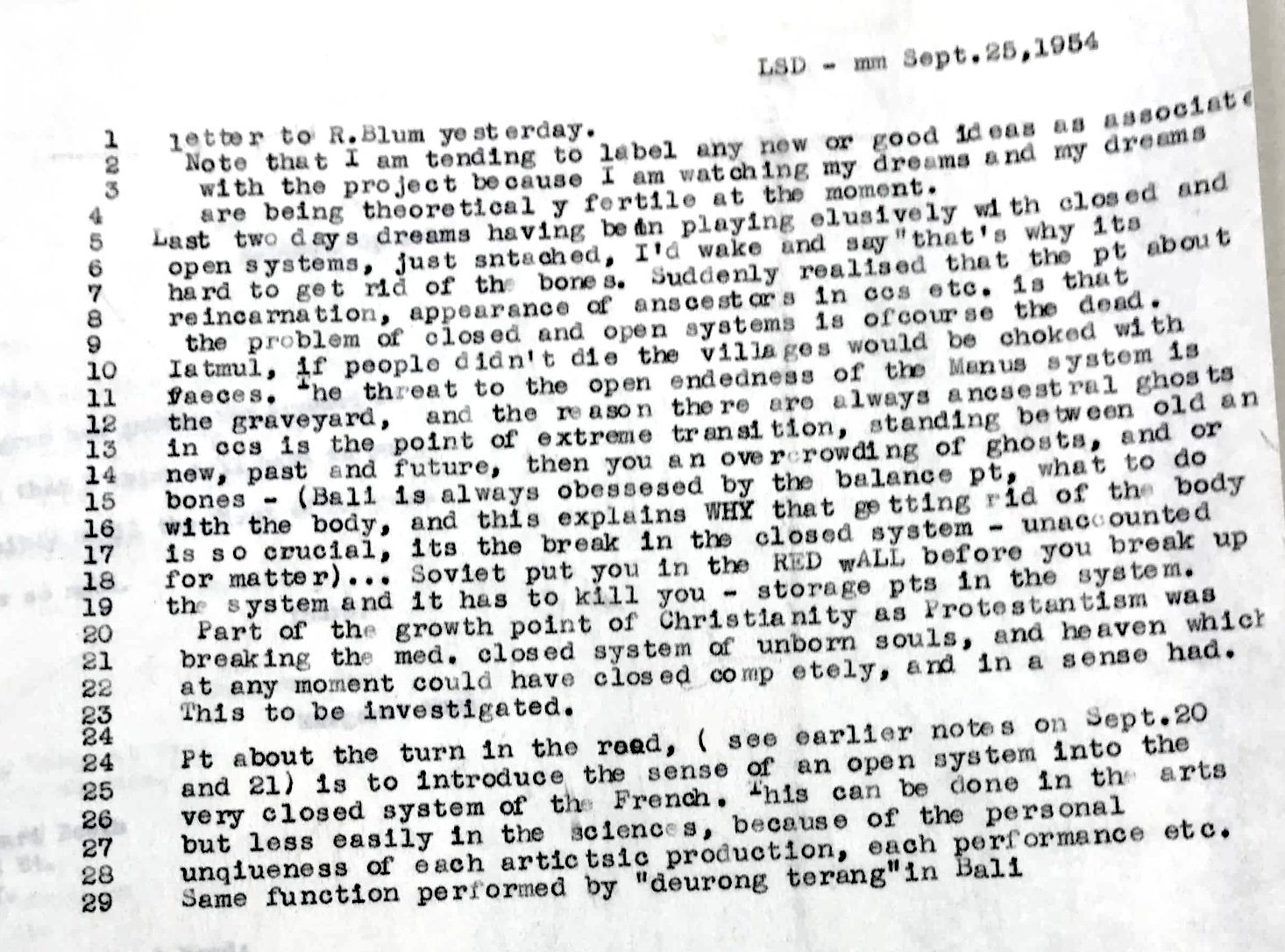
LSD - mm Sept.25,1954
1 letter to: R.Blum yesterday.
2 Note that I am tending to la ber any new or good ideas as associat*
3 with the project because I am watching my dreams and my dreams
4 are being theoretical y fertile at the moment.
5 Last two days dreams havinq be n playing elusively wth closed and
6 open systems, just snatched. I‘d wake and sqy that’s why its
7 hard to get rid of the bone s. Suddenly realised that the pt about
8 reincarnation, appearance of ancestors in cs of c es - is that in
9 the problem of closed and open systems. Also ofcourse the dead.
10 latmul, if people didn’t the villages would be choked with
11 faeces. The threat to the open endedness of the Manus system is
12 the graveyard, and there are always ancestral ghosts
13 in ccs is the point of extreme transition, standing between old an
14 new, past and future, then you [have] an overcrowding of ghosts, and or
15 bones - (Bali is always obsessed by the balance pt, what to do
16 with the body, and this explains WHY that getting rid of the body
17 is so crucial, its the break in the closed system - unaccounted
18 for matter). . . Soviet put you in the RED WALL before you break up
19 the system and it has to kill you - storage pts in the system
20 Part of the growth point of Christianity as Protestantism was
21 breaking the med[ieval] closed system of unborn souls, and heaven which
22 at any moment could have closed completely, and in a sense had.
23 This to be investigated.
24
25 Pt about the turn in the road, ( see earlier notes on Sept.20
26 and 21) is to introduce the sense of an open system into the
27 very closed system of the French. This can be done in the arts
28 but less easily in the sciences, because of the personal
29 uniqueness of each artistic production, each performance etc.
30 Same function performed by “deuronge terang” in Bali
Historical context for Margaret Mead’s LSD Memo
The document presented here—a confidential memorandum by the brilliant cultural anthropologist Margaret Mead, dated to September 1954—challenges the conventional chronology of the psychedelic era. Written nine years before Timothy Leary’s firing from Harvard and more than a decade before the Summer of Love, this memo captures anthropologist Margaret Mead in the midst of a private, rigorously intellectual negotiation with the concept of expanded consciousness. It documents her preparation for an experimental LSD session with Dr. Harold Abramson, a CIA-funded allergist who became a central node in the U.S. government’s covert MKULTRA program.
To understand this document, one must look beyond the counterculture of the 1960s and instead look to the specific anxieties of the mid-1950s: the hydrogen bomb, the rise of cybernetics, and Mead’s urgent quest to understand how cultures—and human minds—change under pressure.
Overview
The intellectual momentum for this memo began in 1953, when Mead returned to the Admiralty Islands (Manus) for the first time since 1928. She was there to study a phenomenon she called “the Noise,” a localized, apocalyptic cargo cult that had swept through the islands following World War II. The Manus people had thrown their old possessions into the sea, radically breaking with tradition to embrace a perceived modern utopia.
Mead was fascinated by this “complete destruction of the past,” as she called it (opinions differ on how complete this really was, and how well Mead understood the phenomenon — for an alternative take by one of Mead’s former students, see Theodore Schwartz and Michael French Smith, Like Fire: the Paliau Movement and Millenarianism in Melanesia, published by ANU Press in 2021). She saw it not as madness, but as a high-speed evolutionary jump, almost a form of cultural mutation. Throughout 1953 and 1954, as she drafted her book New Lives for Old: Cultural Transformation—Manus, 1928–1953 (published 1956), she began to draw parallels between this rapid cultural shift and the rapid psychological shifts reported by subjects under LSD.
In the concluding sections of New Lives for Old—which she was writing in the same period of time as this memo—Mead explicitly links these two phenomena. She speculated that “drugs, such as mescal or LSD,” might serve as tools to induce “conversion experiences”: cognitive ruptures that could allow individuals to break free from rigid, outdated patterns of thought, much like the Manus had broken from their ancestors.
The memo is also a product of the "Problems of Consciousness" conferences (1950–1954), funded by the Josiah Macy Jr. Foundation. These conferences, which Mead chaired and Abramson attended, were the one of the crucibles of the Cybernetics movement. The participants were obsessed with "feedback loops" and the distinction between "closed" and "open" systems.
In the memo, Mead uses the LSD experience to visualize these abstract concepts. She references the architecture of Mies van der Rohe and the paintings of Piet Mondrian to describe an "open system"—a structure where the corners are not sealed, allowing for movement and evolution. She contrasts this with the "Red Wall" of Soviet communism, which she views as the ultimate "closed system"—a totalitarian dead-end where information cannot circulate.
Thus, for Mead, LSD was not an escape from reality, but a "speed + short cut" (Memo, Line 10) to solving the central problem of the Cold War: How can democratic citizens maintain "open" minds in an era of rigid ideological polarization?
The Abramson Connection
The presence here of Dr. Harold Abramson (misspelled by Mead as “Abrahamson”) is of significant historical interest. Abramson was not merely a researcher; he was a cleared contractor for the CIA’s MKULTRA project. Abramson’s lab at Mount Sinai Hospital and his Cold Spring Harbor facility were sites where the therapeutic promise of LSD was inextricably bound up with the Cold War search for a “truth drug” (referenced on page 3 of the memo) and an applied science of the mind which could contribute to strategic imperatives of the 1950s United States.
Mead’s collaboration with Abramson, who she had first met during World War II and who participated with her in the Macy Conference “cybernetics” conferences, demonstrates the degree to which the early psychedelic movement was embedded within the emerging national security state of the early Cold War.
On the other hand, this striking, evocative, and complex document also stands as a testament to a far more hopeful “lost future” of psychedelics. An alternative timeline is visible here wherein it was Margaret Mead and other anthropologists and cybernetics-minded scientists of the 1950s — and not Timothy Leary and psychologists of the 1960s — who led the vanguard of a psychedelic era. It captures Margaret Mead at the height of her powers, idiosyncratic, relentlessly curious, and intellectually wide-ranging—but also entering one of the most morally compromising and complex periods of an eventful life.
— Benjamin Breen (2025)