1800-1950 / Source

Browse filters
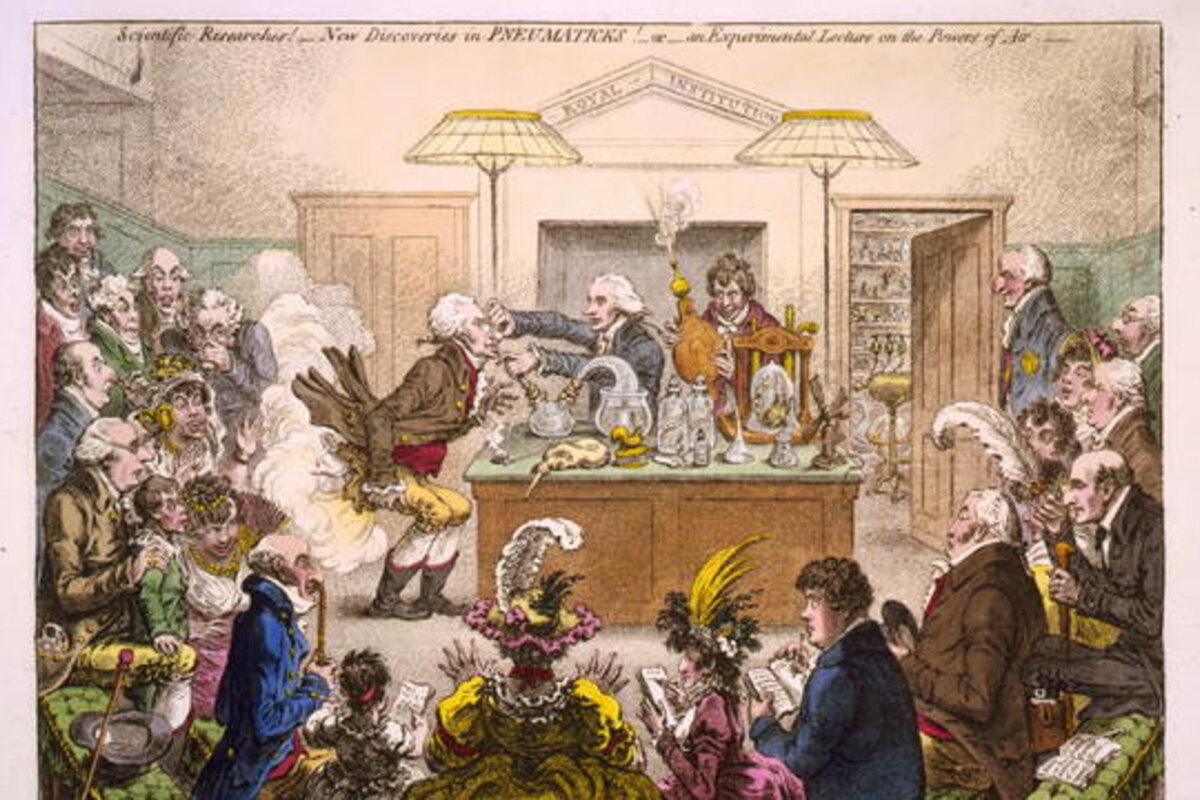
Researches, Chemical and Philosophical; Chiefly Concerning Nitrous Oxide
Source, 1800

Researches, Chemical and Philosophical; Chiefly Concerning Nitrous Oxide

Humphry Davy's account of breathing nitrous oxide at Thomas Beddoes's Pneumatic Institution in Bristol in 1799, from the fourth part of his Researches. The excerpt gives Davy's own experiments, including the session that ended with "Nothing exists but thoughts!", and the reports he collected from Robert Southey, Peter Roget, Samuel Taylor Coleridge, and Thomas Wedgwood.

Read more
Fly Agaric among the Koryaks in Langsdorff's Bemerkungen
Source, 1812

Fly Agaric among the Koryaks in Langsdorff's Bemerkungen

A Kamchatka note on mushroom trade and intoxication

Langsdorff's 1812 German voyage account records fly agaric in Koryak trade with Russians and Kamchadals, noting in a footnote that Koryaks preferred it to brandy as a stupefying or intoxicating substance.

Read more
Paricá among the Mura in Spix and Martius's Reise in Brasilien
Source, 1831

Paricá among the Mura in Spix and Martius's Reise in Brasilien

A German travel account of Amazonian snuff, ceremony, and intoxication

Spix and Martius's 1831 German travel narrative describes paricá among the Mura, including preparation from dried seeds, ceremonial use, insufflation through tubes, and comparison with fly agaric intoxication.

Read more
Hashish and Mental Alienation
Source, 1845

Hashish and Mental Alienation

Moreau de Tours on dawamesc, self-experiment, and experimental psychiatry

Selected passages from Moreau de Tours's 1845 psychiatric treatise on hashish, including his insistence on personal experience, description of dawamesc preparation and dosing, and claim that hashish offered a unique experimental route into the psychology of madness.

Read more
Fly Agaric and Hashish in Die narkotischen Genussmittel
Source, 1855

Fly Agaric and Hashish in Die narkotischen Genussmittel

Ernst von Bibra's German comparative account of Amanita and Cannabis

Selective excerpts from Ernst von Bibra's 1855 German survey of narcotic Genussmittel, focused on fly agaric and hashish. The passages show a mid-century comparative framework linking Amanita, Cannabis, opium, alcohol, travel accounts, chemistry, and differential effects across persons and places.

Read more
The Hasheesh Eater
Source, 1857

The Hasheesh Eater

Fitz Hugh Ludlow's account of his cannabis use as a young man in Poughkeepsie and at Union College, published anonymously in 1857 when he was twenty-one. In this excerpt (pages 18–26) he finds Cannabis indica at a local apothecary's shop, reads about it in the Dispensatory, and takes his first doses.

Read more
Ayahuasca in Villavicencio's Geografía de la República del Ecuador
Source, 1858

Ayahuasca in Villavicencio's Geografía de la República del Ecuador

An 1858 Ecuadorian account of ayahuasca visions and divination

Manuel Villavicencio's 1858 geography gives an early Spanish account of ayahuasca among Indigenous groups of eastern Ecuador, including divination, warfare, illness diagnosis, visionary effects, and a first-person report of his own experience.

Read more
Le Gabon (Deuxième partie)
Source, 1865

Le Gabon

A French naval physician's 1865 travel account surveys Gabon's food plants and condiments, describing iboga as a stimulant and aphrodisiac used by paddlers on long canoe trips. He gives it the genus name 'taberna-ventricosa,' later corrected by Baillon.

Read more
Caapi and Niopo in “On Some Remarkable Narcotics of the Amazon Valley and Orinoco”
Source, c. 1870; published 1908

Caapi and Niopo in “On Some Remarkable Narcotics of the Amazon Valley and Orinoco”

Richard Spruce on ayahuasca, yopo/paricá, and Amazonian medicine-men

Richard Spruce's nineteenth-century account of caapi, aya-huasca, niopo, and paricá, based on field observations in the Uaupés, Orinoco, Rio Negro, Napo, and Pastasa regions. The excerpt records plant identifications, preparation methods, visual effects, ceremonial uses, and the role of payes in curing and divination.

Read more
The Anaesthetic Revelation and the Gist of Philosophy
Source, 1874

The Anaesthetic Revelation and the Gist of Philosophy

Benjamin Paul Blood's privately printed 1874 pamphlet, the source of the phrase "anaesthetic revelation." Hosted here is the section in which Blood, after nearly fourteen years of experiments with anaesthetics, describes the insight that comes at the moment of "coming to." William James reviewed the pamphlet that year and later quoted this passage in The Varieties of Religious Experience.

Read more
Review of The Anaesthetic Revelation and the Gist of Philosophy
Source, 1874

Review of The Anaesthetic Revelation and the Gist of Philosophy

William James's unsigned review of Blood's pamphlet, published in the Atlantic Monthly in November 1874, eight years before his own nitrous oxide experiments. James summarizes Blood's claims at length and judges the pamphlet "thoroughly original and very suggestive," if less important than its author believed.

Read more
Nitrous Oxide and the Anaesthetic Revelation in The Varieties of Religious Experience
Source, 1902

Nitrous Oxide and the Anaesthetic Revelation in The Varieties of Religious Experience

From the lecture on mysticism in William James's Gifford Lectures, delivered in Edinburgh in 1901–2. James argues that nitrous oxide and ether show "our normal waking consciousness" to be only one type among many, then quotes Blood and J. A. Symonds's chloroform experience. His notes add Xenos Clark's letter on the revelation and an Englishwoman's ether dream.

Read more
Anaesthetics Antient and Modern: An Historical Sketch of Anaesthesia
Source, Undated (c. 1907–1910)

Anaesthetics Antient and Modern

An Historical Sketch of Anaesthesia

An illustrated history of anaesthesia issued by the London drug firm Burroughs Wellcome & Co., which closes by advertising its own 'Wellcome' brand chloroform. Hosted here are the chapters on nitrous oxide, ether, and chloroform, covering Horace Wells's 1844 self-experiment, the ether demonstrations of William Morton and Charles Jackson, and James Young Simpson's 1847 chloroform trial.

Read more
A Pluralistic Mystic
Source, 1910

A Pluralistic Mystic

William James's last published essay, an appreciation of Benjamin Paul Blood that appeared in the Hibbert Journal in July 1910, weeks before James died. James quotes Blood's pamphlets and letters at length and traces how the anaesthetic revelation, which James first read as monism, became for Blood the basis of a pluralist philosophy.

Read more
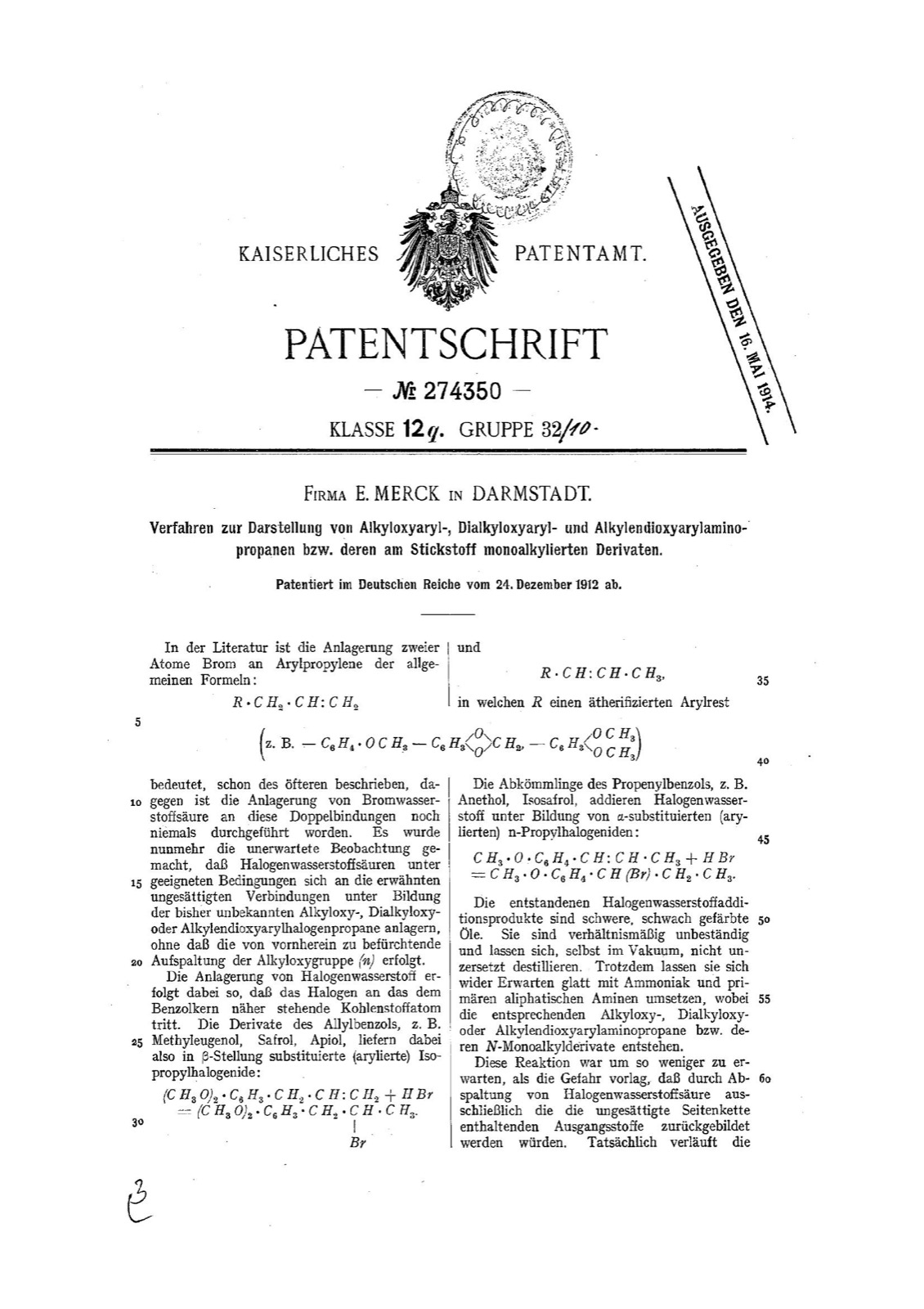
German Reich Patent No. 274350: Process for the Preparation of Alkyloxyaryl-, Dialkyloxyaryl- and Alkylenedioxyarylaminopropanes (Firm E. Merck, Darmstadt)
Source, Patented from 24 December 1912; specification published 1914

Merck Patent DE 274350

Process for the Preparation of Alkyloxyaryl-, Dialkyloxyaryl- and Alkylenedioxyarylaminopropanes (Firm E. Merck, Darmstadt)

German Reich Patent No. 274350 (1912) describes arylaminopropane synthesis from safrole. Example 4 yields MDMA by heating a brominated intermediate with methylamine—the earliest documented synthesis. The patent claims MDMA only as an unnamed chemical intermediate toward unspecified therapeutic compounds, not as a substance of interest itself.

Read more
The Anaesthetic Revelation, from Pluriverse
Source, 1920

The Anaesthetic Revelation, from Pluriverse

Benjamin Paul Blood's last book, published in 1920, the year after his death, with an introduction by Horace Kallen. Hosted here is the opening of the final chapter, "The Anaesthetic Revelation," where Blood compares the anaesthetic insight to the trance cattle fall into at spilled blood and quotes James on the "artificial mystic state of mind."

Read more
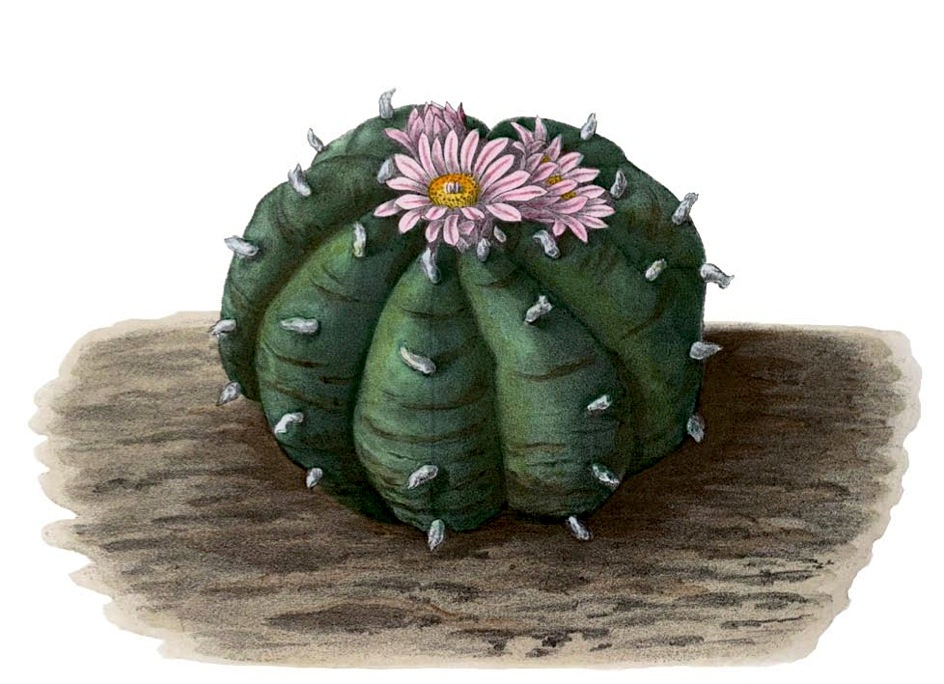
State v. Big Sheep
Source, January 26, 1926

State v. Big Sheep

The Montana Supreme Court reverses a Crow man's peyote conviction, finding the state failed to establish jurisdiction over an offense on the Crow Reservation. The court addresses federal Indian law and rejects the defendant's religious-use defense, but does not decide the jurisdictional question, remanding for new trial.

Read more