All eras

Browse filters
Soma Hymns in the Rigveda
Source, c. 1500-1000 BCE; translation 1897

Soma Hymns in the Rigveda

RV 8.48 and 9.113 on soma, immortality, and light

Two selected Rigvedic hymns to Soma: RV 8.48, the famous hymn of drinking soma and becoming immortal, and RV 9.113, a Soma Pavamana hymn asking to be placed in deathless worlds of light, delight, and fulfilled desire.

Read more
Chavin de Huantar
Archaeological Site, ca. 1200-500 BCE

Chavin de Huantar

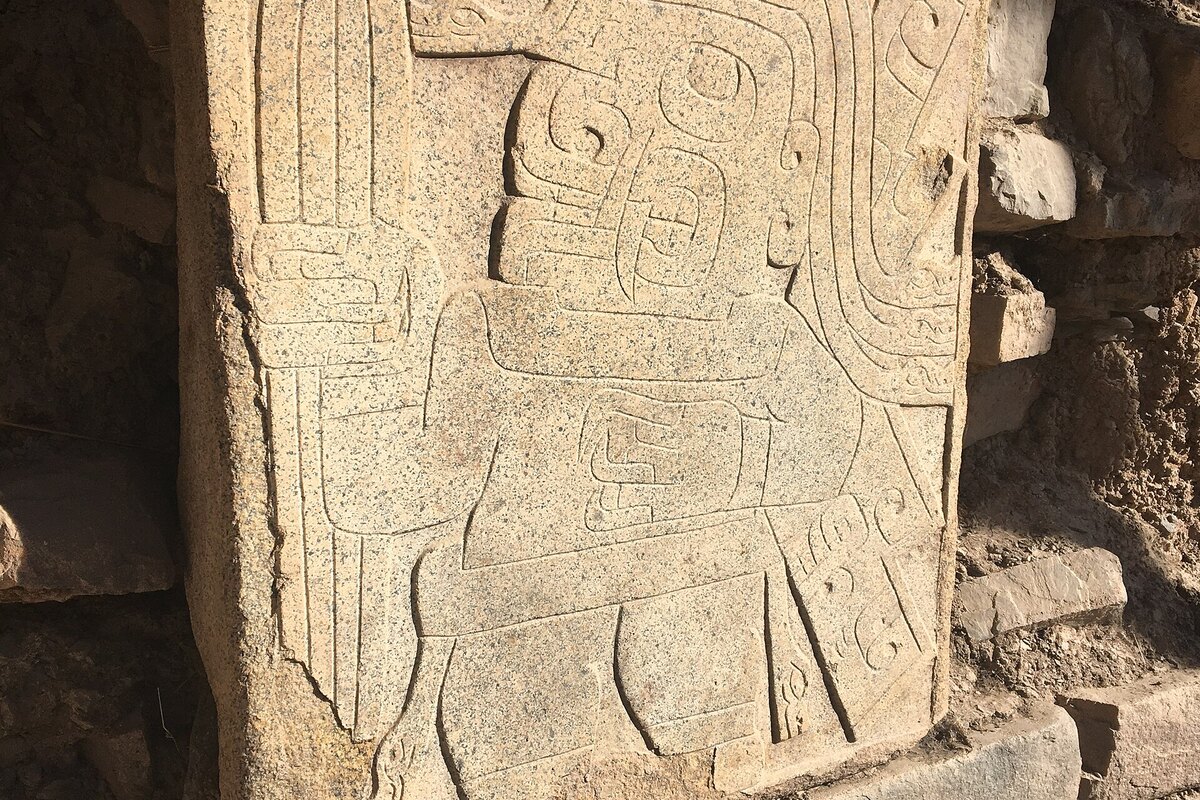
Ritual architecture, psychoactive plants, sound, and authority in the Early Horizon Andes

A concise archaeological site entry on Chavin de Huantar as a ceremonial center where architecture, controlled movement, sound, San Pedro imagery, and direct evidence for vilca and Nicotiana snuff formed part of institutionalized ritual practice.

Read more
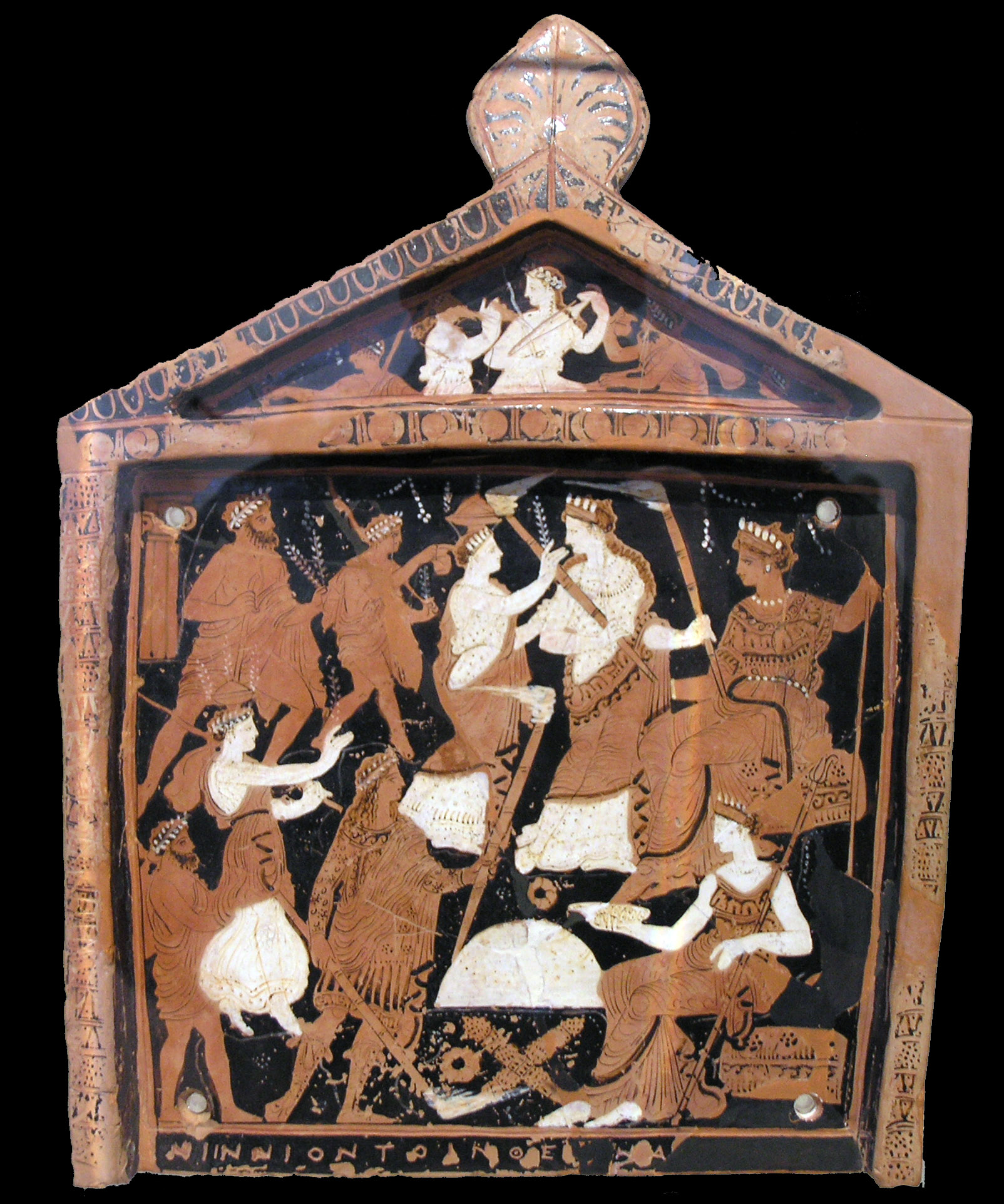
The Homeric Hymn to Demeter
Ancient Text, c. 650–550 BCE (this translation published 1914)

Hymn to Demeter

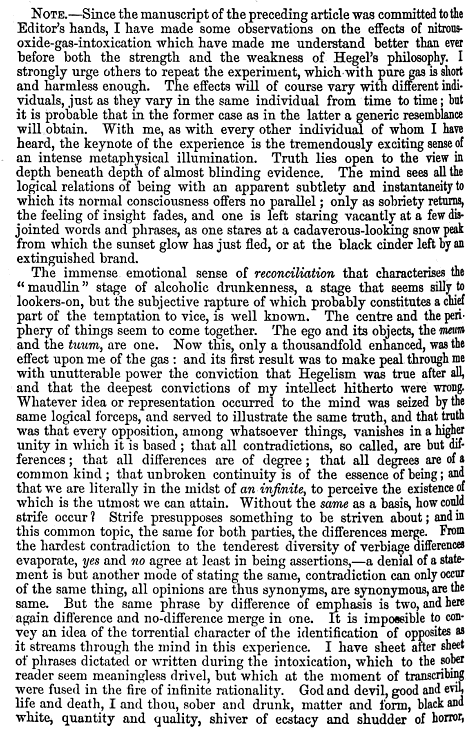
The Homeric Hymn to Demeter (7th-6th century BCE) is the founding myth of the Eleusinian Mysteries. Disguised as an old woman, Demeter drinks kykeon (barley meal, water, and mint) and later teaches the Eleusinians the 'awful mysteries.'

Read more
Exhortation to the Greeks (Chapter II, on the Eleusinian and Related Mysteries)
Ancient Text, c. 195 CE (this translation 1867/1885)

Exhortation to the Greeks, ch. II

Clement of Alexandria's chapter from his Exhortation to the Greeks (c. 195 CE), exposing Greek mystery religions including the Eleusinian rites. He quotes the complete verbal formula recited over the kykeon and recounts the myth of Demeter and Baubo.

Read more
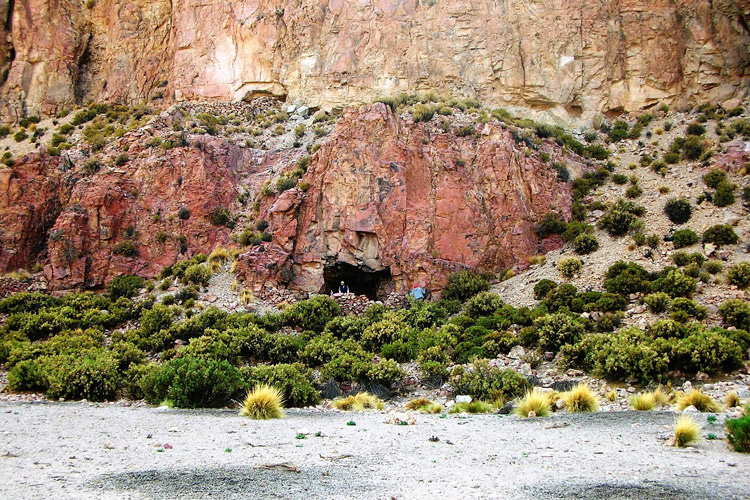
Cueva del Chileno
Archaeological Site, 905-1170 CE

Cueva del Chileno

A high-Andean ritual bundle with direct chemical evidence for multiple psychoactive plants

A rock shelter in southwestern Bolivia where archaeologists found direct chemical evidence for ancient use of coca, harmine-bearing plants, DMT-bearing plants, and possibly psilocin.

Read more
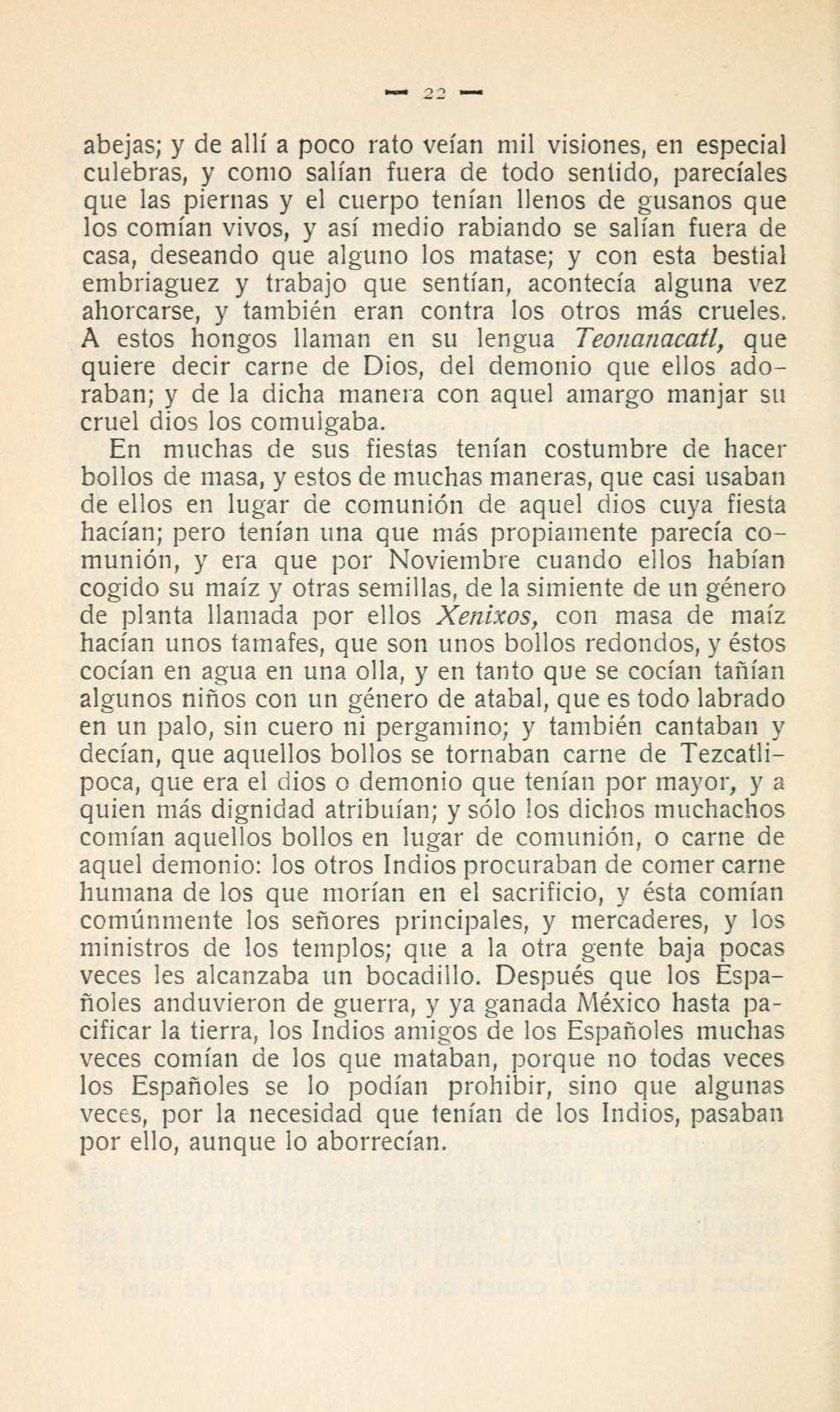
On Teonanácatl, the "Flesh of God"
Manuscript, c. 1541 (published 1858/1914)

Teonanácatl, "carne de Dios"

Motolinía's account of Aztec mushroom intoxication from Historia de los indios de la Nueva España. He describes small bitter mushrooms producing visions of serpents and worms, names them Teonanácatl ("flesh of God"), and compares the rite to other Aztec communal meals.

Read more
Eighth Colloquy: Bangue
Source, 1563; Portuguese edition 1891

Eighth Colloquy: Bangue

A sixteenth-century Portuguese-Goan discussion of bangue, or bhang, describing cannabis preparations in South Asia, their relation to opium, and accounts of intoxication, appetite, laughter, sleep, and imaginative travel.

Read more
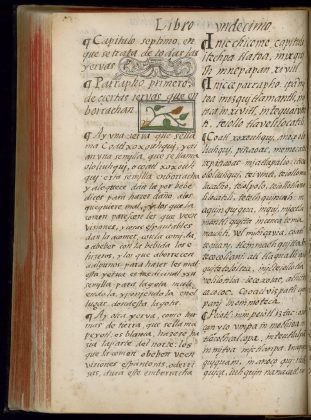
Ololiuhqui, Peyotl, and Teonanácatl in the Florentine Codex
Source, c. 1577

Ololiuhqui, Peyotl, and Teonanácatl in the Florentine Codex

Sahagún’s Book 11 on herbs that intoxicate

Spanish entries from Book 11 of the Florentine Codex, the encyclopedia of Nahua life compiled by Bernardino de Sahagún and Nahua scholars at Tlatelolco around 1577. They describe ololiuhqui, peyotl, tlapatl, mixitl, and teonanácatl, plants and mushrooms that cause intoxication or visions, with an English translation made for the archive.

Read more
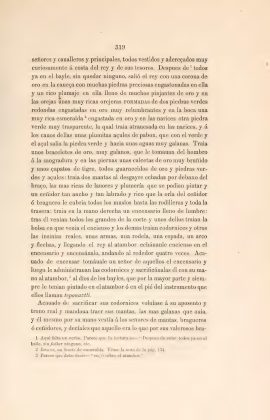
Hongos monteses in Durán's Historia de las Indias de Nueva España
Source, c. 1581; published 1867

Hongos monteses in Durán's Historia de las Indias de Nueva España

Mushrooms, coronations, and the feast of revelations

Three passages from Diego Durán's Historia describing raw mountain mushrooms in Mexica royal ceremonial life: a coronation feast, Durán's note that mushrooms rather than wine appear as the chronicle's intoxicant, and Motecuhzoma's feast of revelations.

Read more
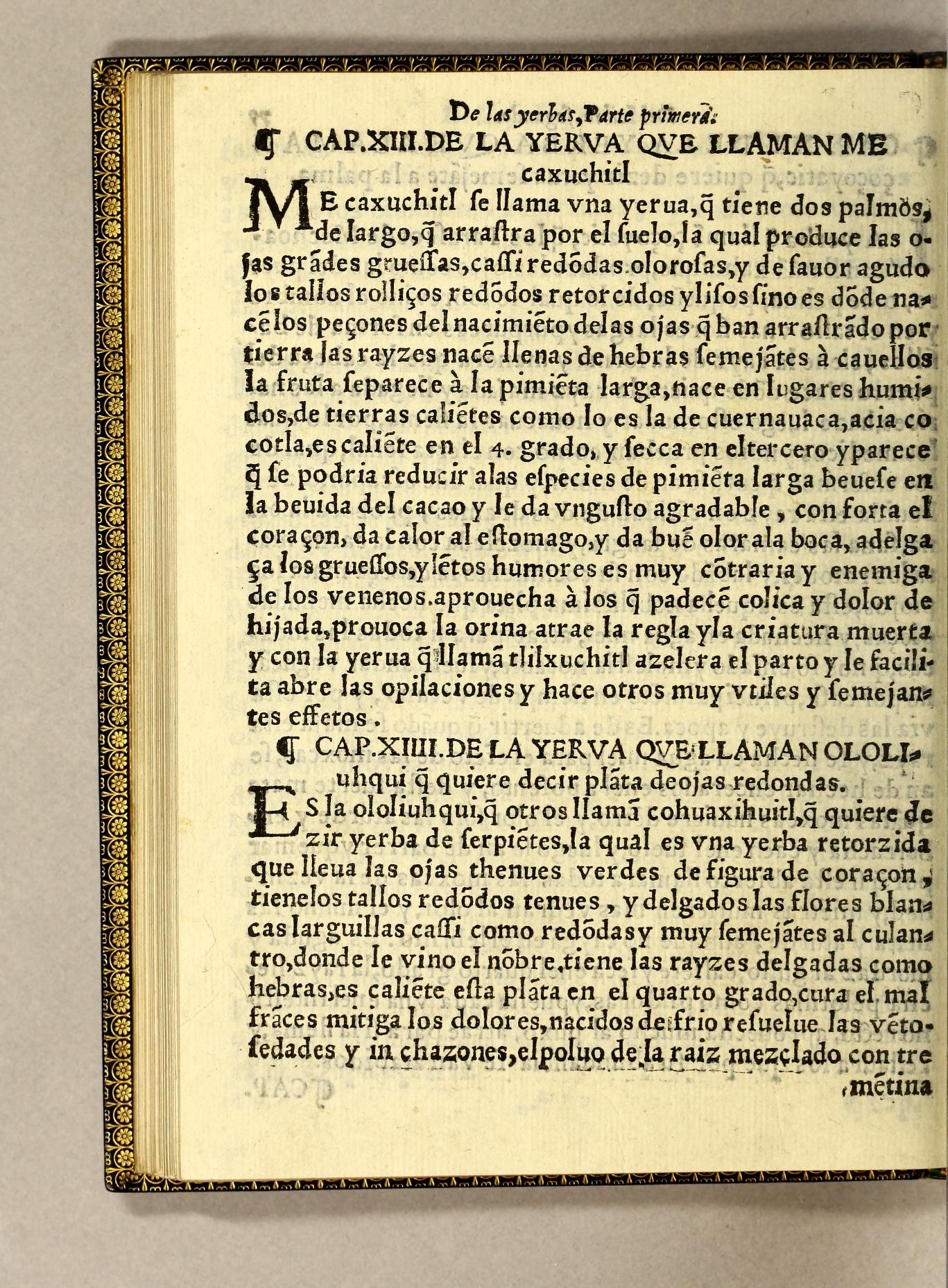
De la yerva que llaman Ololiuhqui
Book, 1615

On the Herb Called Ololiuhqui

Chapter 14 of Francisco Ximénez's 1615 Spanish redaction of Hernández's natural history, describing ololiuhqui. Ximénez gives the plant's Nahuatl name cohuaxihuitl ('serpent herb'), its medicinal uses, and records that priests ate it to commune with the devil and see a thousand phantasms.

Read more
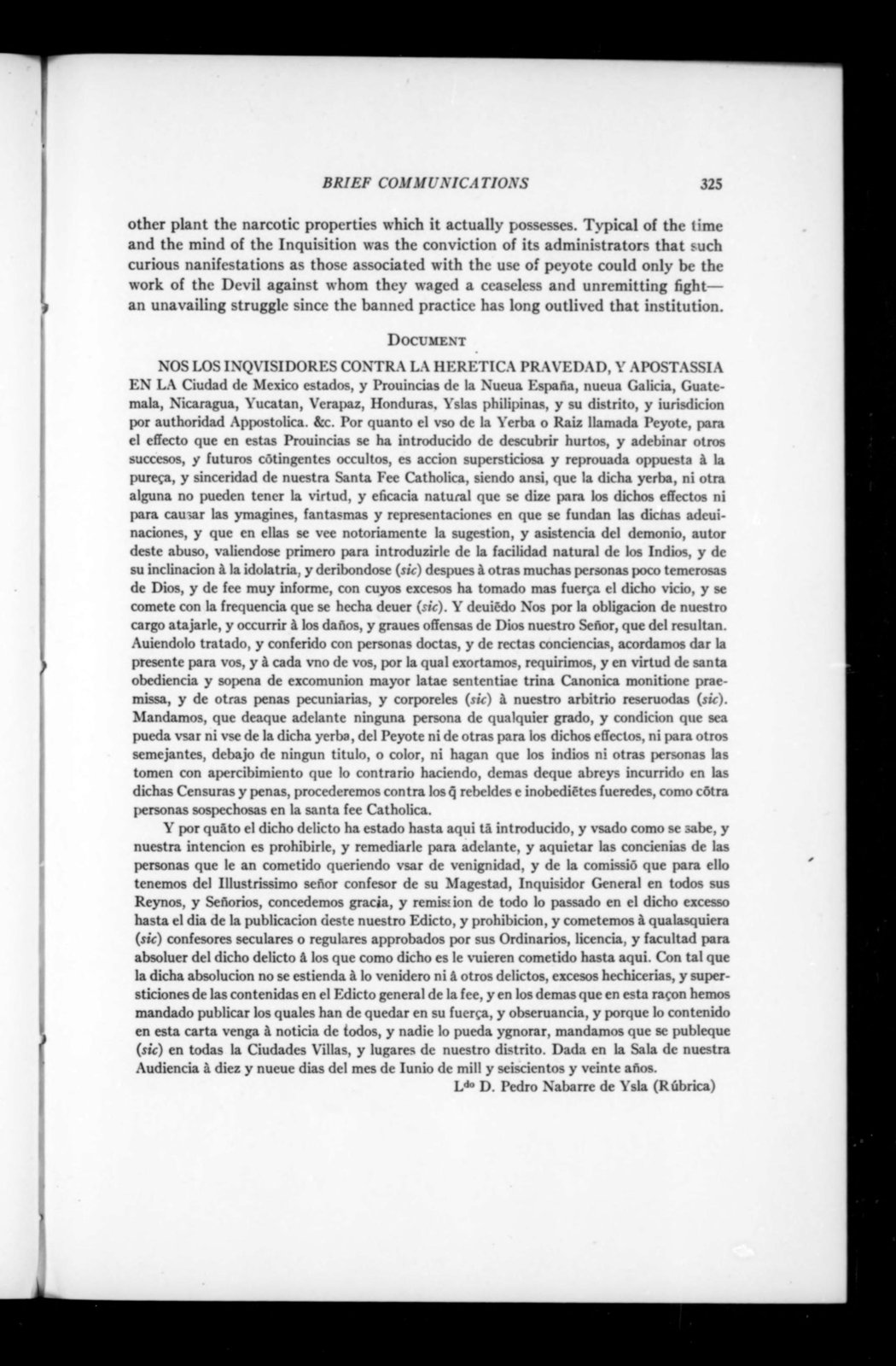
Edict of the Mexican Inquisition Prohibiting the Use of Peyote (1620)
Source, 19 June 1620

Inquisition Edict against Peyote

An edict of the Mexican tribunal of the Holy Office, issued in Mexico City on 19 June 1620 over the signature of Licenciado Pedro Nabarre de Isla, prohibiting the use of peyote to discover thefts and divine hidden or future events. The inquisitors deny the plant any natural power to produce visions, attribute them to the devil, threaten users with excommunication and proceedings as suspects in the faith, and pardon use before the edict's publication. The Spanish text is hosted as printed by Irving A. Leonard (1896–1996) in American Anthropologist in 1942, with a new English translation.

Read more
Ololiuhqui and Peyote in Idolatrías y supersticiones de los indios
Source, 1629-1656; published 1892

Ololiuhqui and Peyote in Idolatrías y supersticiones de los indios

Colonial anti-idolatry texts on divination, healing, and visionary plants

A set of Spanish colonial anti-idolatry excerpts describing ololiuhqui and peyote as oracular substances used in healing, theft investigation, divination, and diagnosis of sorcery. The source preserves rare early descriptions of visionary plant practice while also showing how clerical authorities criminalized and demonized Indigenous ritual knowledge.

Read more
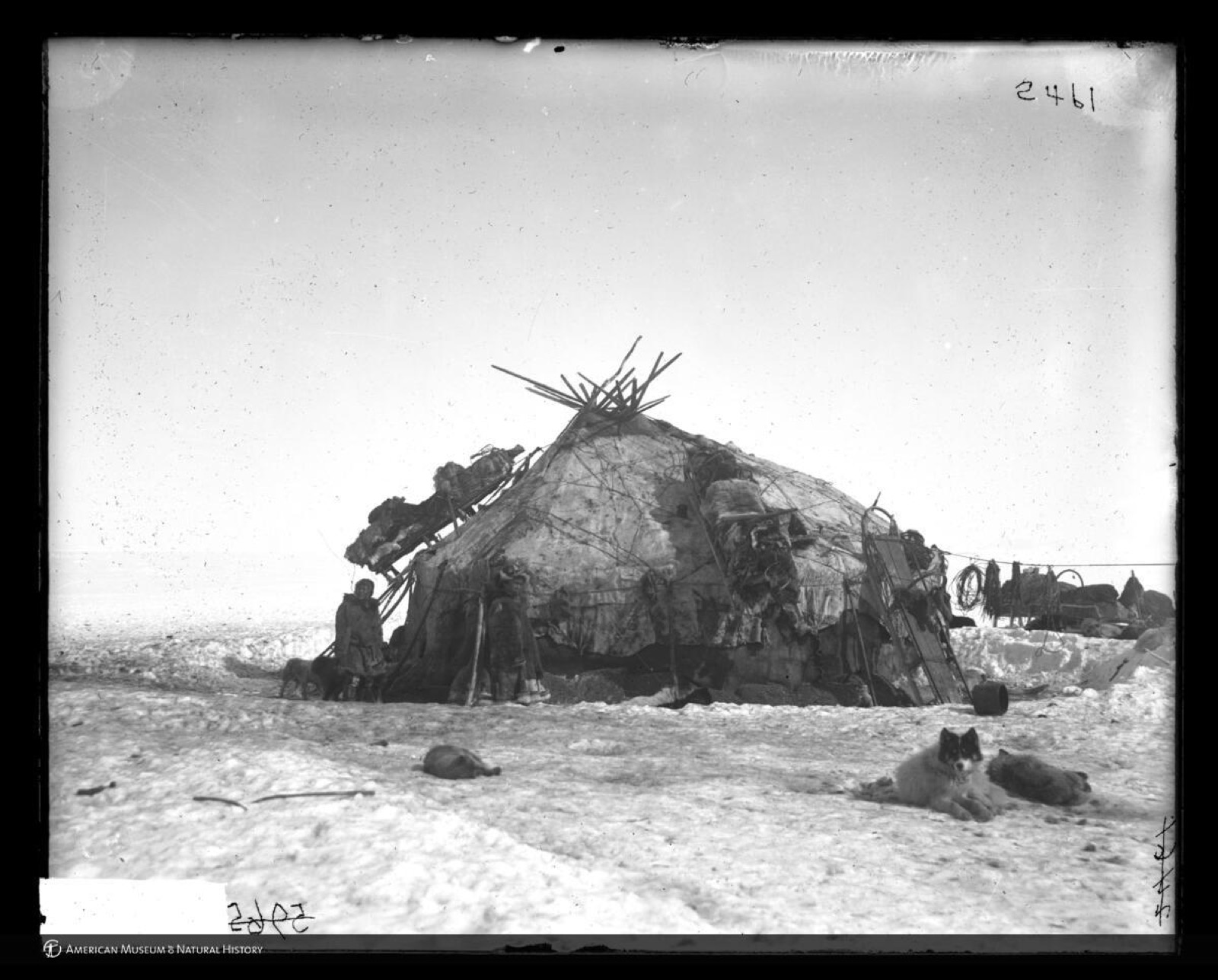
An Histori-Geographical Description of the North and Eastern Part of Europe and Asia: "Koræiki"
Book, 1736 (German original 1730)

Strahlenberg on the Koryaks and Fly-Agaric

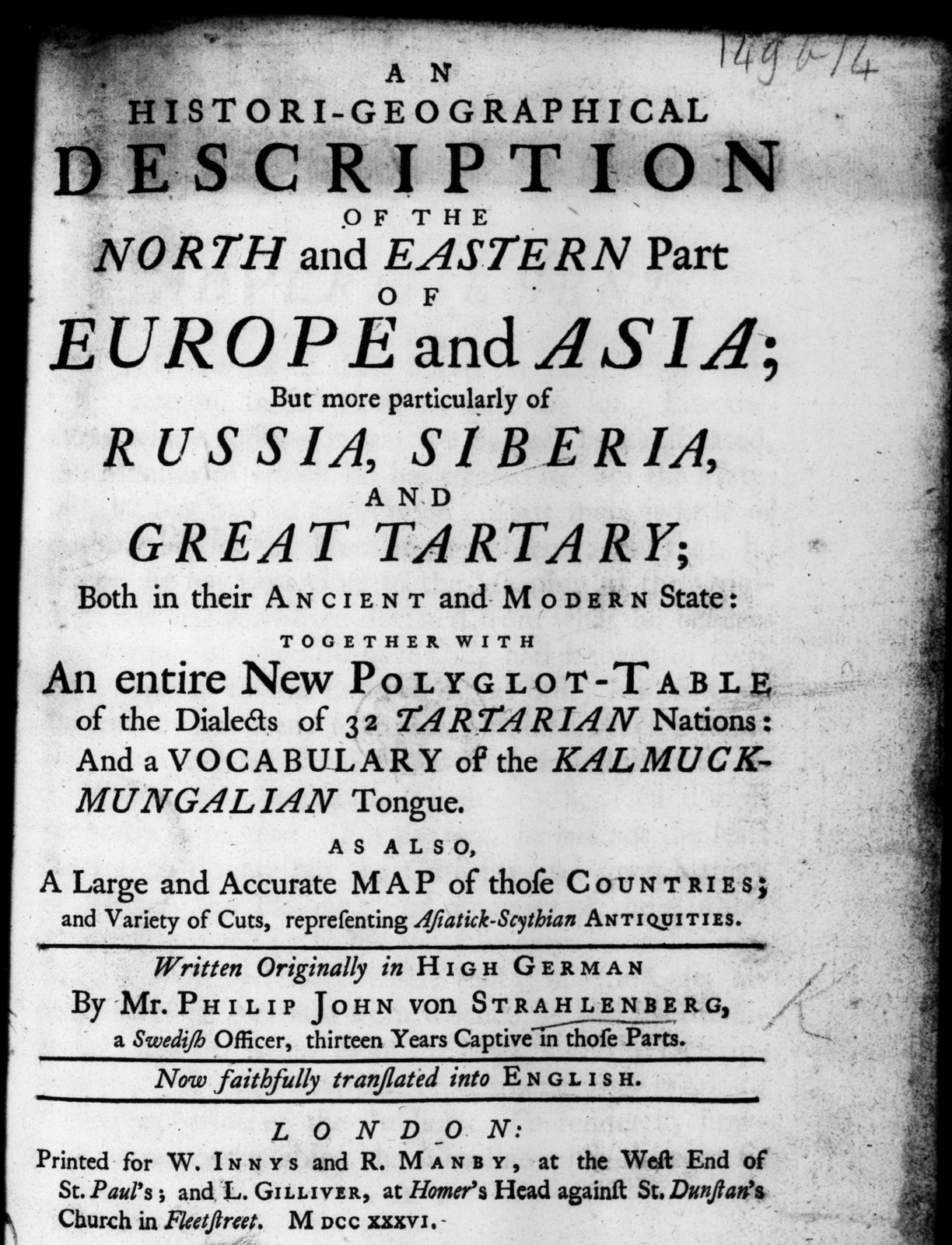
The entry "Koræiki" from the anonymous 1736 London translation of Das Nord- und Ostliche Theil von Europa und Asia (Stockholm, 1730) by Philip Johan von Strahlenberg (1676–1747), a Swedish officer captured at Poltava who spent over a decade as a prisoner in Siberia. Strahlenberg reports that Russian traders exchanged the mushroom Muchumor for Koryak furs, that wealthy Koryaks boiled it and drank the liquor at feasts, and that the poor drank the urine of intoxicated guests to share the effect. The full entry is hosted from pp. 396–97 of the 1736 printing.
Read more
The History of Kamtschatka, and the Kurilski Islands, with the Countries Adjacent
Book, 1764 (English translation; Russian original 1755)

The History of Kamtschatka

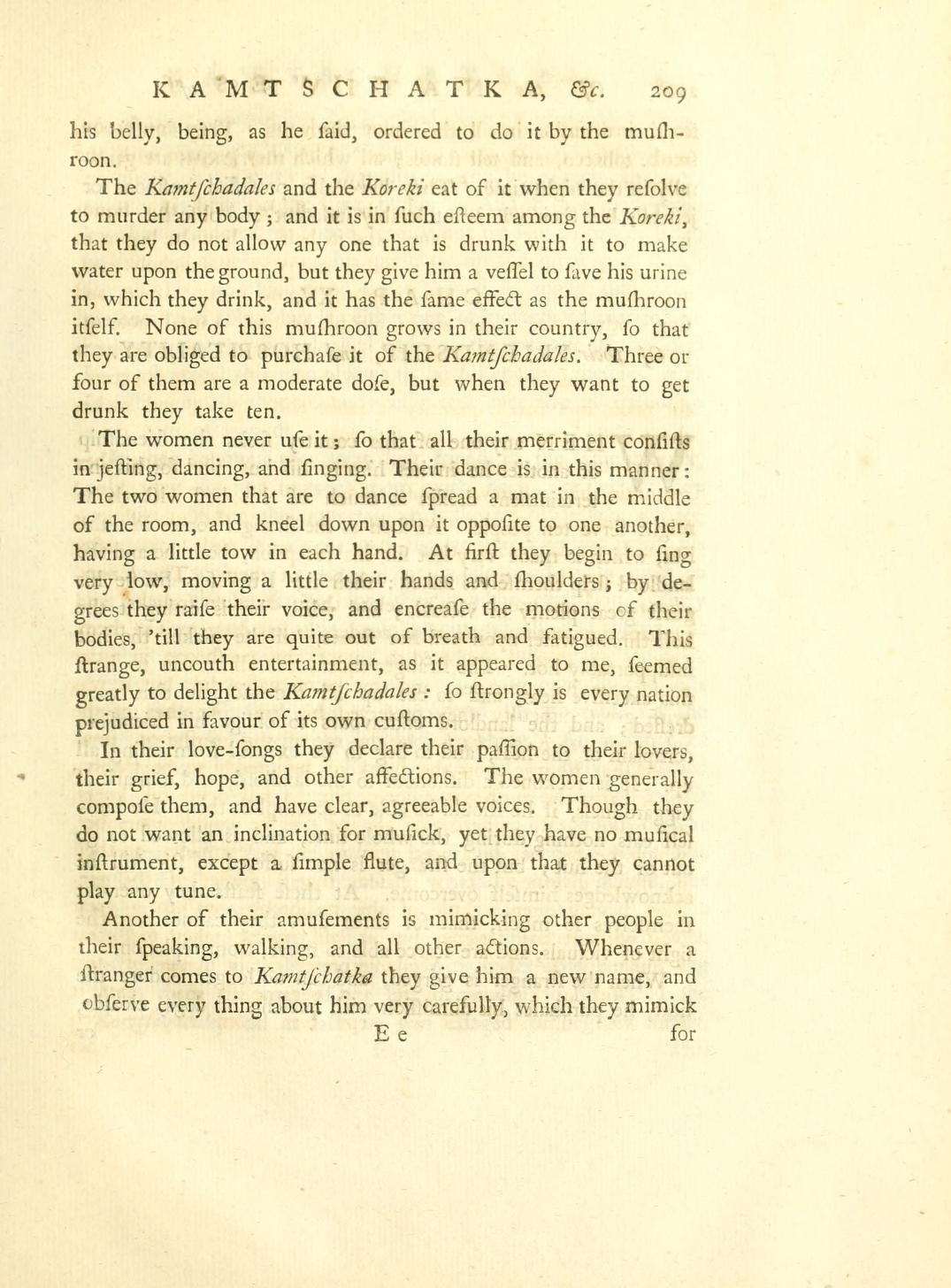
Krasheninnikov's 1764 English translation describes fly-agaric (Amanita muscaria) intoxication in Kamchatka: its effects, use by the Koryak, and the practice of drinking an intoxicated person's urine to prolong inebriation. He covers dose-dependent effects and behavioral consequences including murderous impulses.

Read more
Franz Xaver Veigl on Ayahuasca in Maynas
Source, c. 1768–1785 (exact date unclear)

Franz Xaver Veigl on Ayahuasca in Maynas

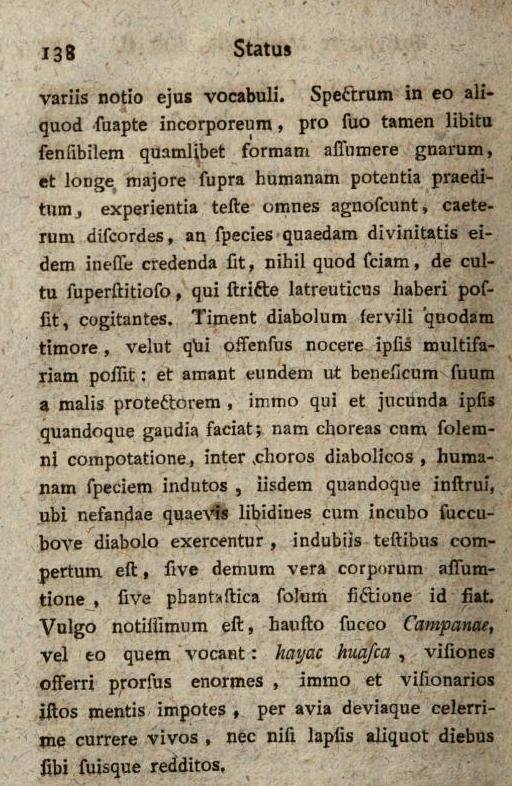
Franz Xaver Veigl, a German Jesuit who worked in the mission province of Maynas in the upper Amazon until the Jesuits were expelled in 1768, describes healers and visionary drinks there. He writes that people who drank "hayac huasca" saw "absolutely enormous visions" and seemed to travel far away, and, like other missionaries of his time, he treats this as dealings with the devil. English translation of Latin passages from his account of Maynas.

Read more
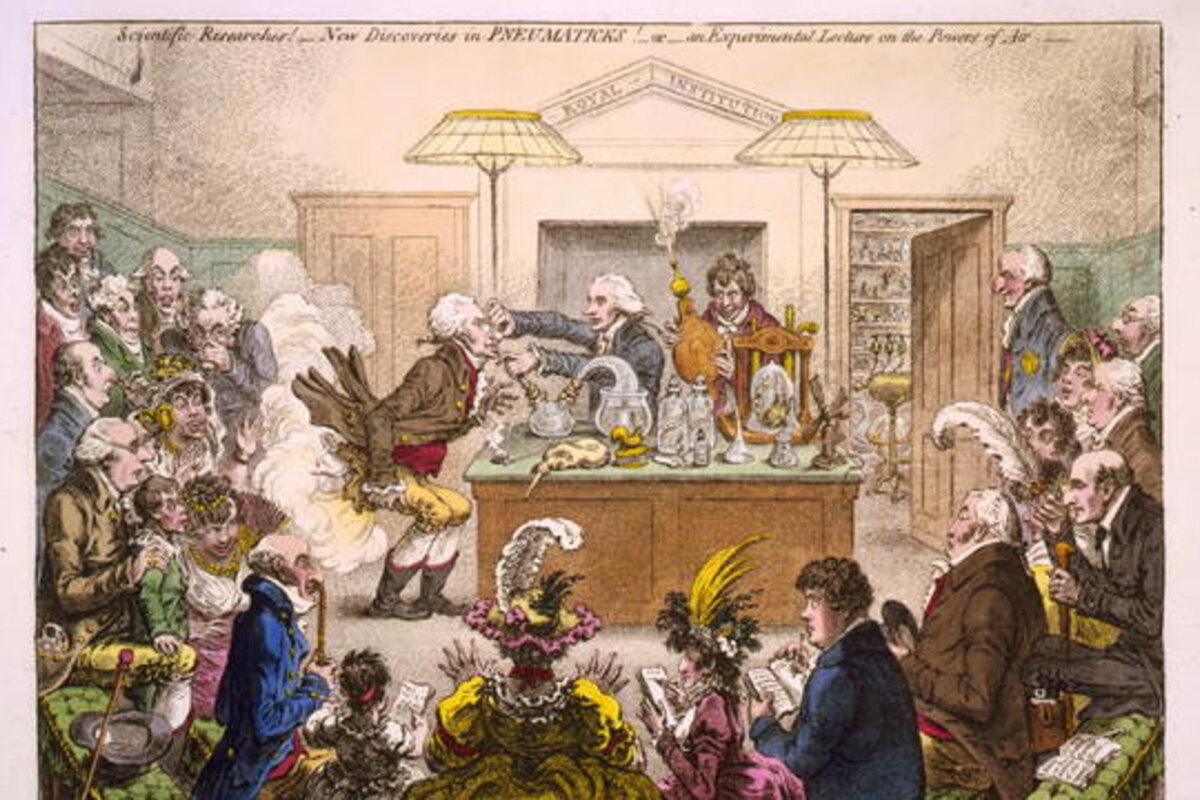
Researches, Chemical and Philosophical; Chiefly Concerning Nitrous Oxide
Source, 1800

Researches, Chemical and Philosophical; Chiefly Concerning Nitrous Oxide

Humphry Davy's account of breathing nitrous oxide at Thomas Beddoes's Pneumatic Institution in Bristol in 1799, from the fourth part of his Researches. The excerpt gives Davy's own experiments, including the session that ended with "Nothing exists but thoughts!", and the reports he collected from Robert Southey, Peter Roget, Samuel Taylor Coleridge, and Thomas Wedgwood.

Read more
Fly Agaric among the Koryaks in Langsdorff's Bemerkungen
Source, 1812

Fly Agaric among the Koryaks in Langsdorff's Bemerkungen

A Kamchatka note on mushroom trade and intoxication

Langsdorff's 1812 German voyage account records fly agaric in Koryak trade with Russians and Kamchadals, noting in a footnote that Koryaks preferred it to brandy as a stupefying or intoxicating substance.

Read more
Paricá among the Mura in Spix and Martius's Reise in Brasilien
Source, 1831

Paricá among the Mura in Spix and Martius's Reise in Brasilien

A German travel account of Amazonian snuff, ceremony, and intoxication

Spix and Martius's 1831 German travel narrative describes paricá among the Mura, including preparation from dried seeds, ceremonial use, insufflation through tubes, and comparison with fly agaric intoxication.

Read more
Hashish and Mental Alienation
Source, 1845

Hashish and Mental Alienation

Moreau de Tours on dawamesc, self-experiment, and experimental psychiatry

Selected passages from Moreau de Tours's 1845 psychiatric treatise on hashish, including his insistence on personal experience, description of dawamesc preparation and dosing, and claim that hashish offered a unique experimental route into the psychology of madness.

Read more
Fly Agaric and Hashish in Die narkotischen Genussmittel
Source, 1855

Fly Agaric and Hashish in Die narkotischen Genussmittel

Ernst von Bibra's German comparative account of Amanita and Cannabis

Selective excerpts from Ernst von Bibra's 1855 German survey of narcotic Genussmittel, focused on fly agaric and hashish. The passages show a mid-century comparative framework linking Amanita, Cannabis, opium, alcohol, travel accounts, chemistry, and differential effects across persons and places.

Read more
The Hasheesh Eater
Source, 1857

The Hasheesh Eater

Fitz Hugh Ludlow's account of his cannabis use as a young man in Poughkeepsie and at Union College, published anonymously in 1857 when he was twenty-one. In this excerpt (pages 18–26) he finds Cannabis indica at a local apothecary's shop, reads about it in the Dispensatory, and takes his first doses.

Read more
Ayahuasca in Villavicencio's Geografía de la República del Ecuador
Source, 1858

Ayahuasca in Villavicencio's Geografía de la República del Ecuador

An 1858 Ecuadorian account of ayahuasca visions and divination

Manuel Villavicencio's 1858 geography gives an early Spanish account of ayahuasca among Indigenous groups of eastern Ecuador, including divination, warfare, illness diagnosis, visionary effects, and a first-person report of his own experience.

Read more
The Seven Sisters of Sleep: Popular History of the Seven Prevailing Narcotics of the World
Book, 1860

The Seven Sisters of Sleep (Amanita chapter)

Popular History of the Seven Prevailing Narcotics of the World

One of seven chapters in a British mycologist's popular survey of the world's narcotics, this one on Amanita muscaria. Cooke gathers the earlier Siberian accounts of Krasheninnikov, Gmelin and Pallas, and describes the preparation, the staged effects, and the urine-drinking practice.

Read more
Le Gabon (Deuxième partie)
Source, 1865

Le Gabon

A French naval physician's 1865 travel account surveys Gabon's food plants and condiments, describing iboga as a stimulant and aphrodisiac used by paddlers on long canoe trips. He gives it the genus name 'taberna-ventricosa,' later corrected by Baillon.

Read more
Caapi and Niopo in “On Some Remarkable Narcotics of the Amazon Valley and Orinoco”
Source, c. 1870; published 1908

Caapi and Niopo in “On Some Remarkable Narcotics of the Amazon Valley and Orinoco”

Richard Spruce on ayahuasca, yopo/paricá, and Amazonian medicine-men

Richard Spruce's nineteenth-century account of caapi, aya-huasca, niopo, and paricá, based on field observations in the Uaupés, Orinoco, Rio Negro, Napo, and Pastasa regions. The excerpt records plant identifications, preparation methods, visual effects, ceremonial uses, and the role of payes in curing and divination.

Read more
Tent Life in Siberia
Book, 1870

Tent Life in Siberia

An American telegraph surveyor's account of Koryak men intoxicated on fly-agaric at a wedding celebration in northern Kamchatka. Kennan describes the mushroom's price, preparation, etiquette of serving, and the trade dynamics between Russian merchants and Koryak consumers.

Read more
The Anaesthetic Revelation and the Gist of Philosophy
Source, 1874

The Anaesthetic Revelation and the Gist of Philosophy

Benjamin Paul Blood's privately printed 1874 pamphlet, the source of the phrase "anaesthetic revelation." Hosted here is the section in which Blood, after nearly fourteen years of experiments with anaesthetics, describes the insight that comes at the moment of "coming to." William James reviewed the pamphlet that year and later quoted this passage in The Varieties of Religious Experience.

Read more
Review of The Anaesthetic Revelation and the Gist of Philosophy
Source, 1874

Review of The Anaesthetic Revelation and the Gist of Philosophy

William James's unsigned review of Blood's pamphlet, published in the Atlantic Monthly in November 1874, eight years before his own nitrous oxide experiments. James summarizes Blood's claims at length and judges the pamphlet "thoroughly original and very suggestive," if less important than its author believed.

Read more
Note on Nitrous Oxide, from “On Some Hegelisms”
Academic Article, April 1882

Note on Nitrous Oxide, from “On Some Hegelisms”

The note William James added to his essay "On Some Hegelisms" in Mind (1882), reporting nitrous oxide experiments he made after reading Blood's pamphlet. He describes a sense of metaphysical illumination and reconciliation of opposites that fades on recovery into "a few disjointed words and phrases." James reprinted the note in The Will to Believe (1897), and Charles Tart excerpted it in 1969 as "Subjective Effects of Nitrous Oxide."

Read more
Ueber Anhalonium Lewinii
Academic Article, 1888

On Anhalonium Lewinii

Berlin pharmacologist Louis Lewin (1850–1929) reports on "Muscale Buttons" received from Parke, Davis & Co. during a visit to the United States in 1887. The botanist Paul Hennings identified the dried cactus as a new species and named it Anhalonium Lewinii after him, and Lewin describes a crude base he called anhalonine and its strychnine-like convulsant effects in frogs, pigeons and rabbits. Hosted here are the introduction, the preliminary chemistry, and the full section on the drug's effects, with the historical survey of cacti omitted.

Read more
Academic Article, 1893

Consciousness under the Influence of Cannabis Indica

The Yale psychologist Edward Wheeler Scripture takes an alcoholic extract of cannabis to test the common claim that it stretches time and space. He reports strong fluctuations of attention and a sense that objects and events had become remote, and compares these with laboratory findings on attention.

Read more
Anhalonium Lewinii (Mescal Buttons): A Study of the Drug, with Especial Reference to its Physiological Action upon Man, with Report of Experiments
Academic Article, September 16, 1895

Anhalonium Lewinii (Mescal Buttons)

A Study of the Drug, with Especial Reference to its Physiological Action upon Man, with Report of Experiments

Prentiss and Morgan conducted the first American clinical study of peyote at Columbian University on buttons supplied by ethnologist James Mooney. They recorded physiological effects alongside subjects' first-person accounts of visions, including kaleidoscopic colors and dissociative experiences.

Read more
The Mescal Plant and Ceremony
Academic Article, January 15, 1896

The Mescal Plant and Ceremony

An account of the Kiowa and Comanche peyote ceremony by ethnologist James Mooney, published in the Therapeutic Gazette in 1896. Drawing on field observation and participation since 1891, Mooney describes the all-night rite, dosages, and cases including his interpreter Paul Setkopti and leader Quanah Parker.

Read more
Remarks on the Effects of Anhelonium Lewinii (the Mescal Button)
Academic Article, December 5, 1896

Effects of Anhelonium Lewinii

S. Weir Mitchell's account of his own peyote self-experiment on May 24, 1896, read before the American Neurological Society. Mitchell describes detailed visions and includes a second self-experiment by a colleague, Dr. Eshner, with physiological notes and subjective observations.

Read more
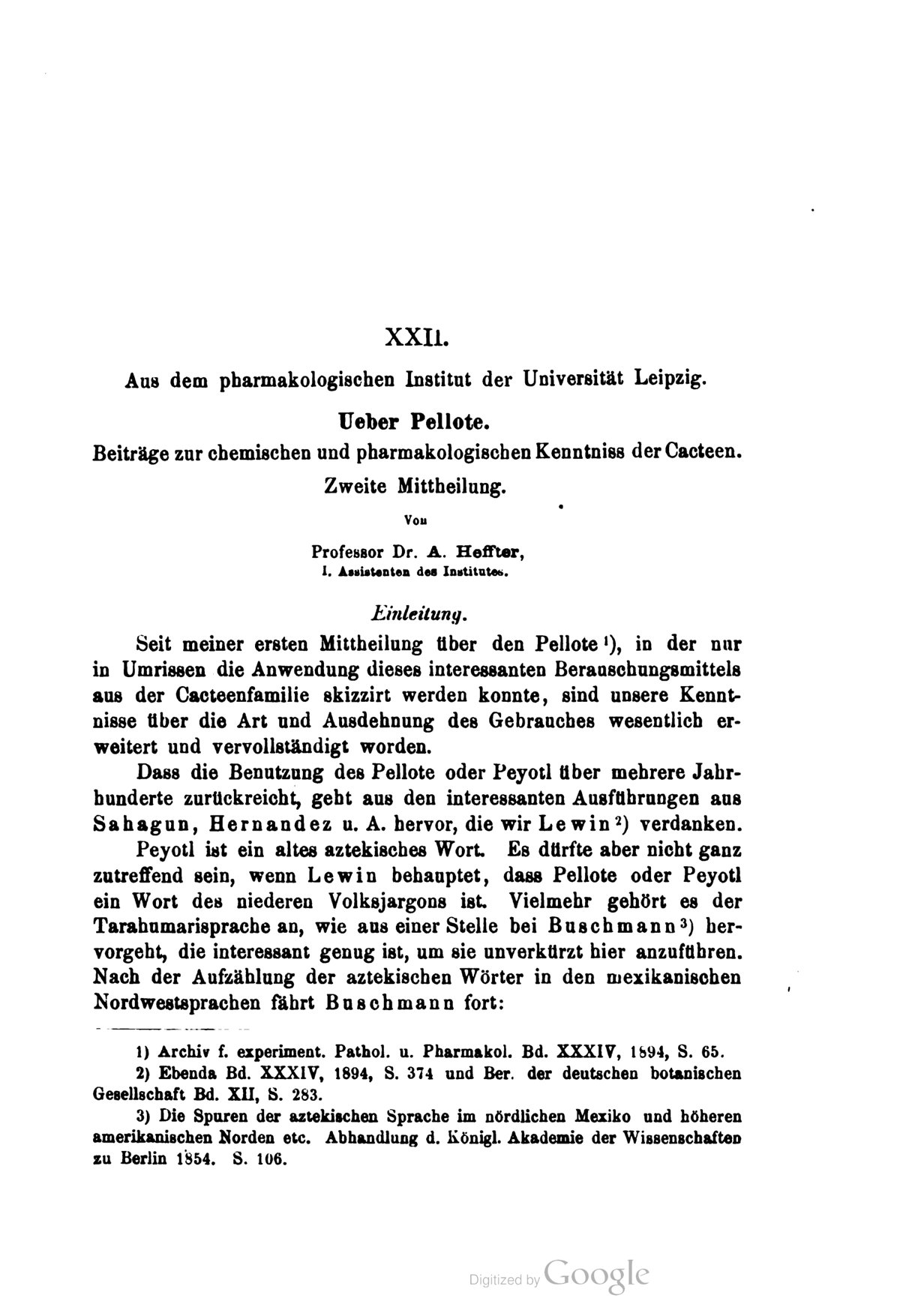
Ueber Pellote. Beiträge zur chemischen und pharmakologischen Kenntniss der Cacteen. Zweite Mittheilung
Academic Article, 1898

On Pellote (Second Communication)

Leipzig pharmacologist Arthur Heffter (1859–1925) reports his separation of five alkaloids from mescal buttons, among them mescaline ("Mezcalin"), and a series of self-experiments made between June and November 1897. Testing the whole drug, its resin, the mixed alkaloids and each isolated base in turn, he found that 0.15 g of mescaline hydrochloride alone reproduced the visions, slowed pulse, dilated pupils and loss of time sense produced by the cactus. Hosted here are the description of mescaline and its salts and the whole of section VI on the drug's action in humans.

Read more
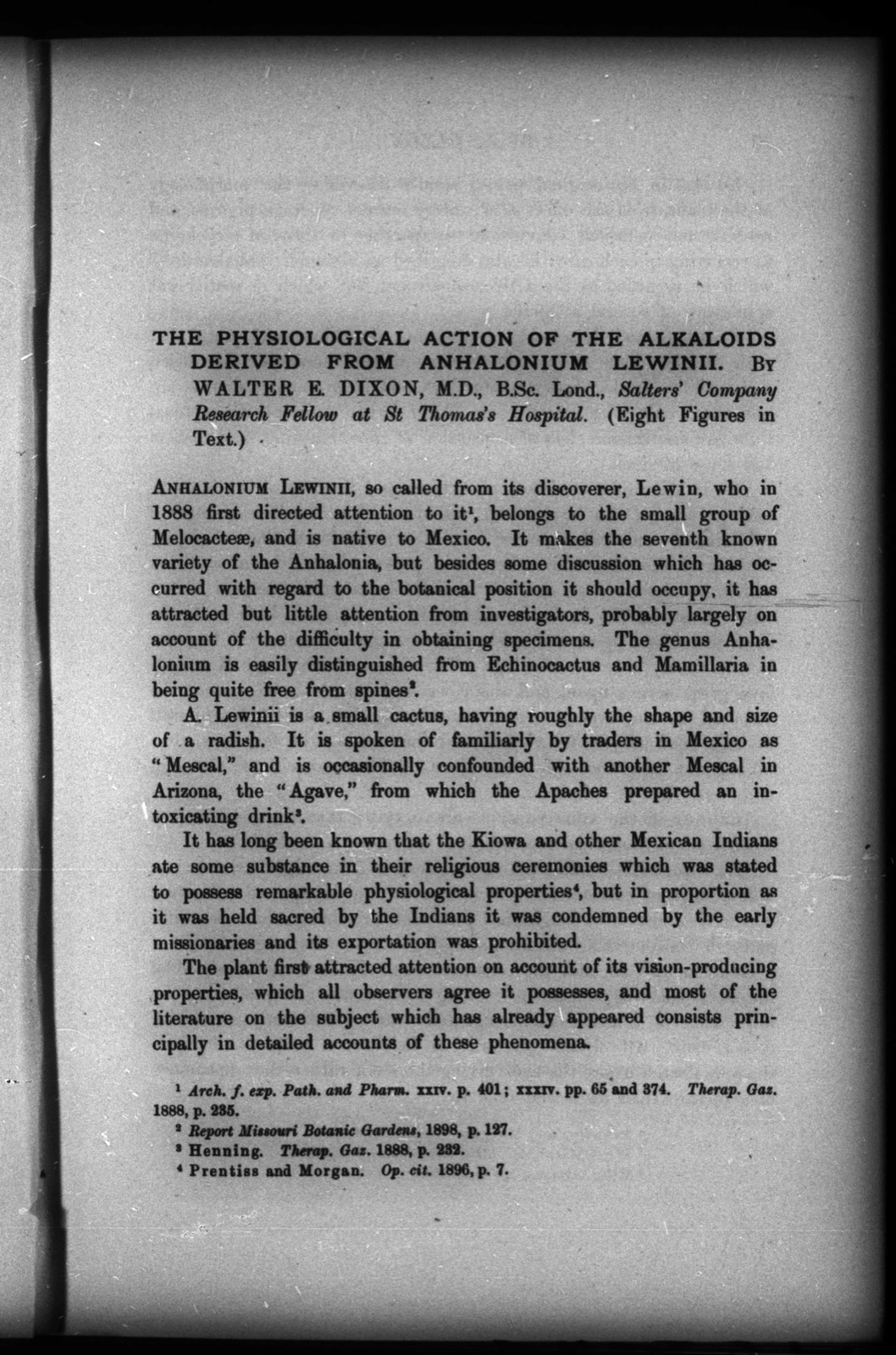
The Physiological Action of the Alkaloids Derived from Anhalonium Lewinii
Academic Article, September 1899

Physiological Action of Anhalonium Alkaloids

A pharmacologist at St Thomas's Hospital reports systematic experiments on Anhalonium alkaloids using frogs, cats, dogs, and rabbits, combined with self-experimentation. Dixon's account is more clinically restrained than Weir Mitchell's or Ellis's but adds music-color synaesthesia and comparisons to cannabis and strychnine.

Read more
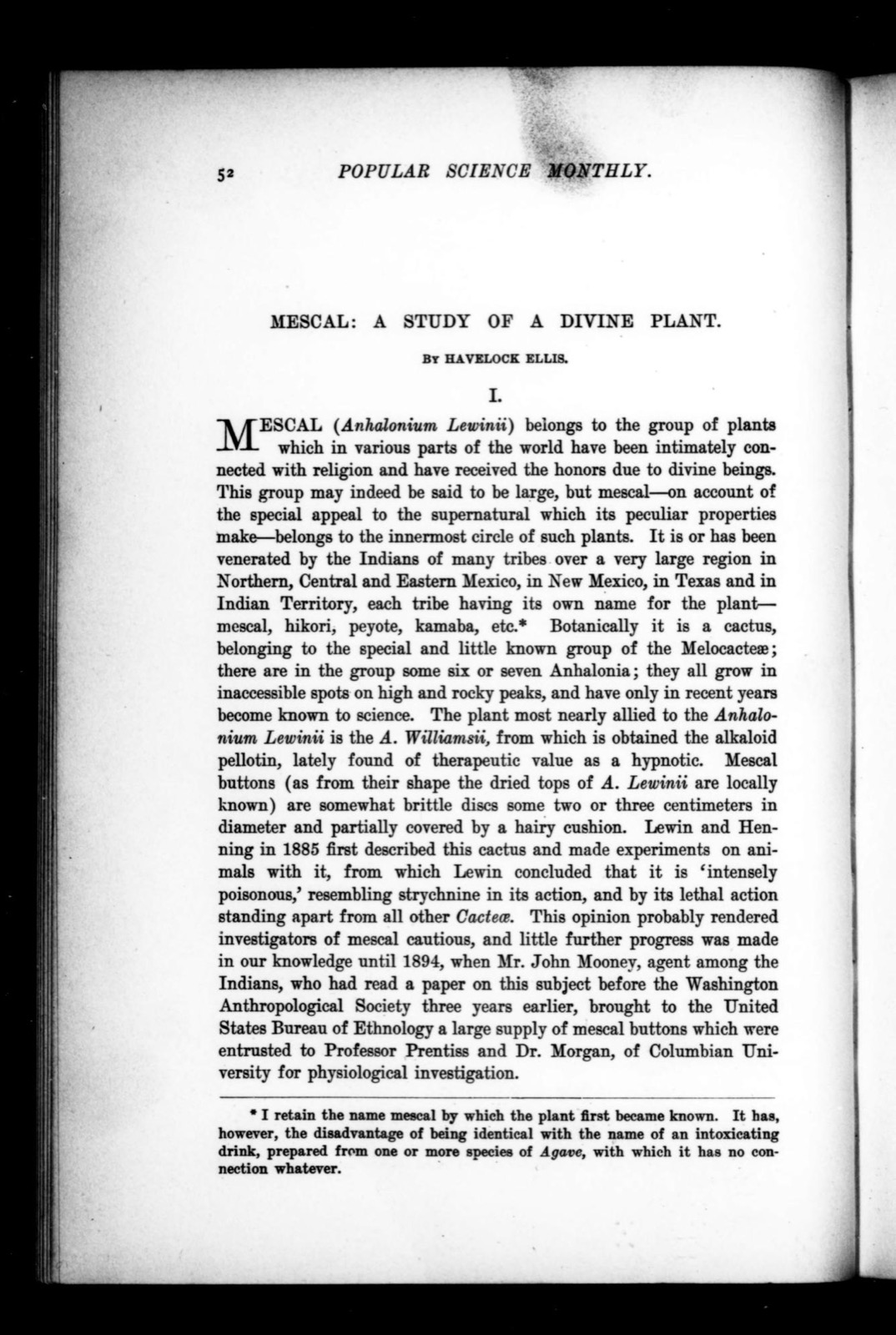
Mescal: A Study of a Divine Plant
Academic Article, May 1902

Mescal: A Study of a Divine Plant

A Study of a Divine Plant

Havelock Ellis's account of his own peyote self-experiment, conducted on Good Friday 1897 in his London chambers. Written for a general scientific audience, it situates his diary of jewel-like visions within the clinical work of Prentiss, Morgan, and Weir Mitchell, alongside Indigenous religious use of the plant.

Read more
Nitrous Oxide and the Anaesthetic Revelation in The Varieties of Religious Experience
Source, 1902

Nitrous Oxide and the Anaesthetic Revelation in The Varieties of Religious Experience

From the lecture on mysticism in William James's Gifford Lectures, delivered in Edinburgh in 1901–2. James argues that nitrous oxide and ether show "our normal waking consciousness" to be only one type among many, then quotes Blood and J. A. Symonds's chloroform experience. His notes add Xenos Clark's letter on the revelation and an Englishwoman's ether dream.

Read more
The Chukchee: Religion — Intoxicants
Book, 1907 (Religion, part 2 of The Chukchee, published 1904-1909)

The Chukchee (on fly-agaric)

Religion — Intoxicants

An ethnographer's account of fly-agaric use among the Chukchee and Koryak, including dosage, preparation, three stages of intoxication, the 'spirits of fly-agaric,' and urine-drinking to extend the effect. The text also records the mushroom's place in Chukchee myth.

Read more
Anaesthetics Antient and Modern: An Historical Sketch of Anaesthesia
Source, Undated (c. 1907–1910)

Anaesthetics Antient and Modern

An Historical Sketch of Anaesthesia

An illustrated history of anaesthesia issued by the London drug firm Burroughs Wellcome & Co., which closes by advertising its own 'Wellcome' brand chloroform. Hosted here are the chapters on nitrous oxide, ether, and chloroform, covering Horace Wells's 1844 self-experiment, the ether demonstrations of William Morton and Charles Jackson, and James Young Simpson's 1847 chloroform trial.

Read more
A Pluralistic Mystic
Source, 1910

A Pluralistic Mystic

William James's last published essay, an appreciation of Benjamin Paul Blood that appeared in the Hibbert Journal in July 1910, weeks before James died. James quotes Blood's pamphlets and letters at length and traces how the anaesthetic revelation, which James first read as monism, became for Blood the basis of a pluralist philosophy.

Read more
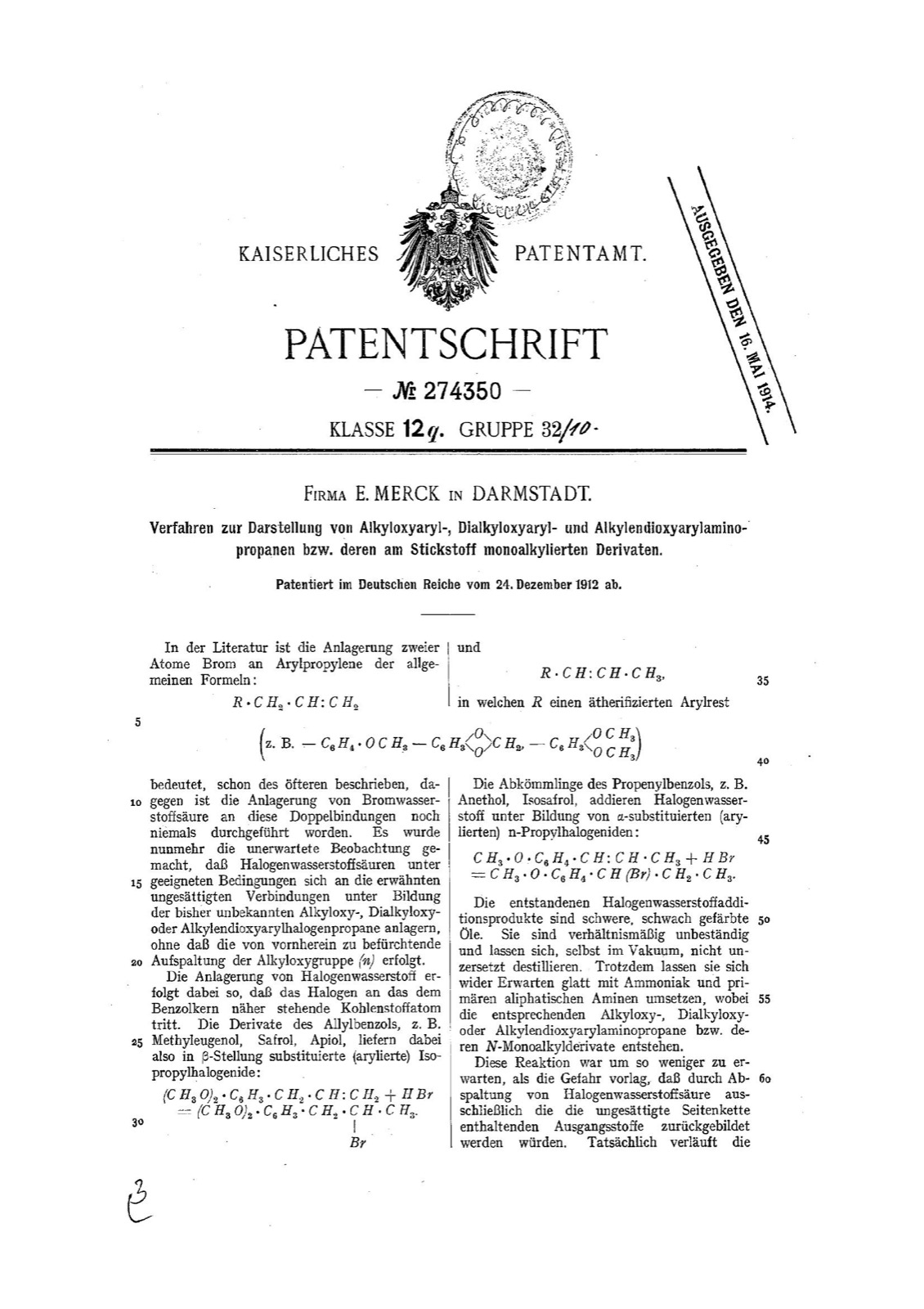
German Reich Patent No. 274350: Process for the Preparation of Alkyloxyaryl-, Dialkyloxyaryl- and Alkylenedioxyarylaminopropanes (Firm E. Merck, Darmstadt)
Source, Patented from 24 December 1912; specification published 1914

Merck Patent DE 274350

Process for the Preparation of Alkyloxyaryl-, Dialkyloxyaryl- and Alkylenedioxyarylaminopropanes (Firm E. Merck, Darmstadt)

German Reich Patent No. 274350 (1912) describes arylaminopropane synthesis from safrole. Example 4 yields MDMA by heating a brominated intermediate with methylamine—the earliest documented synthesis. The patent claims MDMA only as an unnamed chemical intermediate toward unspecified therapeutic compounds, not as a substance of interest itself.

Read more
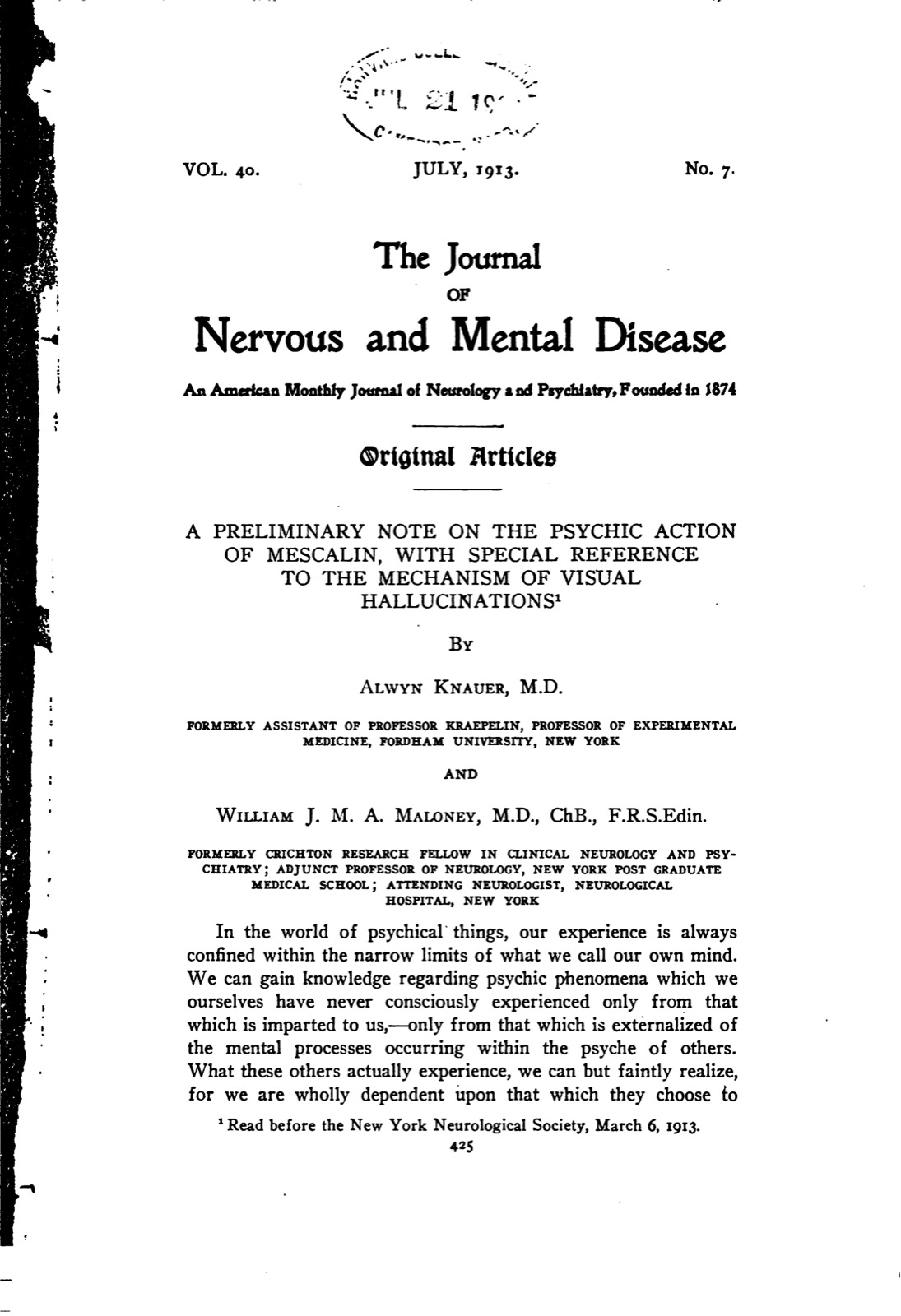
A Preliminary Note on the Psychic Action of Mescalin, with Special Reference to the Mechanism of Visual Hallucinations
Academic Article, July 1913

Psychic Action of Mescalin

New York psychiatrists inject themselves and colleagues with pure mescaline sulphate in twenty-three experiments to model insanity's visual hallucinations. Subjects' reports include specifics—a glass-screen head, the 'mosque of Omar'—and the authors propose a five-level theory of hallucinations versus images.

Read more
An Aztec Narcotic (Lophophora williamsii)
Academic Article, July 1915

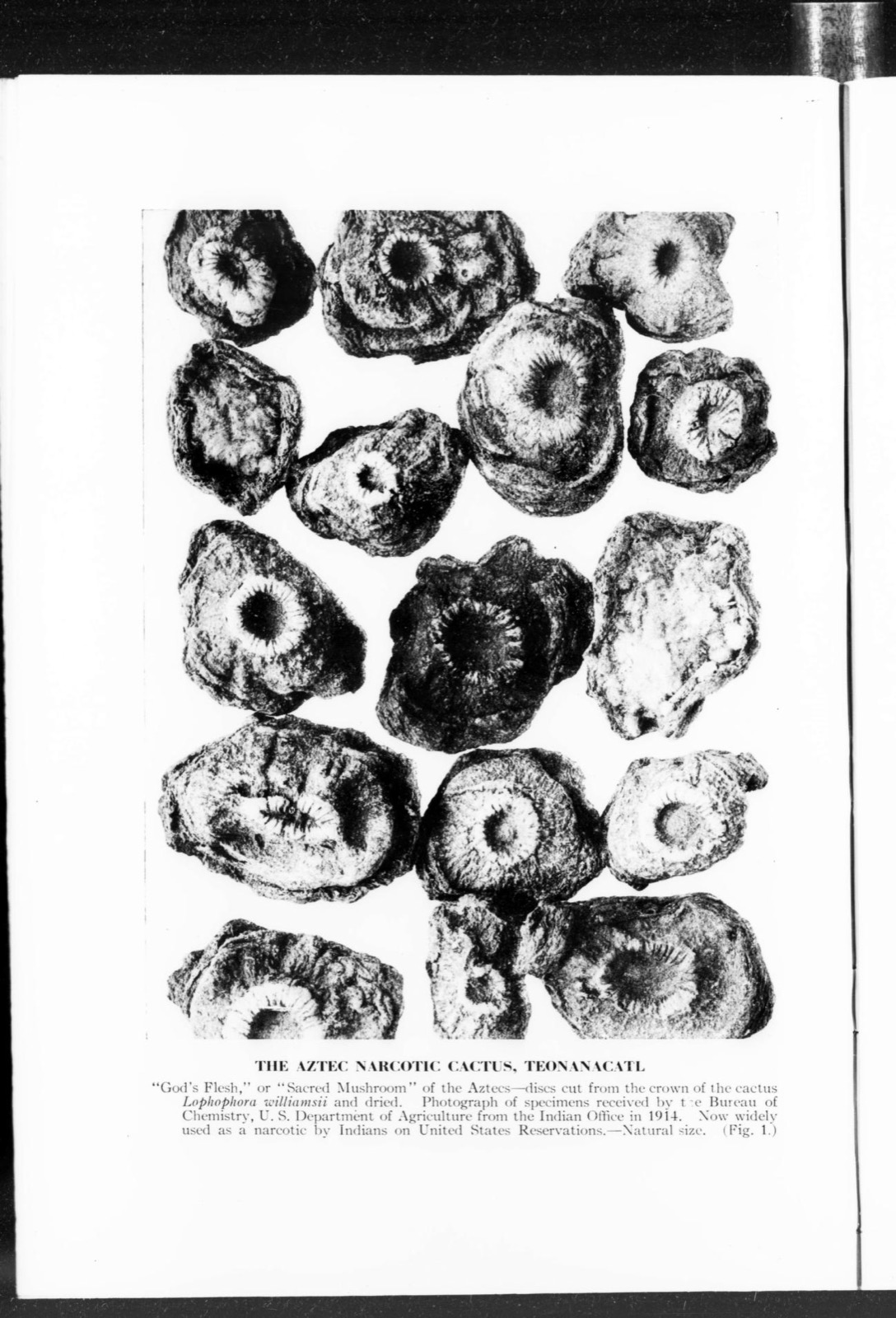
An Aztec Narcotic

Safford, a USDA botanist, analyzes peyote's physiological effects and Native American ceremonial use in 1915. The article incorporates sworn testimony from Menominee, Omaha, and Winnebago members of the Sacred Peyote Society.

Read more
Koryak Texts
Book, 1917

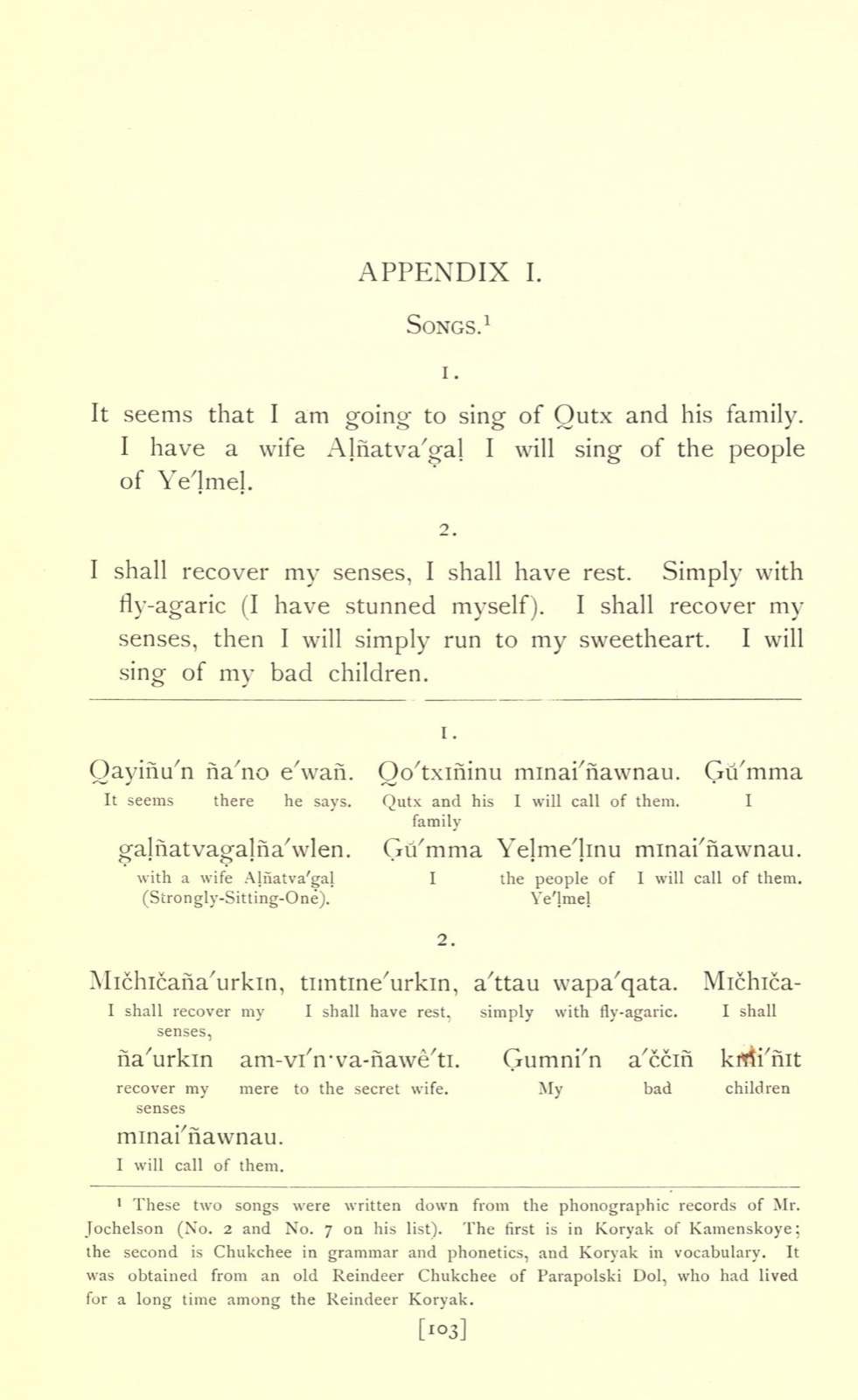
Koryak Texts (Introduction and fly-agaric song)

Excerpts from Bogoras's Koryak Texts, including the introduction and two songs transcribed from phonograph recordings. The second song, sung by an elderly Chukchee man, records an Indigenous voice describing fly-agaric use for recovering consciousness.

Read more
Testimony of Gertrude Bonnin (Zitkála-Šá) against Peyote, House Indian Affairs Subcommittee Hearings on H.R. 2614
Testimony, February 22, 1918

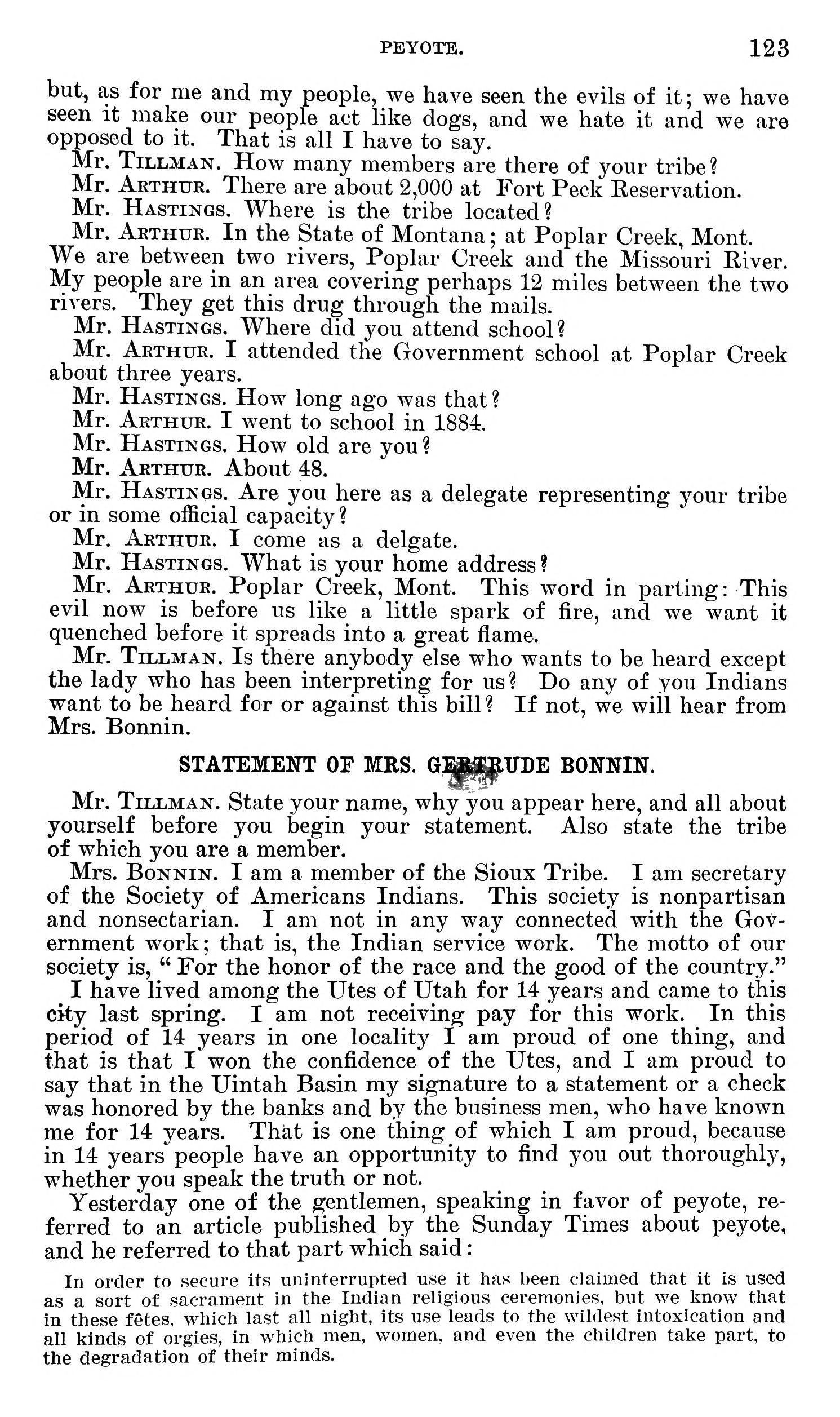
Zitkála-Šá Peyote Testimony (1918)

Gertrude Simmons Bonnin (Zitkála-Šá, 1876–1938), the Yankton Dakota writer and secretary of the Society of American Indians, testified against peyote on February 22, 1918, before the House Indian Affairs subcommittee considering H.R. 2614, a bill to prohibit peyote among Indians. Drawing on her fourteen years among the Utes of the Uintah Basin, she described deaths, sexual misconduct, and fraud by the peyote missionary Peter Phelps, and she disputed the ethnologist James Mooney (1861–1921), who had ridiculed her newspaper photograph the day before. The record hosts her statement and cross-examination in full, her additional statement, the signed statements she co-authored, and the passages by Mooney and Cleaver Warden that answer her.

Read more
Articles of Incorporation of the Native American Church
Manuscript, October 10, 1918

Native American Church Articles of Incorporation (1918)

Filed with the Oklahoma Secretary of State on October 10, 1918, these articles incorporated the Native American Church as a religious and benevolent association. The purpose sections frame peyote as a Christian sacrament, giving the pan-tribal peyote religion legal standing.

Read more
Peyote: Hearings Before a Subcommittee of the Committee on Indian Affairs, House of Representatives, on H.R. 2614
Testimony, February–March 1918

Peyote Hearings, H.R. 2614 (1918)

Hearings Before a Subcommittee of the Committee on Indian Affairs, House of Representatives, on H.R. 2614

A subcommittee of the House Committee on Indian Affairs held February-March 1918 hearings on H.R. 2614, a bill to prohibit peyote use in Indian Country. Witnesses included ethnologist James Mooney, Osage chief Fred Lookout, Omaha ethnographer Francis La Flesche, Arapaho delegate Cleaver Warden, and Cheyenne-Arapaho Paul Boynton.

Read more
Book, 1919

A gunner under ether, 1918

From Smashing Through "the World War" with Fighting Battery C

An American soldier who served in World War I describes being hit by a shell in July of 1918 and his subsequent experience with ether, having "peep[ed] behind the veil, which separates life from death."

Read more