Texts

Browse filters
Active filters:Text xClear all
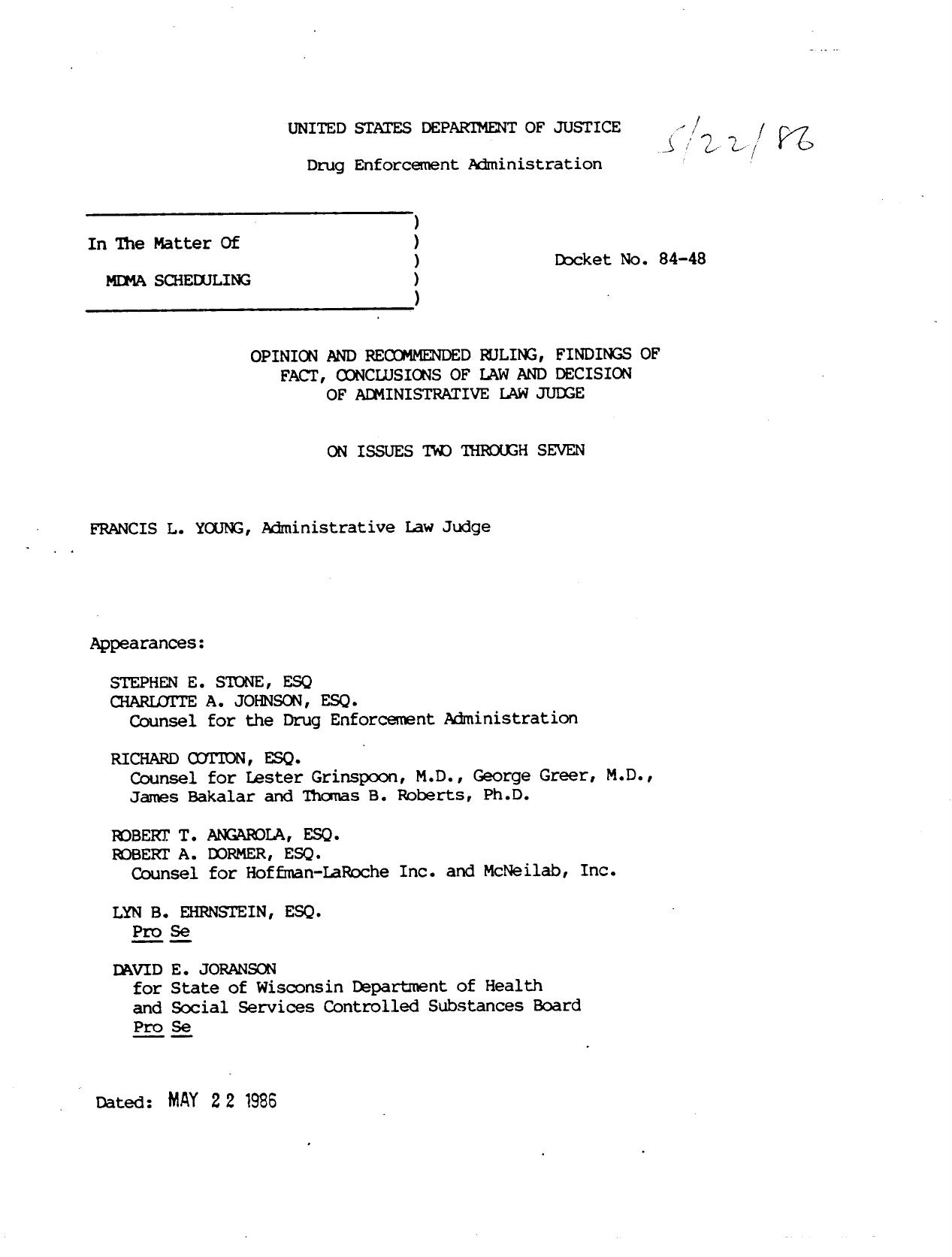
Opinion and Recommended Ruling, Findings of Fact, Conclusions of Law, and Decision of Administrative Law Judge (MDMA Scheduling)
Source, May 22, 1986

In re MDMA Scheduling (ALJ Young opinion)

After seventeen days of hearings, Administrative Law Judge Francis L. Young recommends placing MDMA in Schedule III rather than Schedule I. He finds currently accepted medical use and accepted safety for medical supervision based on psychiatrists' testimony, animal lethality studies, and clinical experience with supervised psychotherapy.

Read more
Grinspoon v. Drug Enforcement Administration
Source, September 18, 1987

Grinspoon v. DEA

The First Circuit vacates the DEA's rule placing MDMA in Schedule I, holding the Administrator's interpretation of 'accepted medical use' was contrary to Congress's intent. Dr. Grinspoon, a Harvard psychiatrist seeking to research MDMA therapeutically, brought the appeal after the Administrator overruled the ALJ's Schedule III recommendation.

Read more
Employment Division, Department of Human Resources of Oregon v. Smith
Source, April 17, 1990

Employment Division v. Smith

The Supreme Court holds that Oregon may deny unemployment benefits to two Native American Church members dismissed for sacramental peyote use, since a neutral criminal drug law requires no religious exemption. Blackmun dissents.

Read more
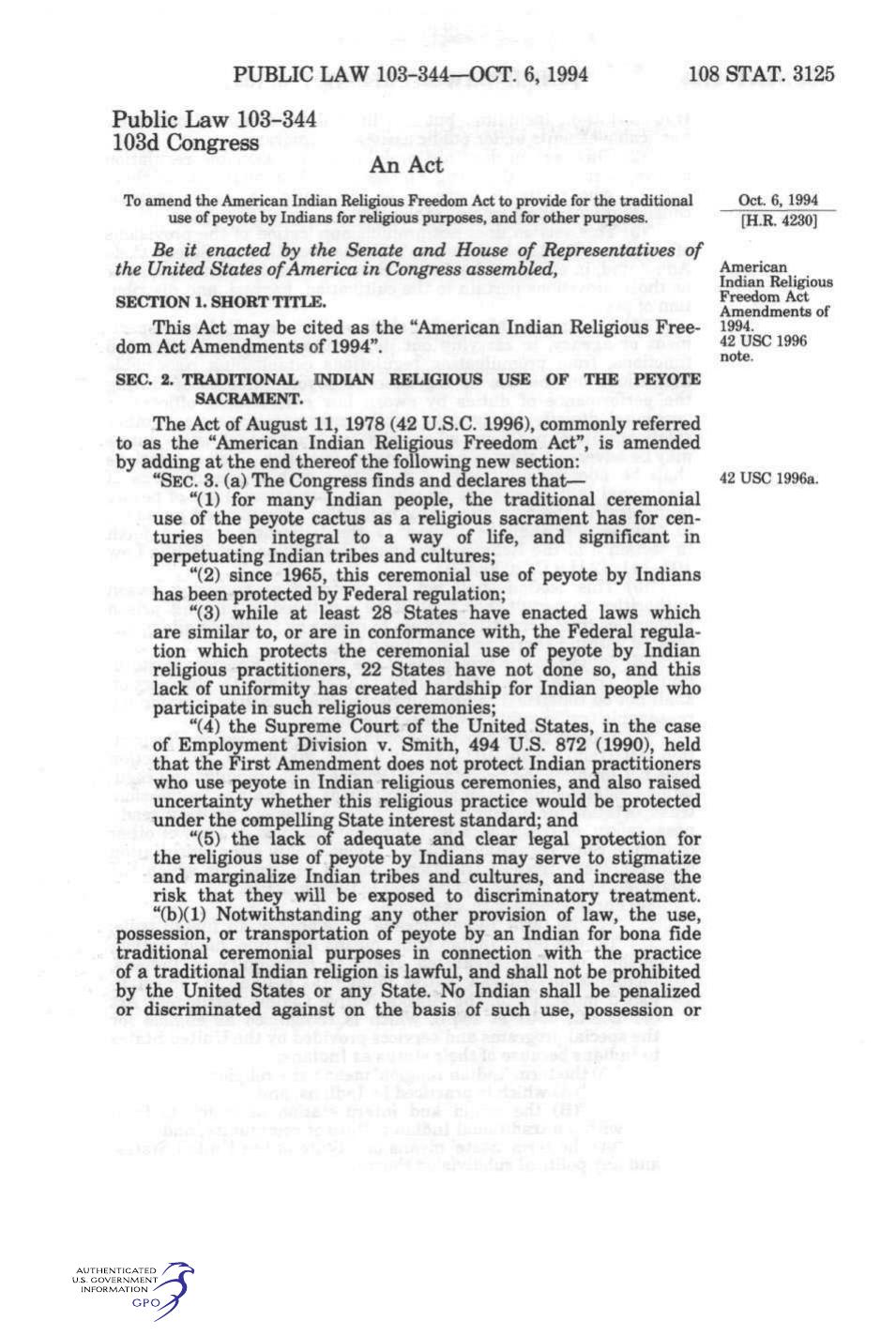
American Indian Religious Freedom Act Amendments of 1994 (Public Law 103-344)
Source, Approved October 6, 1994

AIRFA Amendments of 1994

Congress restored a nationwide exemption for the ceremonial use of peyote by Indians in connection with traditional religions. The statute carves out exceptions for prison, military, and safety-sensitive positions.

Read more
Hallucinogens: An Update (NIDA Research Monograph 146)
Academic Article, 1994

NIDA Research Monograph 146

An Update (NIDA Research Monograph 146)

Proceedings of a 1992 NIDA technical review on hallucinogen research, prompted by rising LSD use among teenagers. Includes Rick Strassman's account of the regulatory process (IRB, DEA, FDA) for his DMT study, the first human hallucinogen study approved since the early 1970s.

Read more
Gonzales v. O Centro Espirita Beneficente Uniao do Vegetal
Source, February 21, 2006

Gonzales v. O Centro

Chief Justice Roberts holds the federal government failed to show a compelling interest justifying its ban on the Uniao do Vegetal church's sacramental use of hoasca (ayahuasca tea with DMT) under the Religious Freedom Restoration Act. The Court rejects the UN Convention argument and upholds the peyote precedent for religious exemptions to the Controlled Substances Act.

Read more
Church of the Holy Light of the Queen v. Mukasey
Source, March 18, 2009

Church of the Holy Light of the Queen v. Mukasey

A federal court ruling applying Gonzales v. O Centro to the Santo Daime church in Oregon, granting the right to import and drink ayahuasca under RFRA. Judge Panner's findings describe the religion's origins, ritual, physiological effects, and the government's health and diversion evidence.

Read more
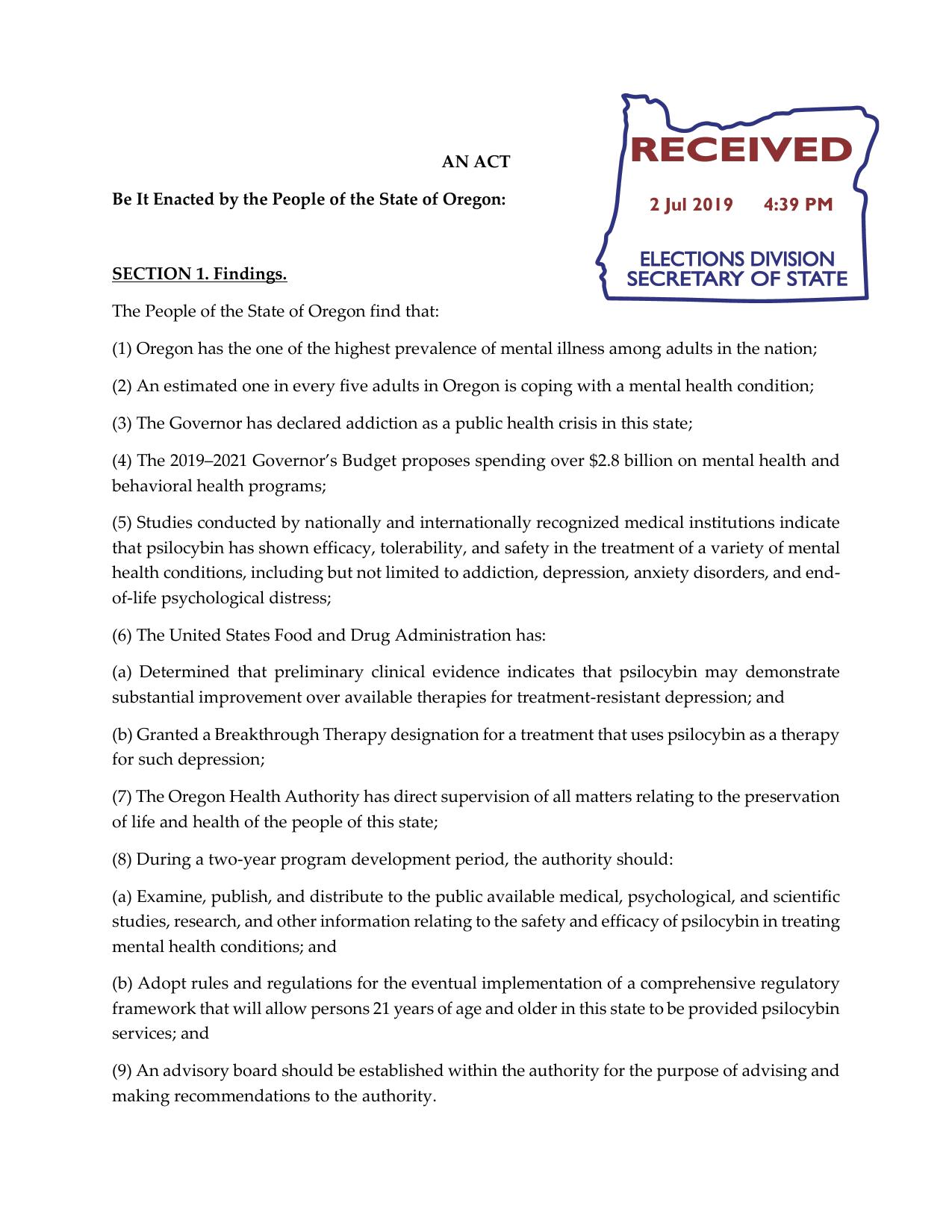
Oregon Psilocybin Services Act (Ballot Measure 109)
Source, Approved by voters November 3, 2020; codified as Oregon Laws 2021, chapter 1

Oregon Measure 109

Oregon's 2020 ballot measure created the first US state-licensed psilocybin services program. The findings cite FDA's breakthrough-therapy designation for depression, and the statute establishes licensed service centers and facilitators rather than unsupervised legalization.

Read more
Psychopharmacologic Drugs Advisory Committee Meeting on Midomafetamine (MDMA) for PTSD: Discussion and Votes
Testimony, June 4, 2024

FDA advisory committee on MDMA, 2024

The transcript of the FDA advisory committee that reviewed Lykos Therapeutics' application for MDMA-assisted therapy for post-traumatic stress disorder. Hosted here are the chair's opening of the committee questions and the two votes: 2 to 9 against finding the drug effective, and 1 to 10 against finding that its benefits outweighed its risks, with each member's stated reasons. Members cited functional unblinding, expectation bias, the many trial participants who had used MDMA before, and reports of misconduct. The FDA declined to approve the application in August 2024.

Read more
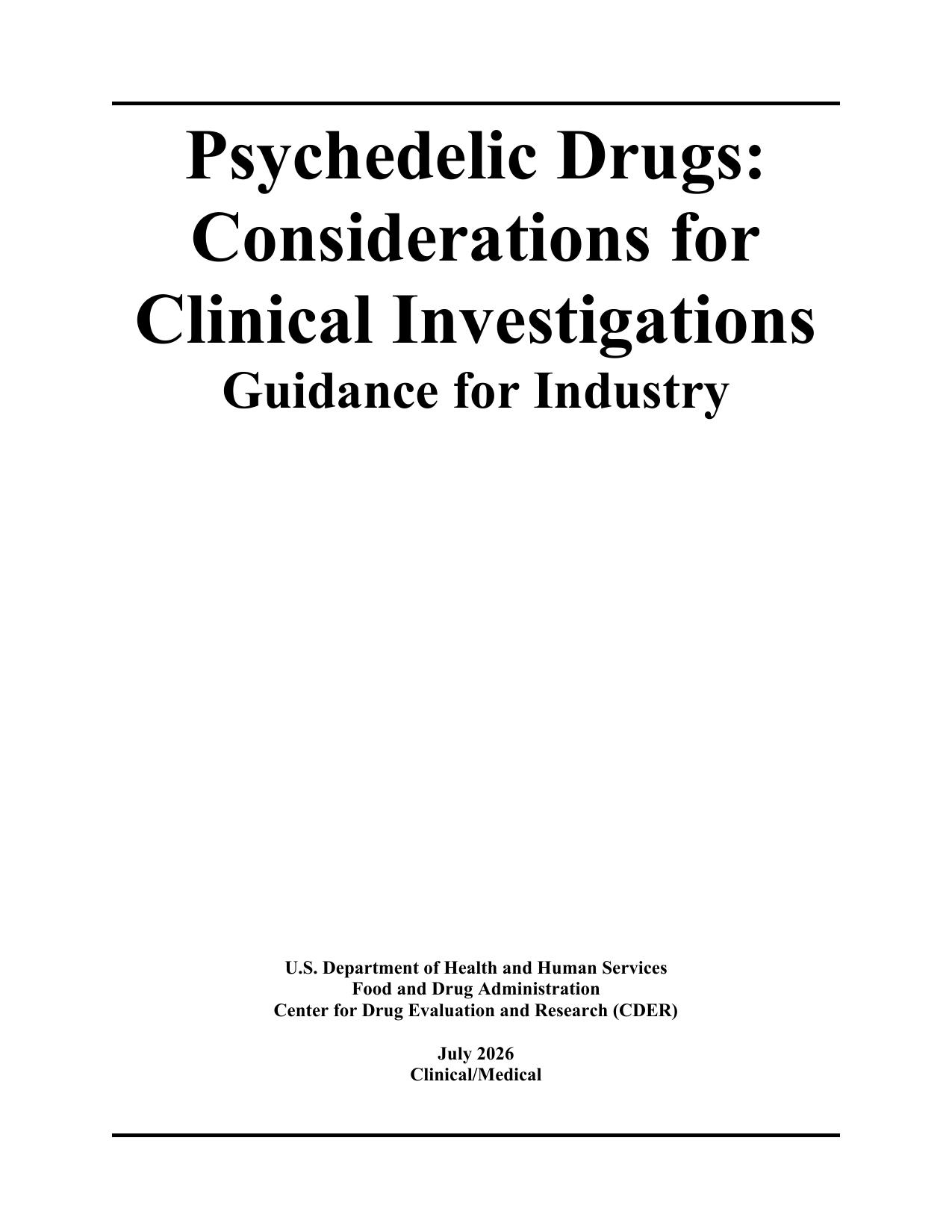
Psychedelic Drugs: Considerations for Clinical Investigations (Guidance for Industry)
Source, July 2026 (finalizing a June 2023 draft)

FDA Psychedelic Drugs Guidance

Considerations for Clinical Investigations (Guidance for Industry)

FDA guidance (July 2026) for sponsors developing psychedelics—5-HT2A agonists including psilocybin and LSD, plus MDMA—as approved medicines. It addresses the regulatory pathway for Schedule I drugs in clinical trials and identifies methodological challenges: perceptual effects complicate blinding ('functional unblinding'), and the independent contribution of psychotherapy paired with dosing remains uncharacterized.

Read more