Texts / Nitrous oxide

Browse filters
Researches, Chemical and Philosophical; Chiefly Concerning Nitrous Oxide
Source, 1800

Researches, Chemical and Philosophical; Chiefly Concerning Nitrous Oxide

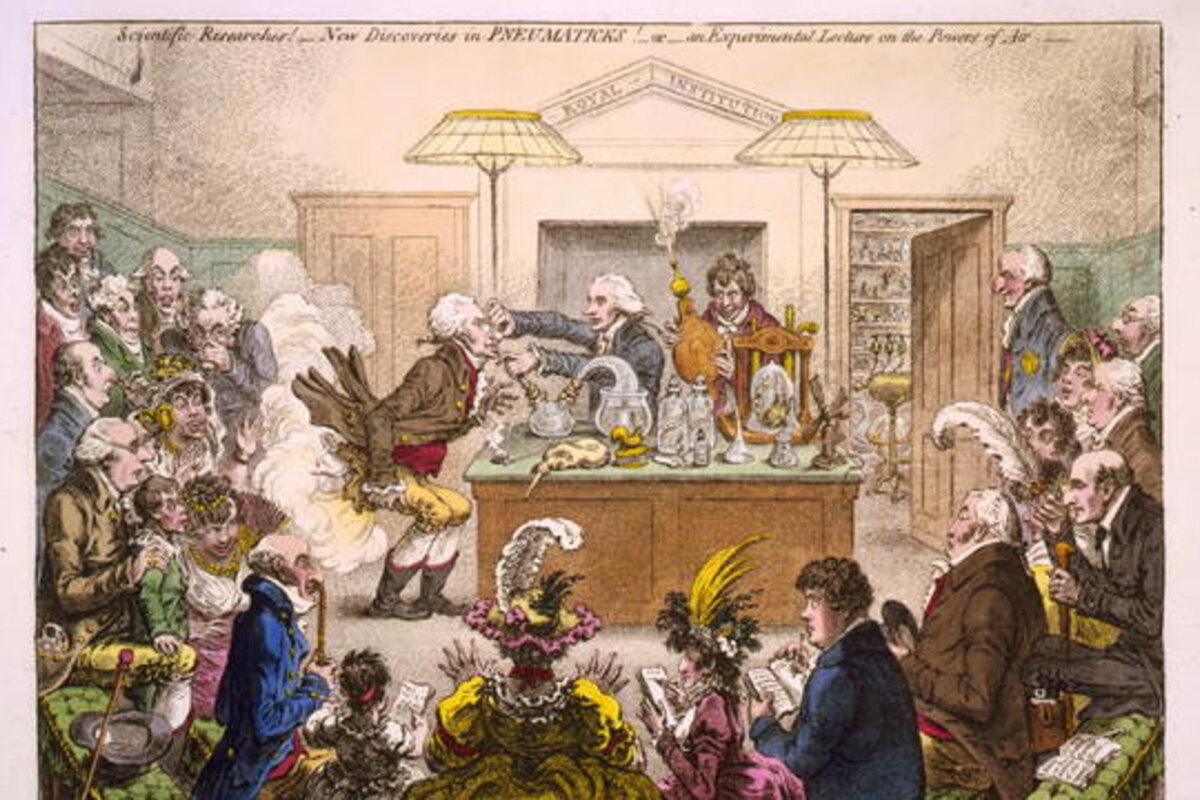
Humphry Davy's account of breathing nitrous oxide at Thomas Beddoes's Pneumatic Institution in Bristol in 1799, from the fourth part of his Researches. The excerpt gives Davy's own experiments, including the session that ended with "Nothing exists but thoughts!", and the reports he collected from Robert Southey, Peter Roget, Samuel Taylor Coleridge, and Thomas Wedgwood.

Read more
The Anaesthetic Revelation and the Gist of Philosophy
Source, 1874

The Anaesthetic Revelation and the Gist of Philosophy

Benjamin Paul Blood's privately printed 1874 pamphlet, the source of the phrase "anaesthetic revelation." Hosted here is the section in which Blood, after nearly fourteen years of experiments with anaesthetics, describes the insight that comes at the moment of "coming to." William James reviewed the pamphlet that year and later quoted this passage in The Varieties of Religious Experience.

Read more
Review of The Anaesthetic Revelation and the Gist of Philosophy
Source, 1874

Review of The Anaesthetic Revelation and the Gist of Philosophy

William James's unsigned review of Blood's pamphlet, published in the Atlantic Monthly in November 1874, eight years before his own nitrous oxide experiments. James summarizes Blood's claims at length and judges the pamphlet "thoroughly original and very suggestive," if less important than its author believed.

Read more
Note on Nitrous Oxide, from “On Some Hegelisms”
Academic Article, April 1882

Note on Nitrous Oxide, from “On Some Hegelisms”

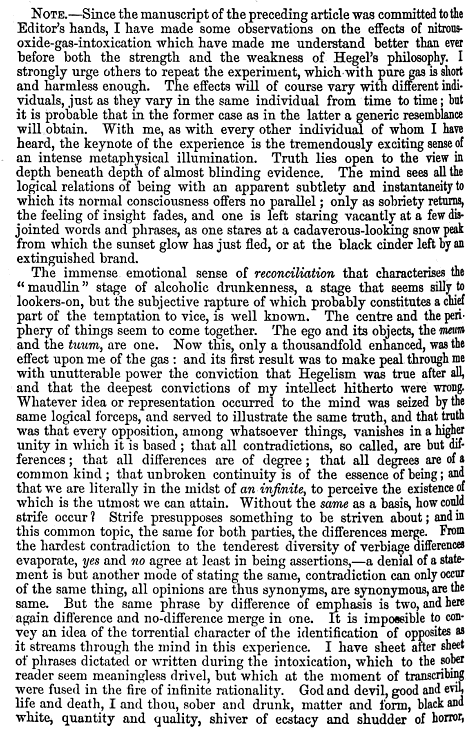
The note William James added to his essay "On Some Hegelisms" in Mind (1882), reporting nitrous oxide experiments he made after reading Blood's pamphlet. He describes a sense of metaphysical illumination and reconciliation of opposites that fades on recovery into "a few disjointed words and phrases." James reprinted the note in The Will to Believe (1897), and Charles Tart excerpted it in 1969 as "Subjective Effects of Nitrous Oxide."

Read more
Nitrous Oxide and the Anaesthetic Revelation in The Varieties of Religious Experience
Source, 1902

Nitrous Oxide and the Anaesthetic Revelation in The Varieties of Religious Experience

From the lecture on mysticism in William James's Gifford Lectures, delivered in Edinburgh in 1901–2. James argues that nitrous oxide and ether show "our normal waking consciousness" to be only one type among many, then quotes Blood and J. A. Symonds's chloroform experience. His notes add Xenos Clark's letter on the revelation and an Englishwoman's ether dream.

Read more
Anaesthetics Antient and Modern: An Historical Sketch of Anaesthesia
Source, Undated (c. 1907–1910)

Anaesthetics Antient and Modern

An Historical Sketch of Anaesthesia

An illustrated history of anaesthesia issued by the London drug firm Burroughs Wellcome & Co., which closes by advertising its own 'Wellcome' brand chloroform. Hosted here are the chapters on nitrous oxide, ether, and chloroform, covering Horace Wells's 1844 self-experiment, the ether demonstrations of William Morton and Charles Jackson, and James Young Simpson's 1847 chloroform trial.

Read more
A Pluralistic Mystic
Source, 1910

A Pluralistic Mystic

William James's last published essay, an appreciation of Benjamin Paul Blood that appeared in the Hibbert Journal in July 1910, weeks before James died. James quotes Blood's pamphlets and letters at length and traces how the anaesthetic revelation, which James first read as monism, became for Blood the basis of a pluralist philosophy.

Read more
The Anaesthetic Revelation, from Pluriverse
Source, 1920

The Anaesthetic Revelation, from Pluriverse

Benjamin Paul Blood's last book, published in 1920, the year after his death, with an introduction by Horace Kallen. Hosted here is the opening of the final chapter, "The Anaesthetic Revelation," where Blood compares the anaesthetic insight to the trance cattle fall into at spilled blood and quotes James on the "artificial mystic state of mind."

Read more