1851-1900

Browse filters
Fly Agaric and Hashish in Die narkotischen Genussmittel
Source, 1855

Fly Agaric and Hashish in Die narkotischen Genussmittel

Ernst von Bibra's German comparative account of Amanita and Cannabis

Selective excerpts from Ernst von Bibra's 1855 German survey of narcotic Genussmittel, focused on fly agaric and hashish. The passages show a mid-century comparative framework linking Amanita, Cannabis, opium, alcohol, travel accounts, chemistry, and differential effects across persons and places.

Read more
The Hasheesh Eater
Source, 1857

The Hasheesh Eater

Fitz Hugh Ludlow's account of his cannabis use as a young man in Poughkeepsie and at Union College, published anonymously in 1857 when he was twenty-one. In this excerpt (pages 18–26) he finds Cannabis indica at a local apothecary's shop, reads about it in the Dispensatory, and takes his first doses.

Read more
Ayahuasca in Villavicencio's Geografía de la República del Ecuador
Source, 1858

Ayahuasca in Villavicencio's Geografía de la República del Ecuador

An 1858 Ecuadorian account of ayahuasca visions and divination

Manuel Villavicencio's 1858 geography gives an early Spanish account of ayahuasca among Indigenous groups of eastern Ecuador, including divination, warfare, illness diagnosis, visionary effects, and a first-person report of his own experience.

Read more
The Seven Sisters of Sleep: Popular History of the Seven Prevailing Narcotics of the World
Book, 1860

The Seven Sisters of Sleep (Amanita chapter)

Popular History of the Seven Prevailing Narcotics of the World

One of seven chapters in a British mycologist's popular survey of the world's narcotics, this one on Amanita muscaria. Cooke gathers the earlier Siberian accounts of Krasheninnikov, Gmelin and Pallas, and describes the preparation, the staged effects, and the urine-drinking practice.

Read more
Le Gabon (Deuxième partie)
Source, 1865

Le Gabon

A French naval physician's 1865 travel account surveys Gabon's food plants and condiments, describing iboga as a stimulant and aphrodisiac used by paddlers on long canoe trips. He gives it the genus name 'taberna-ventricosa,' later corrected by Baillon.

Read more
Caapi and Niopo in “On Some Remarkable Narcotics of the Amazon Valley and Orinoco”
Source, c. 1870; published 1908

Caapi and Niopo in “On Some Remarkable Narcotics of the Amazon Valley and Orinoco”

Richard Spruce on ayahuasca, yopo/paricá, and Amazonian medicine-men

Richard Spruce's nineteenth-century account of caapi, aya-huasca, niopo, and paricá, based on field observations in the Uaupés, Orinoco, Rio Negro, Napo, and Pastasa regions. The excerpt records plant identifications, preparation methods, visual effects, ceremonial uses, and the role of payes in curing and divination.

Read more
Tent Life in Siberia
Book, 1870

Tent Life in Siberia

An American telegraph surveyor's account of Koryak men intoxicated on fly-agaric at a wedding celebration in northern Kamchatka. Kennan describes the mushroom's price, preparation, etiquette of serving, and the trade dynamics between Russian merchants and Koryak consumers.

Read more
The Anaesthetic Revelation and the Gist of Philosophy
Source, 1874

The Anaesthetic Revelation and the Gist of Philosophy

Benjamin Paul Blood's privately printed 1874 pamphlet, the source of the phrase "anaesthetic revelation." Hosted here is the section in which Blood, after nearly fourteen years of experiments with anaesthetics, describes the insight that comes at the moment of "coming to." William James reviewed the pamphlet that year and later quoted this passage in The Varieties of Religious Experience.

Read more
Review of The Anaesthetic Revelation and the Gist of Philosophy
Source, 1874

Review of The Anaesthetic Revelation and the Gist of Philosophy

William James's unsigned review of Blood's pamphlet, published in the Atlantic Monthly in November 1874, eight years before his own nitrous oxide experiments. James summarizes Blood's claims at length and judges the pamphlet "thoroughly original and very suggestive," if less important than its author believed.

Read more
Note on Nitrous Oxide, from “On Some Hegelisms”
Academic Article, April 1882

Note on Nitrous Oxide, from “On Some Hegelisms”

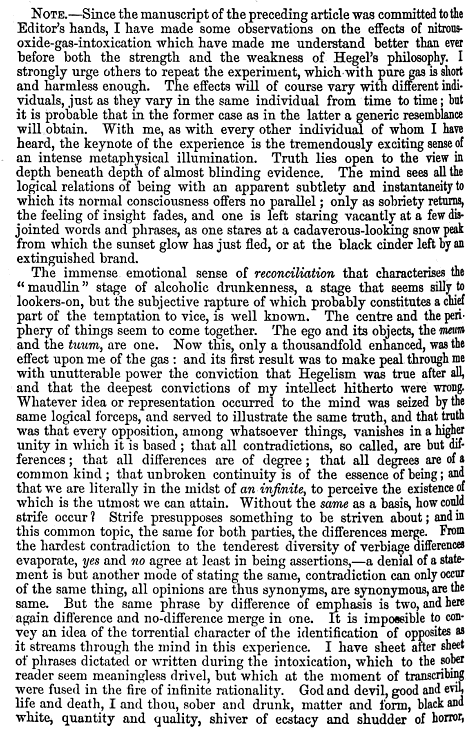
The note William James added to his essay "On Some Hegelisms" in Mind (1882), reporting nitrous oxide experiments he made after reading Blood's pamphlet. He describes a sense of metaphysical illumination and reconciliation of opposites that fades on recovery into "a few disjointed words and phrases." James reprinted the note in The Will to Believe (1897), and Charles Tart excerpted it in 1969 as "Subjective Effects of Nitrous Oxide."

Read more
Ueber Anhalonium Lewinii
Academic Article, 1888

On Anhalonium Lewinii

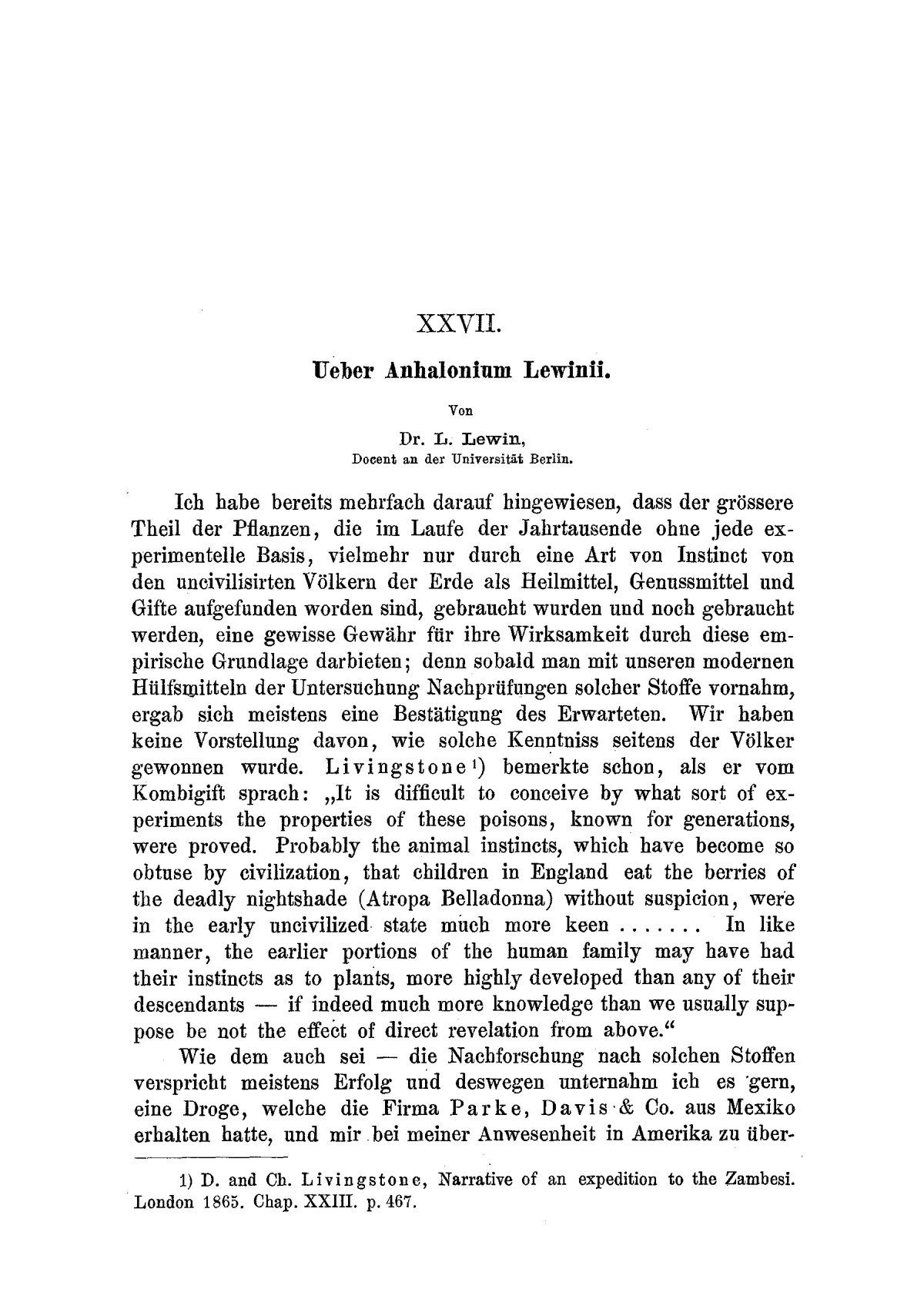
Berlin pharmacologist Louis Lewin (1850–1929) reports on "Muscale Buttons" received from Parke, Davis & Co. during a visit to the United States in 1887. The botanist Paul Hennings identified the dried cactus as a new species and named it Anhalonium Lewinii after him, and Lewin describes a crude base he called anhalonine and its strychnine-like convulsant effects in frogs, pigeons and rabbits. Hosted here are the introduction, the preliminary chemistry, and the full section on the drug's effects, with the historical survey of cacti omitted.

Read more
Academic Article, 1893

Consciousness under the Influence of Cannabis Indica

The Yale psychologist Edward Wheeler Scripture takes an alcoholic extract of cannabis to test the common claim that it stretches time and space. He reports strong fluctuations of attention and a sense that objects and events had become remote, and compares these with laboratory findings on attention.

Read more
Anhalonium Lewinii (Mescal Buttons): A Study of the Drug, with Especial Reference to its Physiological Action upon Man, with Report of Experiments
Academic Article, September 16, 1895

Anhalonium Lewinii (Mescal Buttons)

A Study of the Drug, with Especial Reference to its Physiological Action upon Man, with Report of Experiments

Prentiss and Morgan conducted the first American clinical study of peyote at Columbian University on buttons supplied by ethnologist James Mooney. They recorded physiological effects alongside subjects' first-person accounts of visions, including kaleidoscopic colors and dissociative experiences.

Read more
The Mescal Plant and Ceremony
Academic Article, January 15, 1896

The Mescal Plant and Ceremony

An account of the Kiowa and Comanche peyote ceremony by ethnologist James Mooney, published in the Therapeutic Gazette in 1896. Drawing on field observation and participation since 1891, Mooney describes the all-night rite, dosages, and cases including his interpreter Paul Setkopti and leader Quanah Parker.

Read more
Remarks on the Effects of Anhelonium Lewinii (the Mescal Button)
Academic Article, December 5, 1896

Effects of Anhelonium Lewinii

S. Weir Mitchell's account of his own peyote self-experiment on May 24, 1896, read before the American Neurological Society. Mitchell describes detailed visions and includes a second self-experiment by a colleague, Dr. Eshner, with physiological notes and subjective observations.

Read more
Ueber Pellote. Beiträge zur chemischen und pharmakologischen Kenntniss der Cacteen. Zweite Mittheilung
Academic Article, 1898

On Pellote (Second Communication)

Leipzig pharmacologist Arthur Heffter (1859–1925) reports his separation of five alkaloids from mescal buttons, among them mescaline ("Mezcalin"), and a series of self-experiments made between June and November 1897. Testing the whole drug, its resin, the mixed alkaloids and each isolated base in turn, he found that 0.15 g of mescaline hydrochloride alone reproduced the visions, slowed pulse, dilated pupils and loss of time sense produced by the cactus. Hosted here are the description of mescaline and its salts and the whole of section VI on the drug's action in humans.

Read more
The Physiological Action of the Alkaloids Derived from Anhalonium Lewinii
Academic Article, September 1899

Physiological Action of Anhalonium Alkaloids

A pharmacologist at St Thomas's Hospital reports systematic experiments on Anhalonium alkaloids using frogs, cats, dogs, and rabbits, combined with self-experimentation. Dixon's account is more clinically restrained than Weir Mitchell's or Ellis's but adds music-color synaesthesia and comparisons to cannabis and strychnine.

Read more