1800-1950 / Academic Article

Browse filters
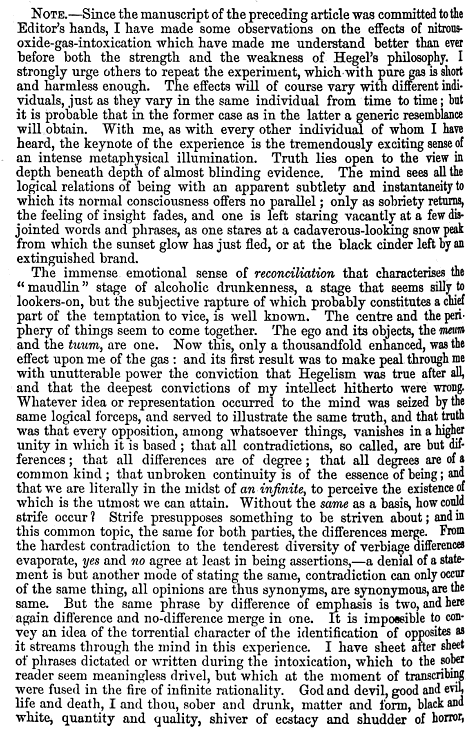
Note on Nitrous Oxide, from “On Some Hegelisms”
Academic Article, April 1882

Note on Nitrous Oxide, from “On Some Hegelisms”

The note William James added to his essay "On Some Hegelisms" in Mind (1882), reporting nitrous oxide experiments he made after reading Blood's pamphlet. He describes a sense of metaphysical illumination and reconciliation of opposites that fades on recovery into "a few disjointed words and phrases." James reprinted the note in The Will to Believe (1897), and Charles Tart excerpted it in 1969 as "Subjective Effects of Nitrous Oxide."

Read more
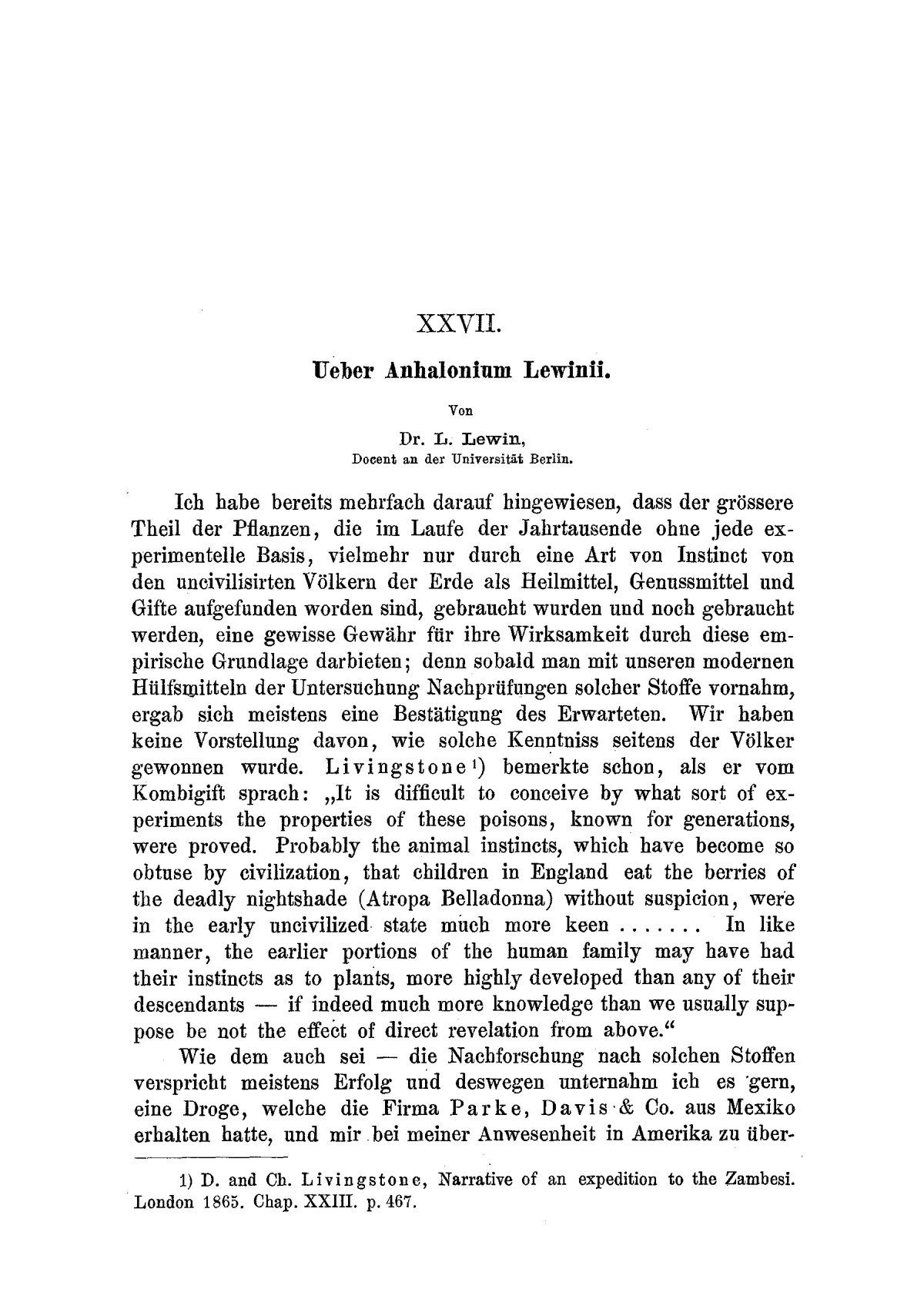
Ueber Anhalonium Lewinii
Academic Article, 1888

On Anhalonium Lewinii

Berlin pharmacologist Louis Lewin (1850–1929) reports on "Muscale Buttons" received from Parke, Davis & Co. during a visit to the United States in 1887. The botanist Paul Hennings identified the dried cactus as a new species and named it Anhalonium Lewinii after him, and Lewin describes a crude base he called anhalonine and its strychnine-like convulsant effects in frogs, pigeons and rabbits. Hosted here are the introduction, the preliminary chemistry, and the full section on the drug's effects, with the historical survey of cacti omitted.

Read more
Academic Article, 1893

Consciousness under the Influence of Cannabis Indica

The Yale psychologist Edward Wheeler Scripture takes an alcoholic extract of cannabis to test the common claim that it stretches time and space. He reports strong fluctuations of attention and a sense that objects and events had become remote, and compares these with laboratory findings on attention.

Read more
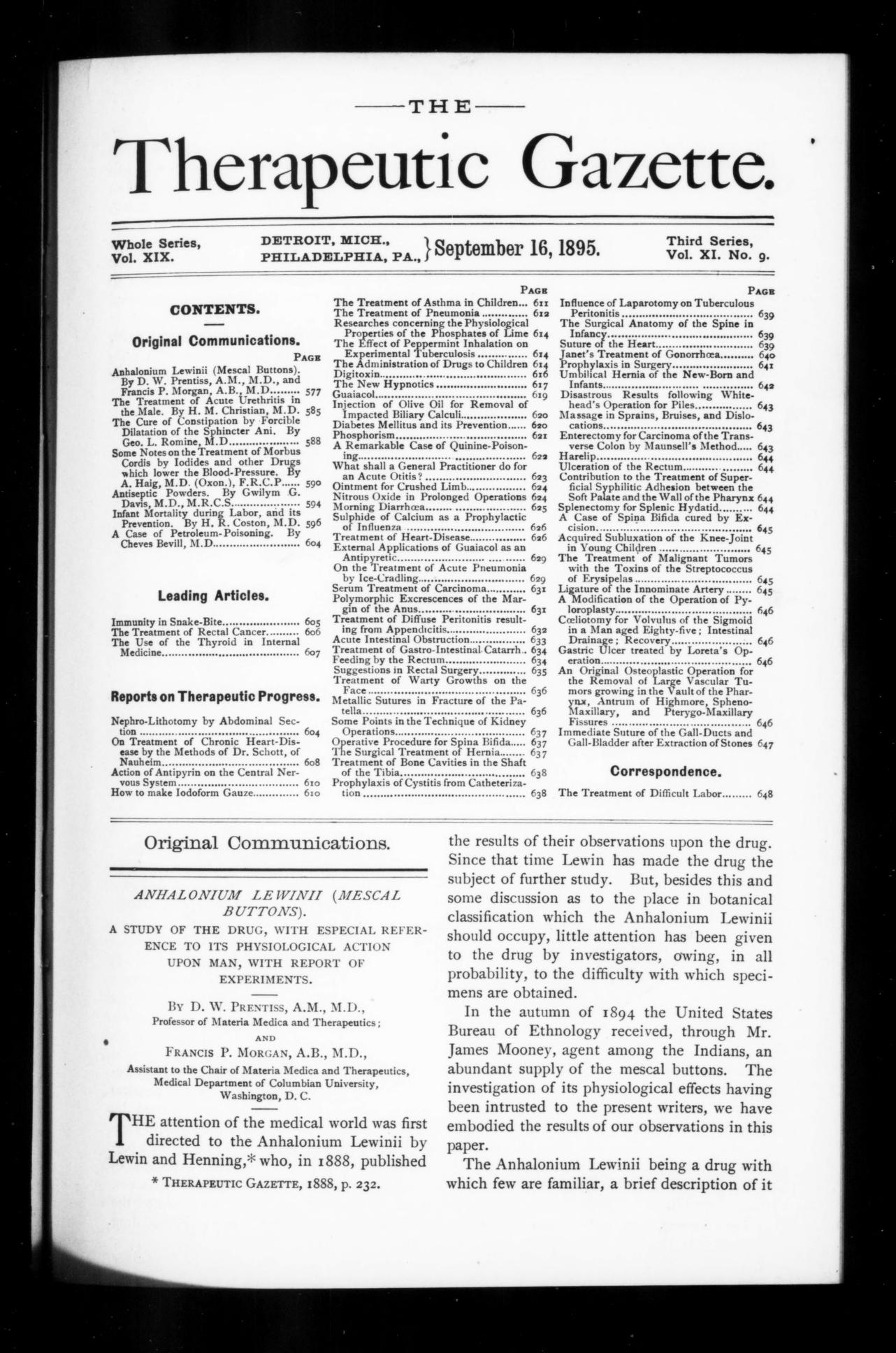
Anhalonium Lewinii (Mescal Buttons): A Study of the Drug, with Especial Reference to its Physiological Action upon Man, with Report of Experiments
Academic Article, September 16, 1895

Anhalonium Lewinii (Mescal Buttons)

A Study of the Drug, with Especial Reference to its Physiological Action upon Man, with Report of Experiments

Prentiss and Morgan conducted the first American clinical study of peyote at Columbian University on buttons supplied by ethnologist James Mooney. They recorded physiological effects alongside subjects' first-person accounts of visions, including kaleidoscopic colors and dissociative experiences.

Read more
The Mescal Plant and Ceremony
Academic Article, January 15, 1896

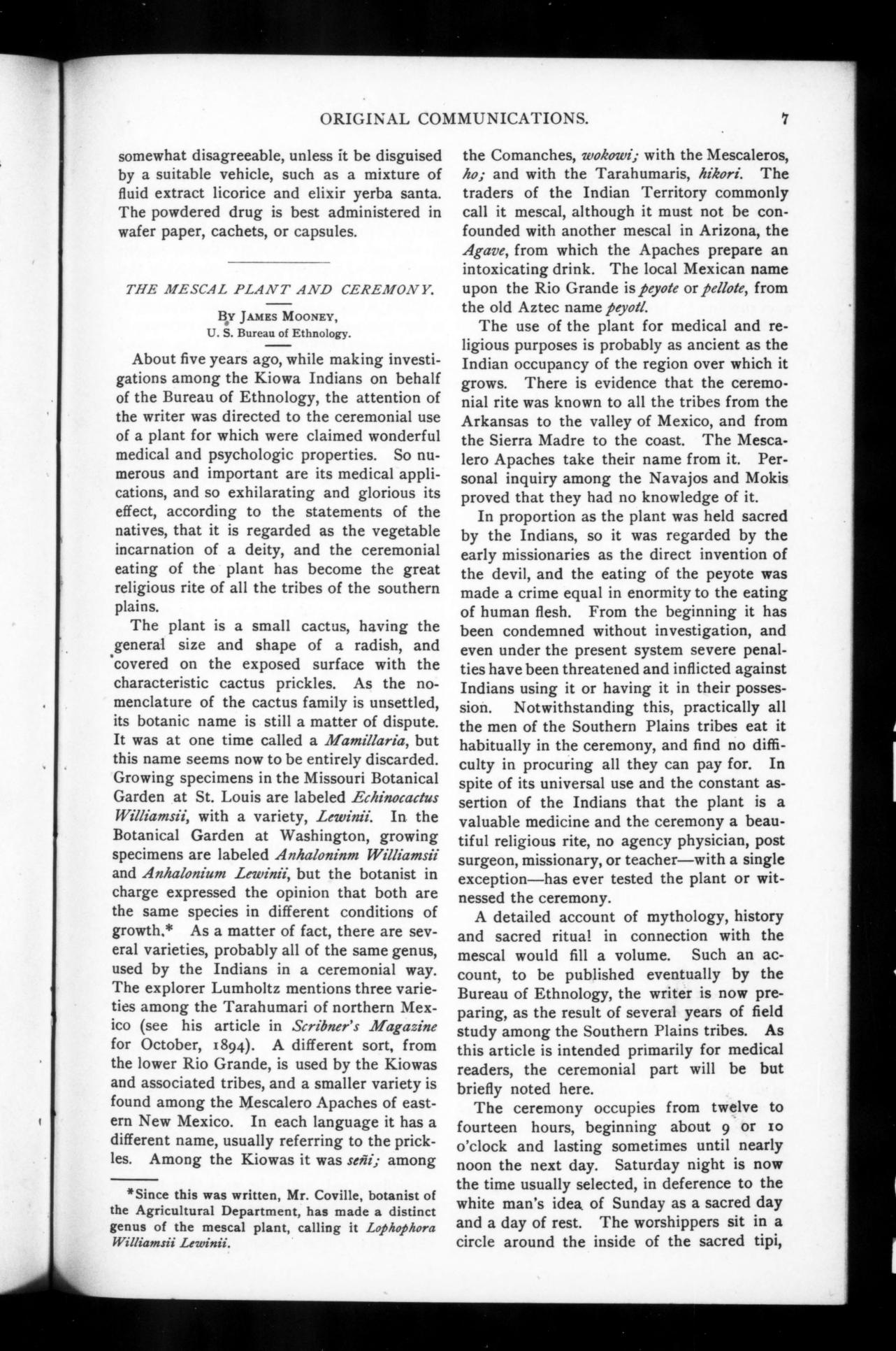
The Mescal Plant and Ceremony

An account of the Kiowa and Comanche peyote ceremony by ethnologist James Mooney, published in the Therapeutic Gazette in 1896. Drawing on field observation and participation since 1891, Mooney describes the all-night rite, dosages, and cases including his interpreter Paul Setkopti and leader Quanah Parker.

Read more
Remarks on the Effects of Anhelonium Lewinii (the Mescal Button)
Academic Article, December 5, 1896

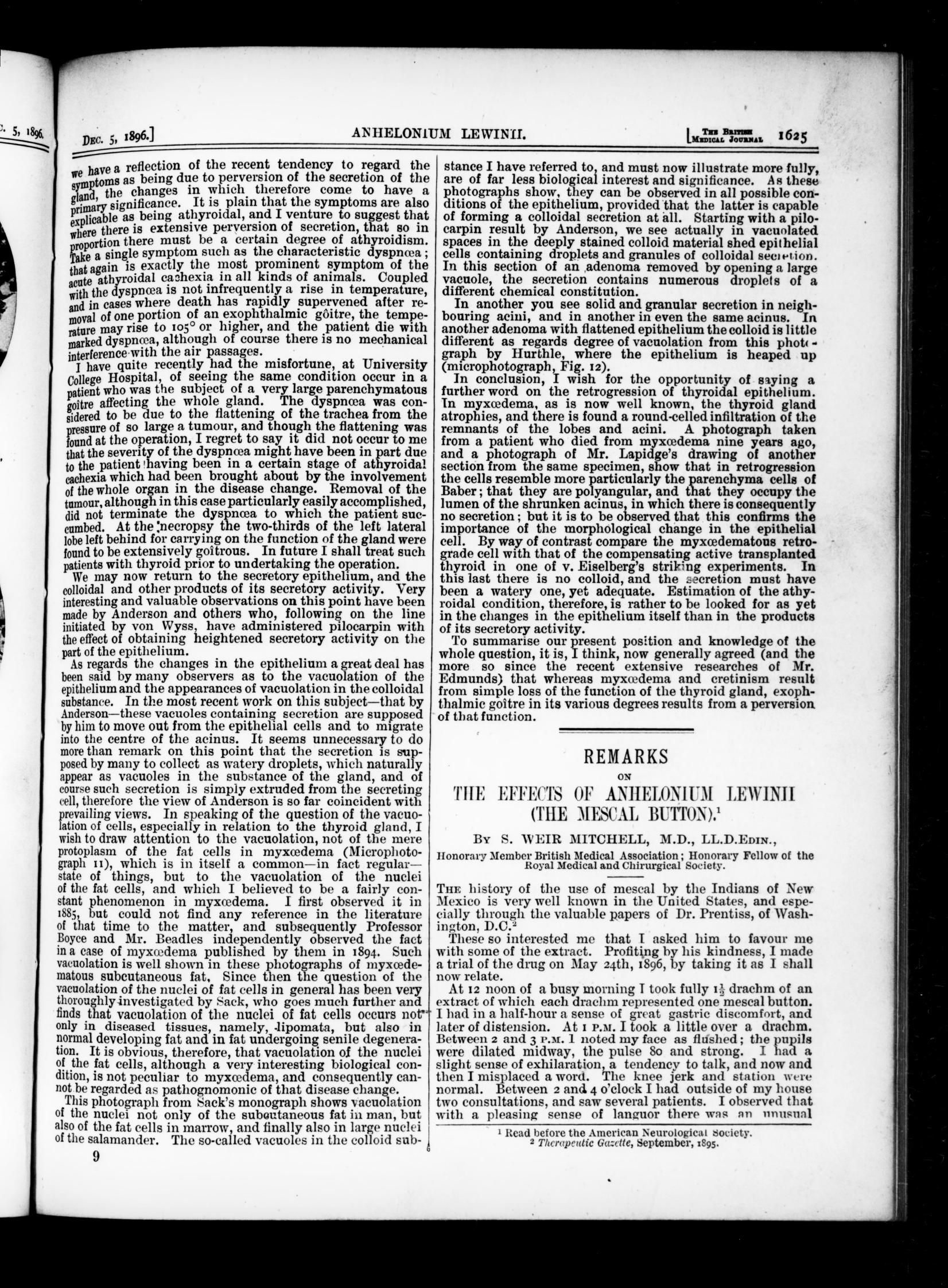
Effects of Anhelonium Lewinii

S. Weir Mitchell's account of his own peyote self-experiment on May 24, 1896, read before the American Neurological Society. Mitchell describes detailed visions and includes a second self-experiment by a colleague, Dr. Eshner, with physiological notes and subjective observations.

Read more
Ueber Pellote. Beiträge zur chemischen und pharmakologischen Kenntniss der Cacteen. Zweite Mittheilung
Academic Article, 1898

On Pellote (Second Communication)

Leipzig pharmacologist Arthur Heffter (1859–1925) reports his separation of five alkaloids from mescal buttons, among them mescaline ("Mezcalin"), and a series of self-experiments made between June and November 1897. Testing the whole drug, its resin, the mixed alkaloids and each isolated base in turn, he found that 0.15 g of mescaline hydrochloride alone reproduced the visions, slowed pulse, dilated pupils and loss of time sense produced by the cactus. Hosted here are the description of mescaline and its salts and the whole of section VI on the drug's action in humans.

Read more
The Physiological Action of the Alkaloids Derived from Anhalonium Lewinii
Academic Article, September 1899

Physiological Action of Anhalonium Alkaloids

A pharmacologist at St Thomas's Hospital reports systematic experiments on Anhalonium alkaloids using frogs, cats, dogs, and rabbits, combined with self-experimentation. Dixon's account is more clinically restrained than Weir Mitchell's or Ellis's but adds music-color synaesthesia and comparisons to cannabis and strychnine.

Read more
Mescal: A Study of a Divine Plant
Academic Article, May 1902

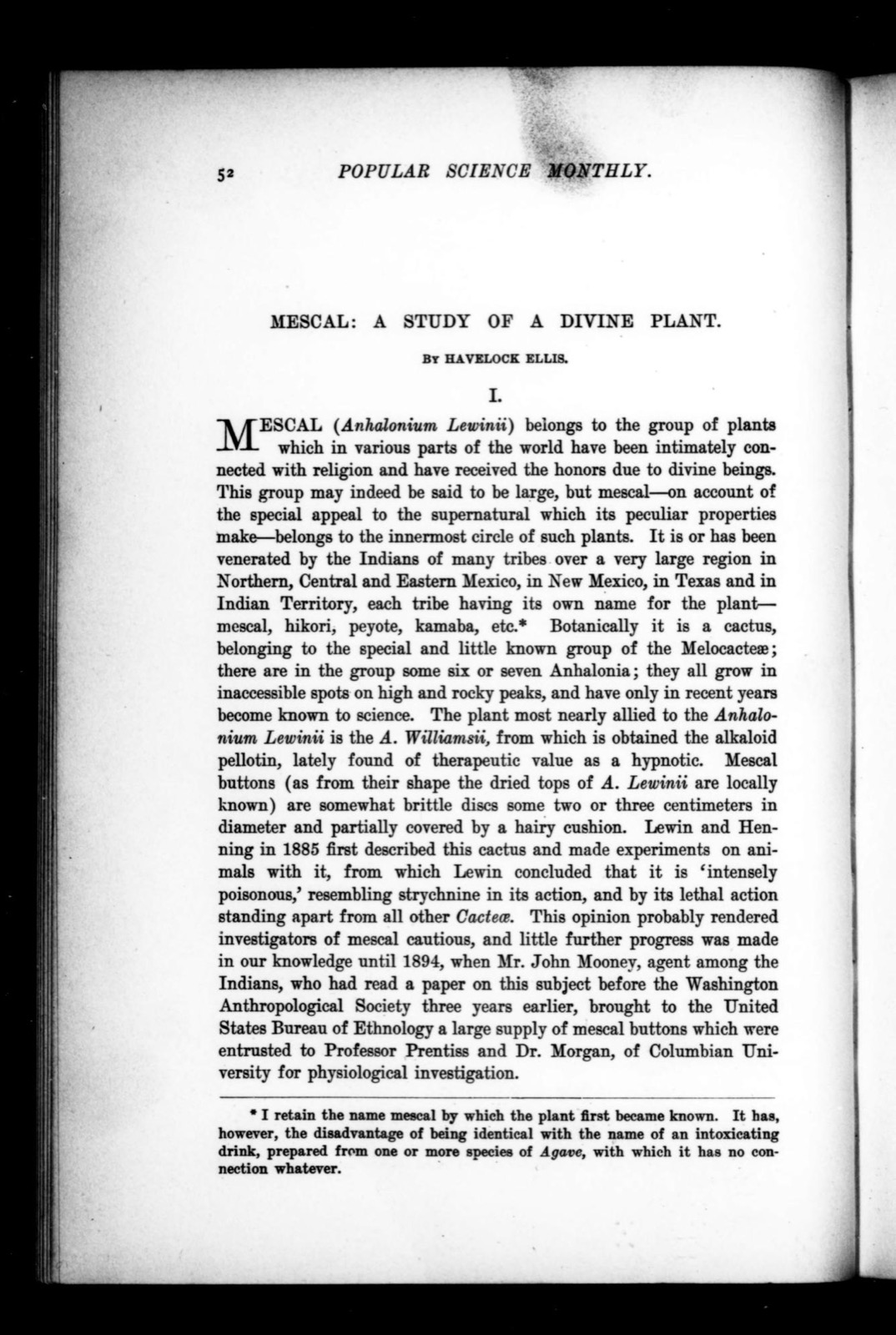
Mescal: A Study of a Divine Plant

A Study of a Divine Plant

Havelock Ellis's account of his own peyote self-experiment, conducted on Good Friday 1897 in his London chambers. Written for a general scientific audience, it situates his diary of jewel-like visions within the clinical work of Prentiss, Morgan, and Weir Mitchell, alongside Indigenous religious use of the plant.

Read more
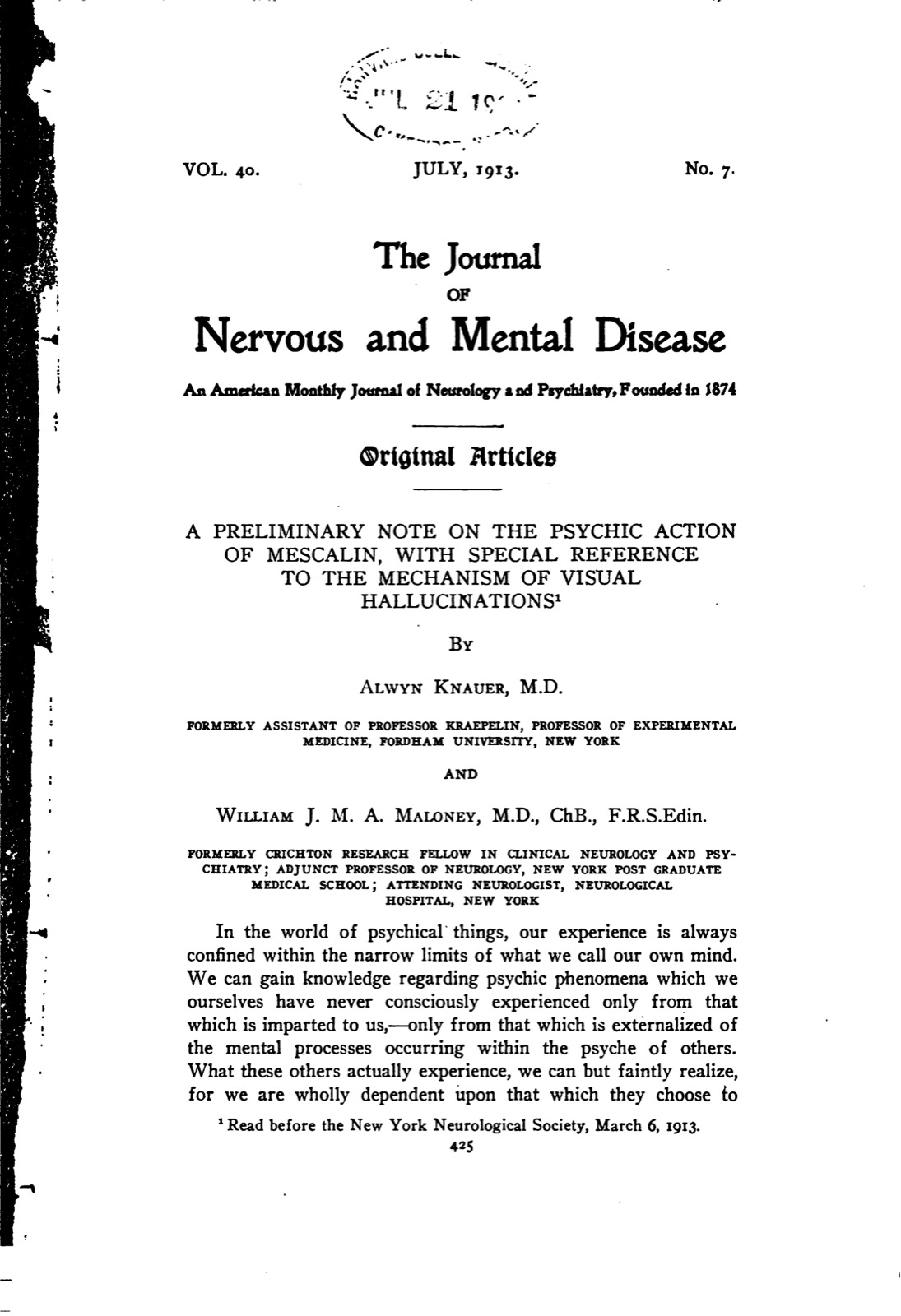
A Preliminary Note on the Psychic Action of Mescalin, with Special Reference to the Mechanism of Visual Hallucinations
Academic Article, July 1913

Psychic Action of Mescalin

New York psychiatrists inject themselves and colleagues with pure mescaline sulphate in twenty-three experiments to model insanity's visual hallucinations. Subjects' reports include specifics—a glass-screen head, the 'mosque of Omar'—and the authors propose a five-level theory of hallucinations versus images.

Read more
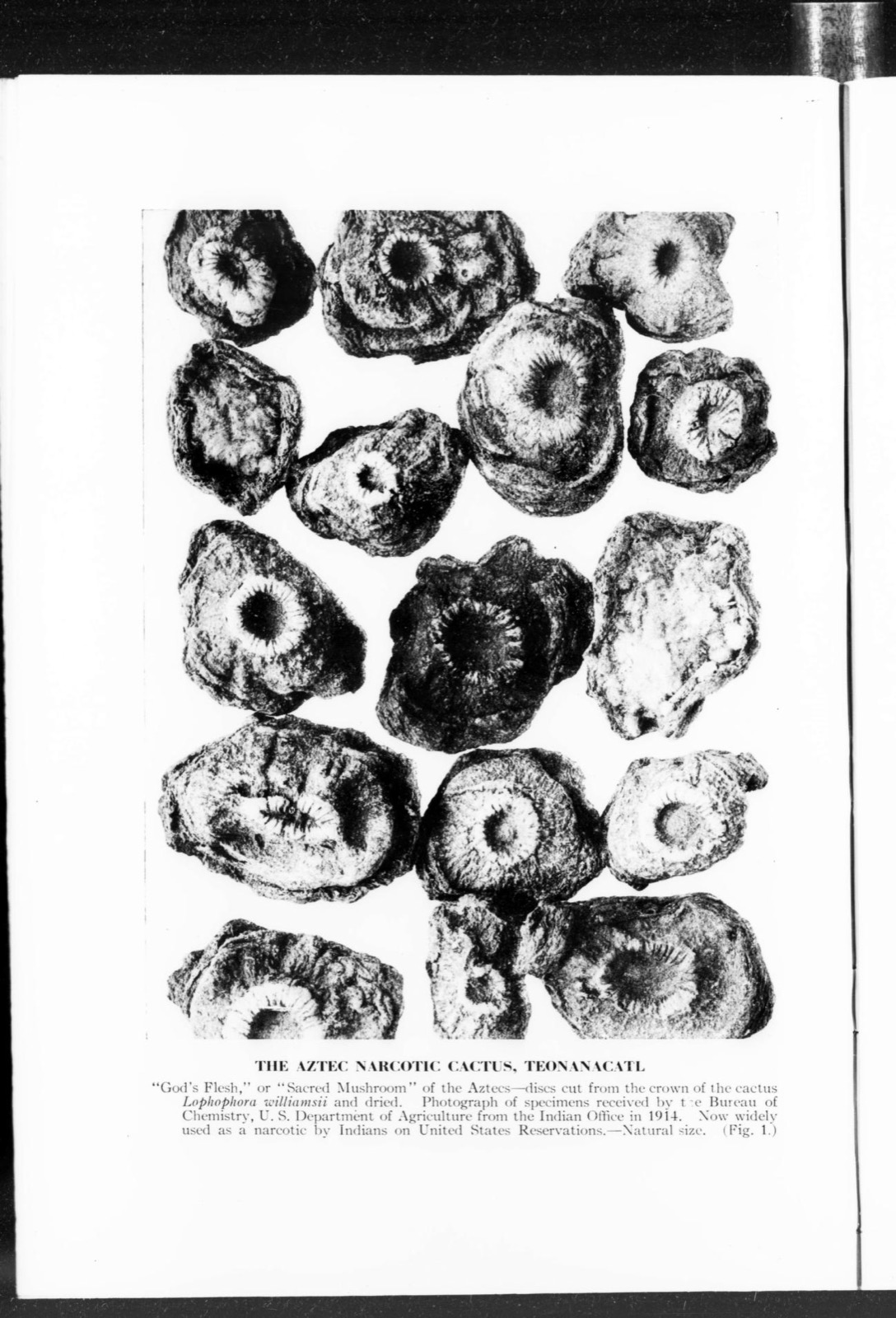
An Aztec Narcotic (Lophophora williamsii)
Academic Article, July 1915

An Aztec Narcotic

Safford, a USDA botanist, analyzes peyote's physiological effects and Native American ceremonial use in 1915. The article incorporates sworn testimony from Menominee, Omaha, and Winnebago members of the Sacred Peyote Society.

Read more
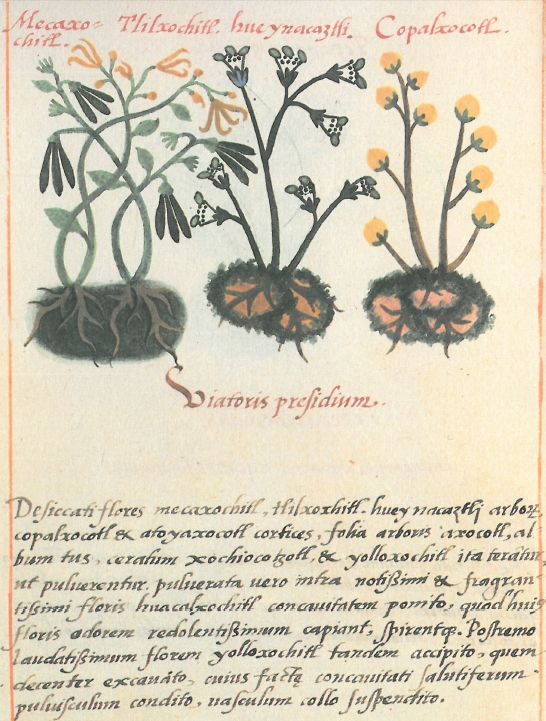
De los nombres botánicos aztecas
Academic Article, December 1919

On Aztec Botanical Names

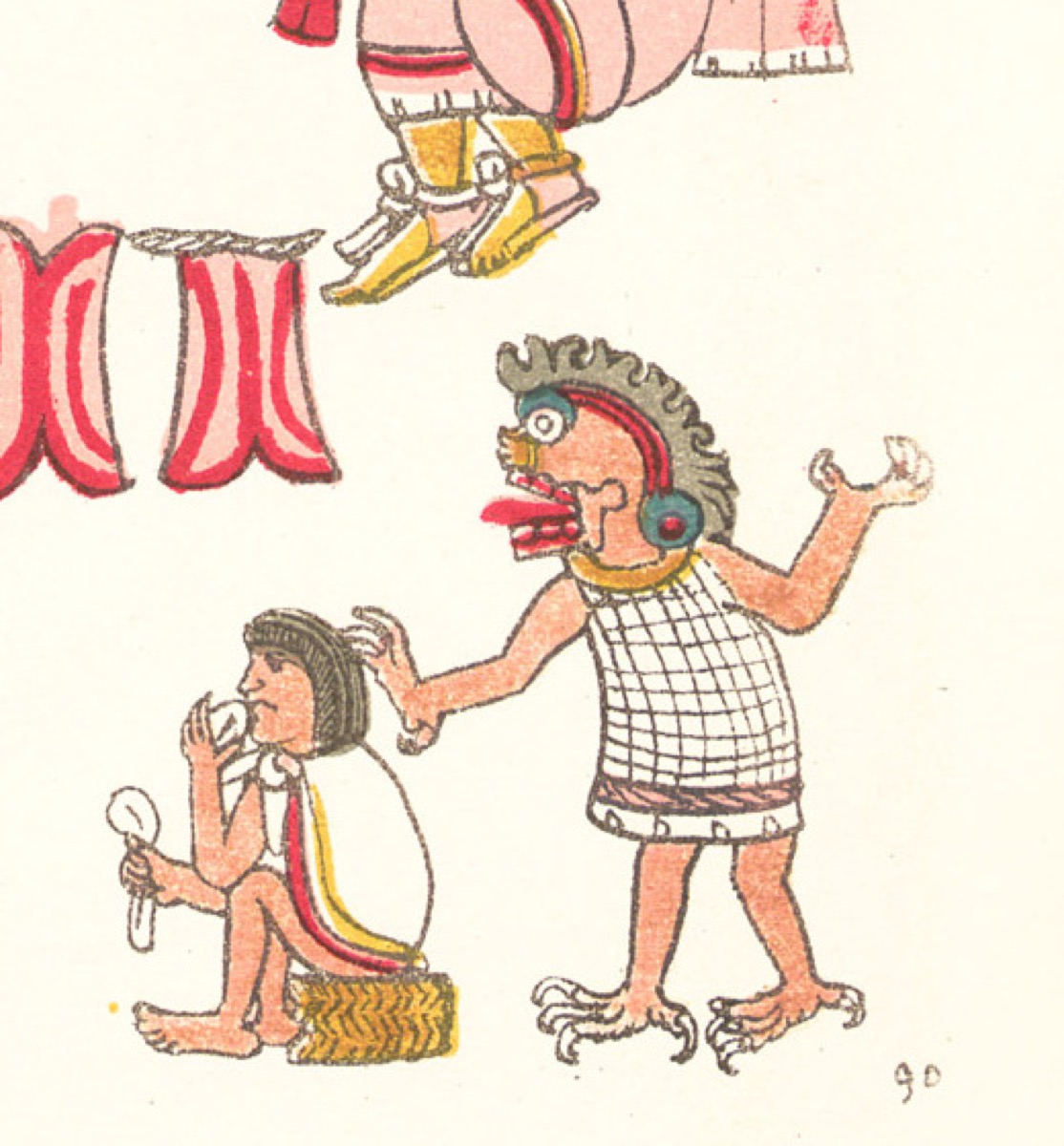
An essay by physician and ethnobotanist Blas Pablo Reko arguing against Safford's claim that teonanácatl was a fanciful name for peyote. Reko insists teonanácatl was a real mushroom still eaten by Indigenous communities in Oaxaca.

Read more
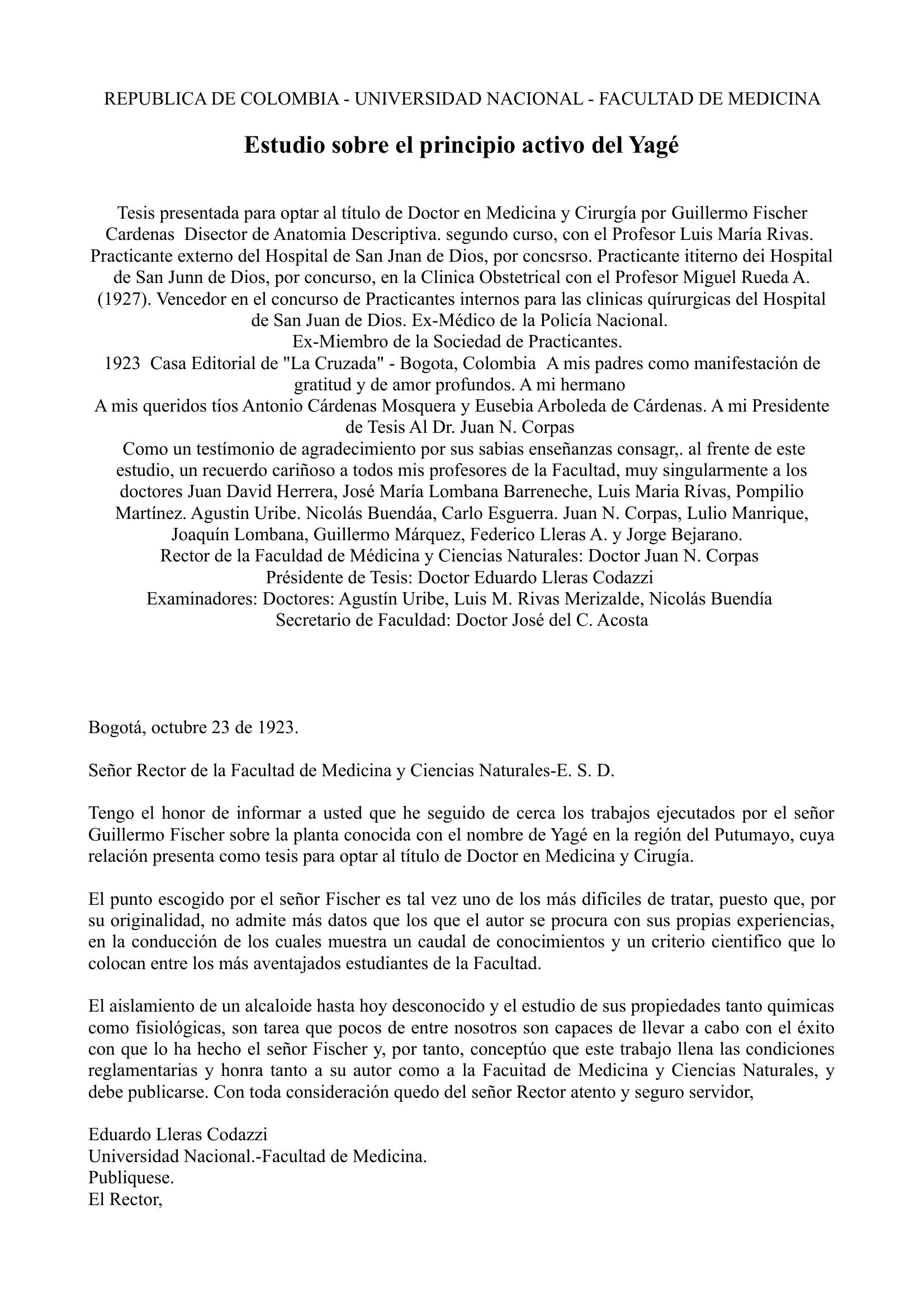
Estudio sobre el principio activo del Yagé
Academic Article, 1923

Study on the Active Principle of Yagé

A 1923 doctoral thesis reporting Fischer Cárdenas's isolation of the yagé alkaloid that Rafael Zerda Bayón had named telepathine (telepatina) decades earlier without isolating it. Seven case reports detail effects on human subjects, including the author's self-experiment, describing vivid dreams, visual hallucinations, and euphoria at low doses, followed by a systematic summary of physiological action.

Read more
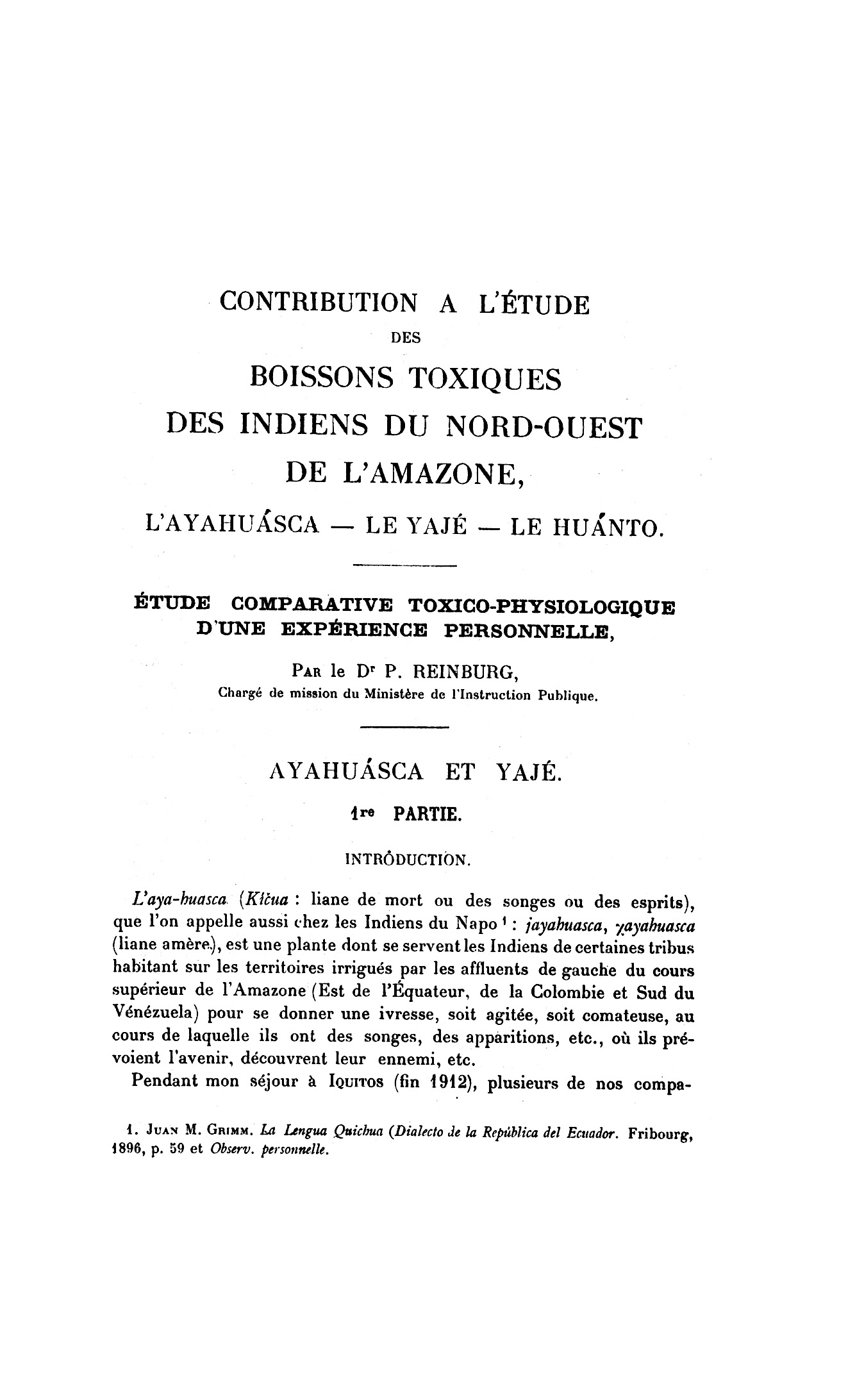
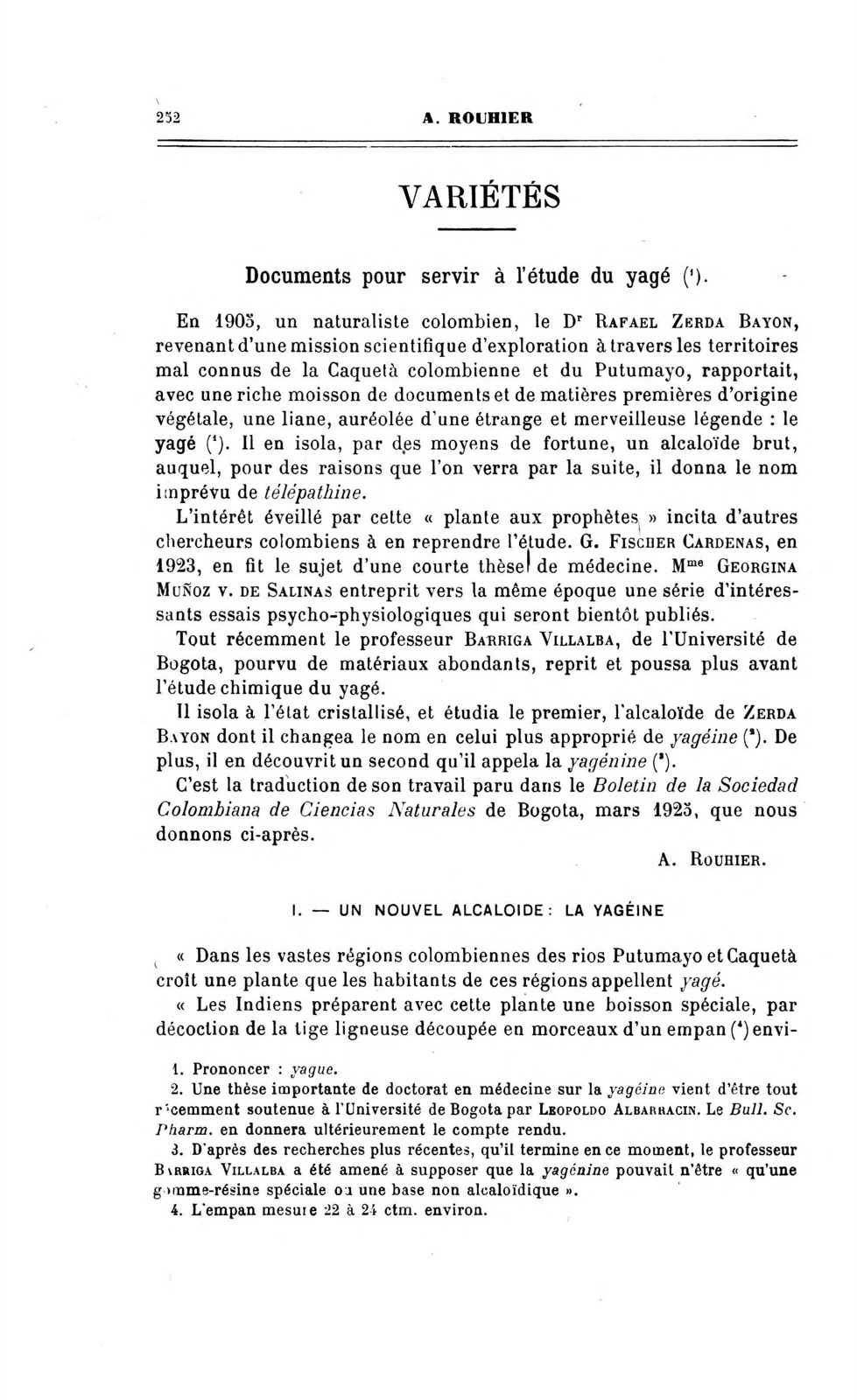
Documents pour servir à l'étude du yagé
Academic Article, April 1926

Documents Toward a Study of Yagé

Rouhier's two-part dossier for Bulletin des Sciences Pharmacologiques: a translation of Barriga Villalba's 1923 paper on alkaloid yagéine, followed by Rouhier's ethnographic and pharmacological notes. Rouhier catalogues dose-dependent effects and includes chemical analysis of a Jívaro preparation.

Read more
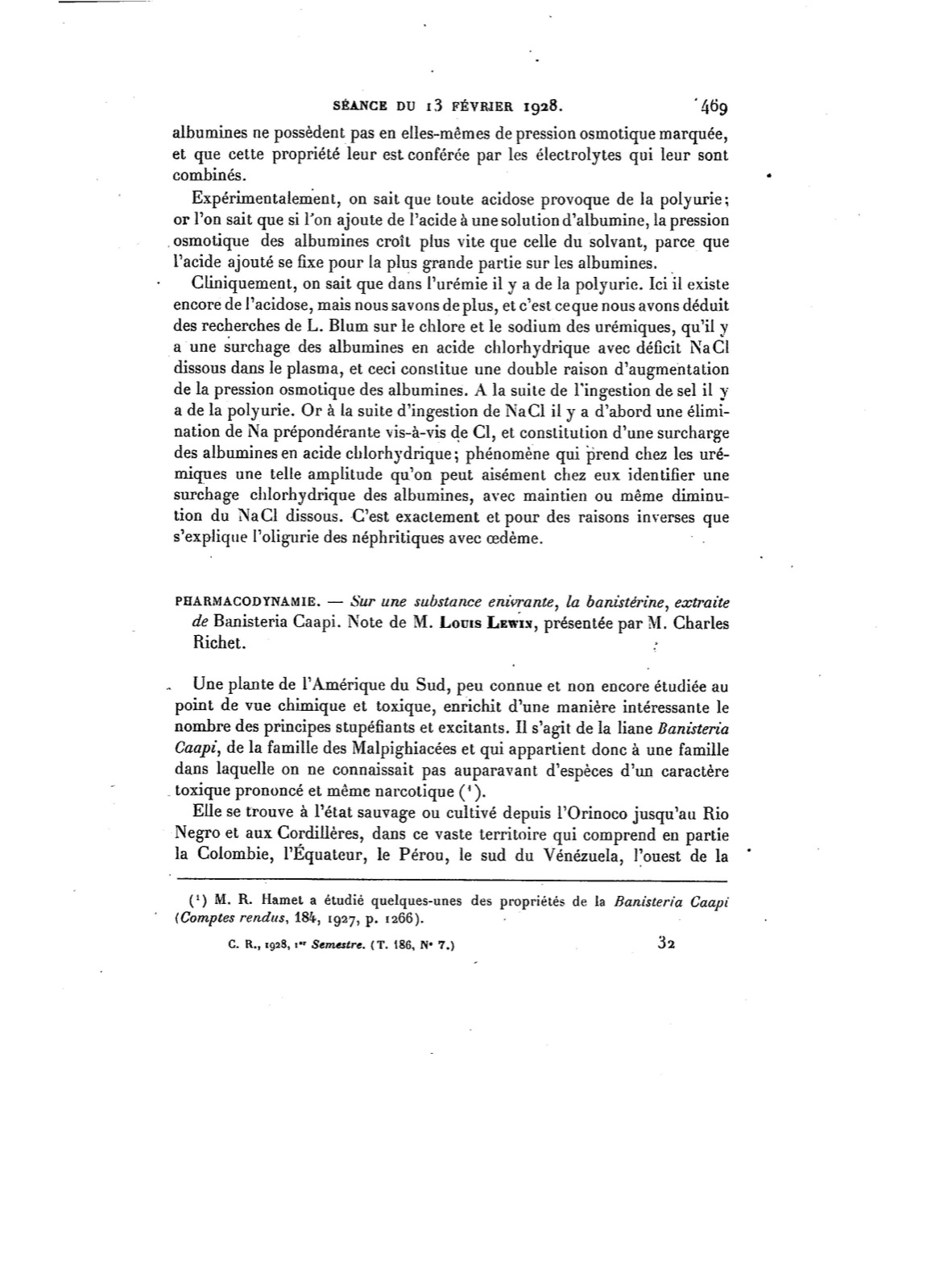
Sur une substance enivrante, la banistérine, extraite de Banisteria Caapi
Academic Article, 1928

On Banisterine, an Intoxicating Substance from Banisteria Caapi

Berlin pharmacologist Louis Lewin announces his isolation of banisterine from Banisteria caapi and its identity to harmine. He describes animal experiments and preliminary human trials showing that banisterine relieved the muscular rigidity of encephalitis lethargica (post-influenza sleeping sickness).

Read more
The Elements of Mazatec Witchcraft
Academic Article, 1939

The Elements of Mazatec Witchcraft

A Berkeley anthropologist's field survey of Mazatec witchcraft from a 1938 expedition to Huautla de Jiménez, Oaxaca. Hosted here is a fair-use excerpt: Johnson's eyewitness account of a curing ceremony he and his party attended on July 16, 1938 -- the first outsider-witnessed session involving the sacred mushrooms -- along with his description of the mushroom species and their ritual use among Mazatec brujos.

Read more
Teonanacatl: The Narcotic Mushroom of the Aztecs
Academic Article, July-September 1940

Teonanacatl

The Narcotic Mushroom of the Aztecs

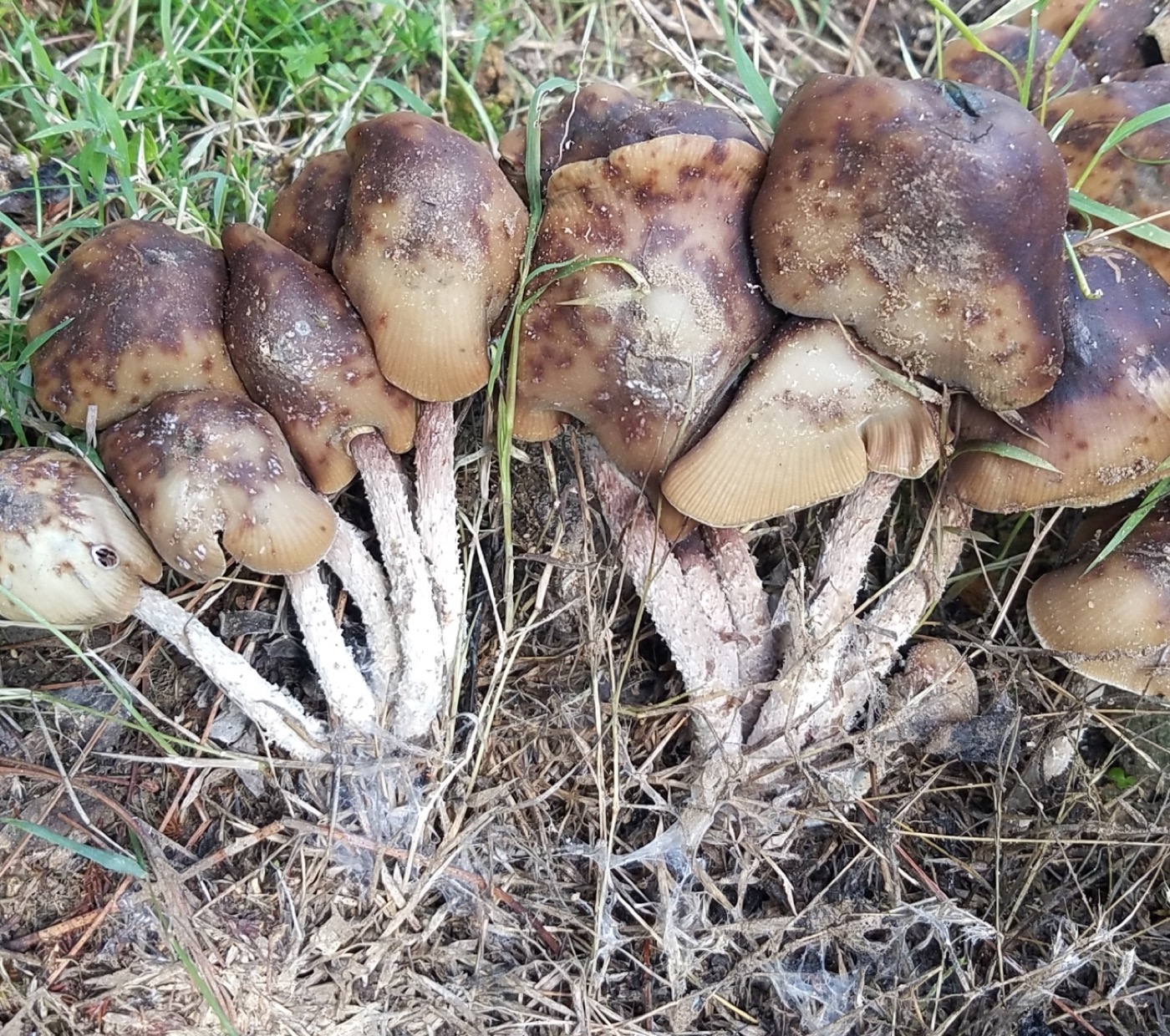
Schultes's botanical account of his 1938-39 fieldwork with Blas Pablo Reko among the Mazatec, tracing the teonanácatl rediscovery from Reko's 1923 letter through Robert Weitlaner's 1936 visit to Huautla de Jiménez. Schultes identifies the mushroom as Paneolus campanulatus var. sphinctrinus.

Read more
A Contribution to Our Knowledge of Rivea Corymbosa: The Narcotic Ololiuqui of the Aztecs
Academic Article, 1941

A Contribution to Our Knowledge of Rivea Corymbosa

The Narcotic Ololiuqui of the Aztecs

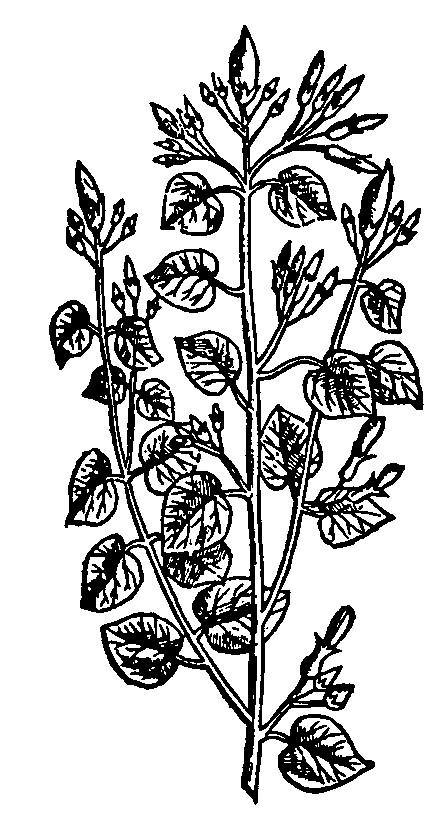
Schultes's botanical monograph settling the identity of ololiuqui, the Aztec morning-glory narcotic. He credits Urbina's 1897 identification as Rivea corymbosa, corrects Safford's 1915 misidentification as jimsonweed, and surveys continued ritual and medicinal use among the Chinantec, Mazatec, Mixtec, and Zapotec of Oaxaca.

Read more
Lysergsäure-diäthylamid, ein Phantastikum aus der Mutterkorngruppe
Academic Article, 1947

LSD, a Phantasticum from the Ergot Group

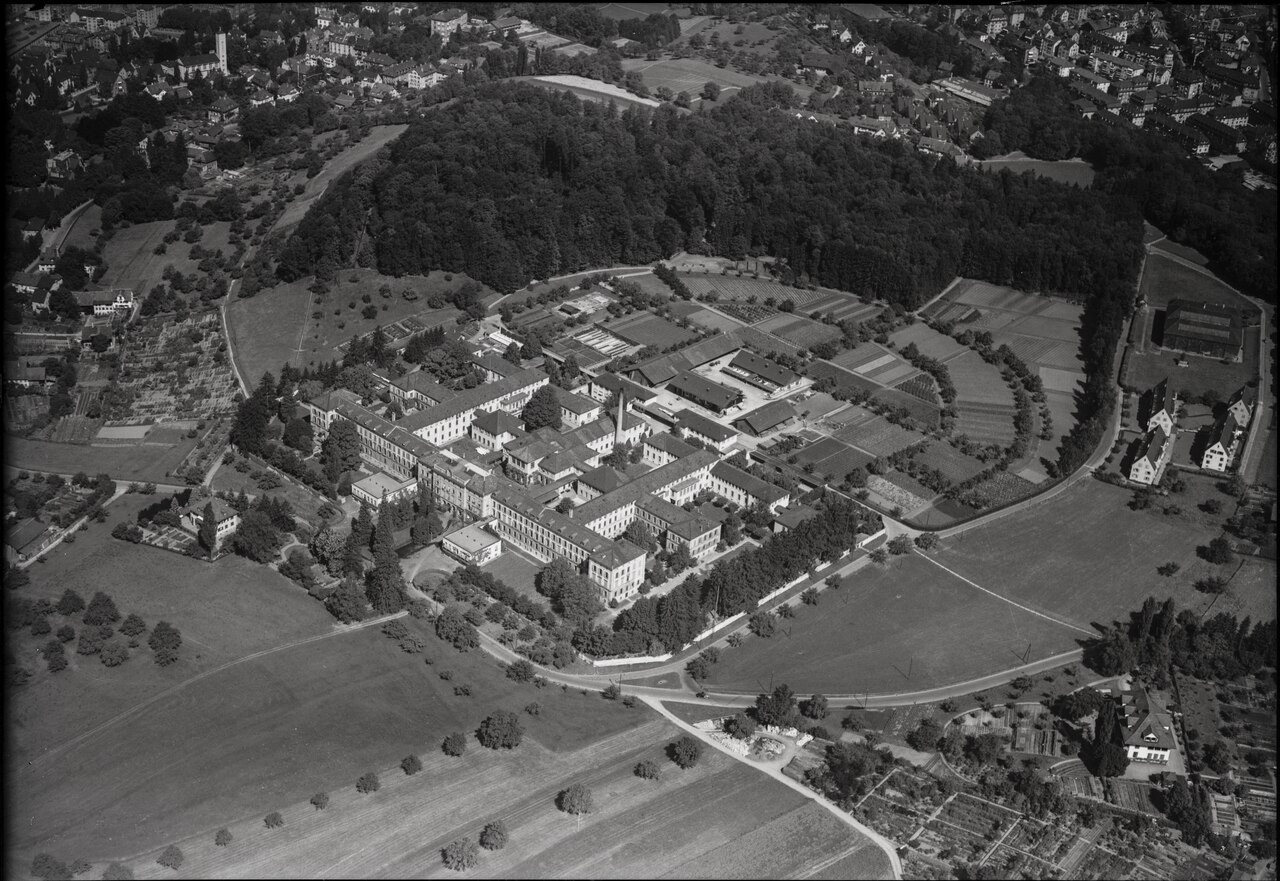
Werner Stoll's first systematic clinical study of LSD, examining sixteen healthy volunteers and six schizophrenic patients, plus Stoll's own self-experiment. Published in 1947 following Hofmann's 1943 discovery at Sandoz, it established key vocabulary for psychiatric LSD research.

Read more