Texts / Source

Browse filters
Soma Hymns in the Rigveda
Source, c. 1500-1000 BCE; translation 1897

Soma Hymns in the Rigveda

RV 8.48 and 9.113 on soma, immortality, and light

Two selected Rigvedic hymns to Soma: RV 8.48, the famous hymn of drinking soma and becoming immortal, and RV 9.113, a Soma Pavamana hymn asking to be placed in deathless worlds of light, delight, and fulfilled desire.

Read more
Eighth Colloquy: Bangue
Source, 1563; Portuguese edition 1891

Eighth Colloquy: Bangue

A sixteenth-century Portuguese-Goan discussion of bangue, or bhang, describing cannabis preparations in South Asia, their relation to opium, and accounts of intoxication, appetite, laughter, sleep, and imaginative travel.

Read more
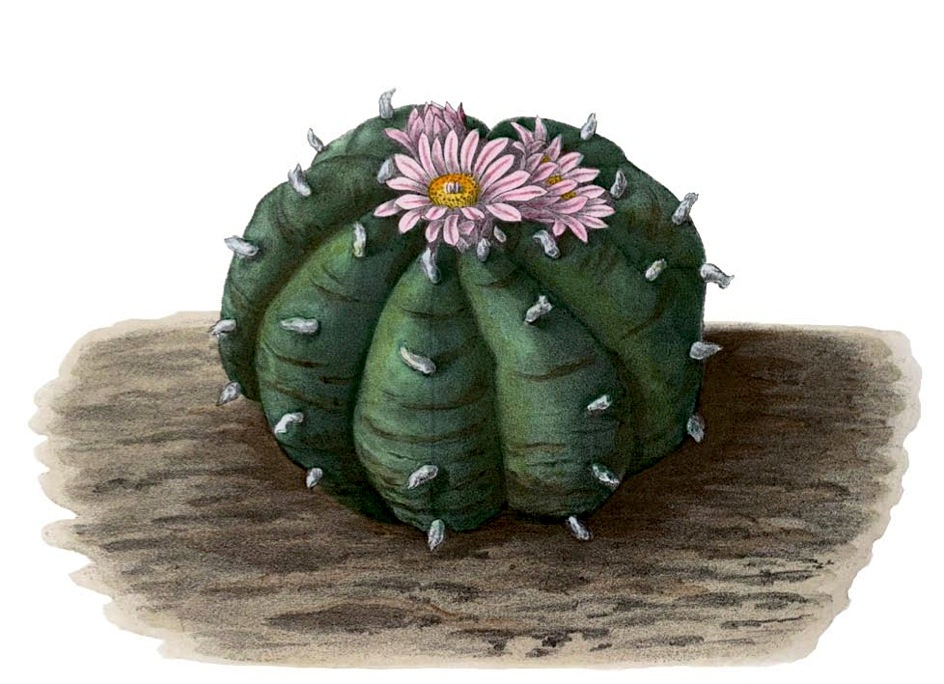
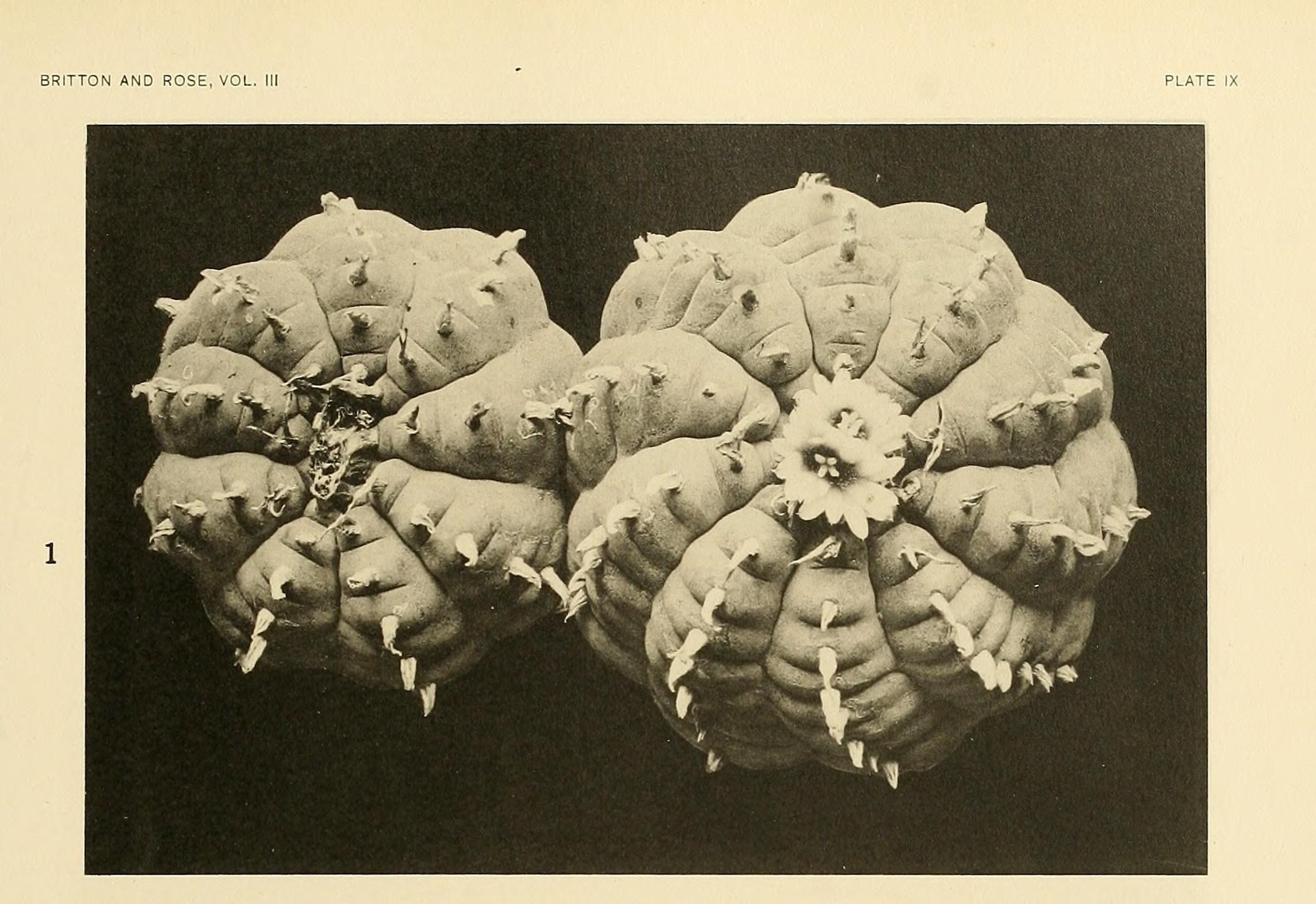
Ololiuhqui, Peyotl, and Teonanácatl in the Florentine Codex
Source, c. 1577

Ololiuhqui, Peyotl, and Teonanácatl in the Florentine Codex

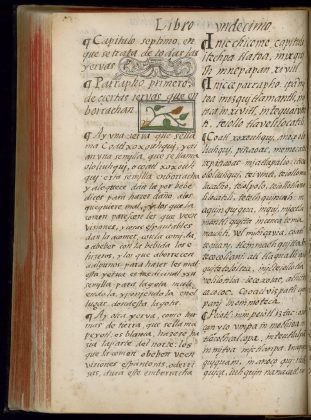
Sahagún’s Book 11 on herbs that intoxicate

Spanish entries from Book 11 of the Florentine Codex, the encyclopedia of Nahua life compiled by Bernardino de Sahagún and Nahua scholars at Tlatelolco around 1577. They describe ololiuhqui, peyotl, tlapatl, mixitl, and teonanácatl, plants and mushrooms that cause intoxication or visions, with an English translation made for the archive.

Read more
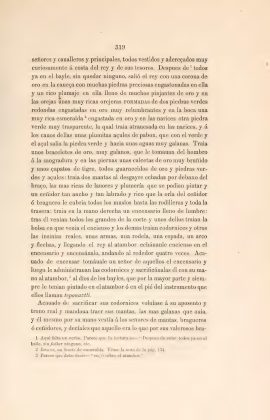
Hongos monteses in Durán's Historia de las Indias de Nueva España
Source, c. 1581; published 1867

Hongos monteses in Durán's Historia de las Indias de Nueva España

Mushrooms, coronations, and the feast of revelations

Three passages from Diego Durán's Historia describing raw mountain mushrooms in Mexica royal ceremonial life: a coronation feast, Durán's note that mushrooms rather than wine appear as the chronicle's intoxicant, and Motecuhzoma's feast of revelations.

Read more
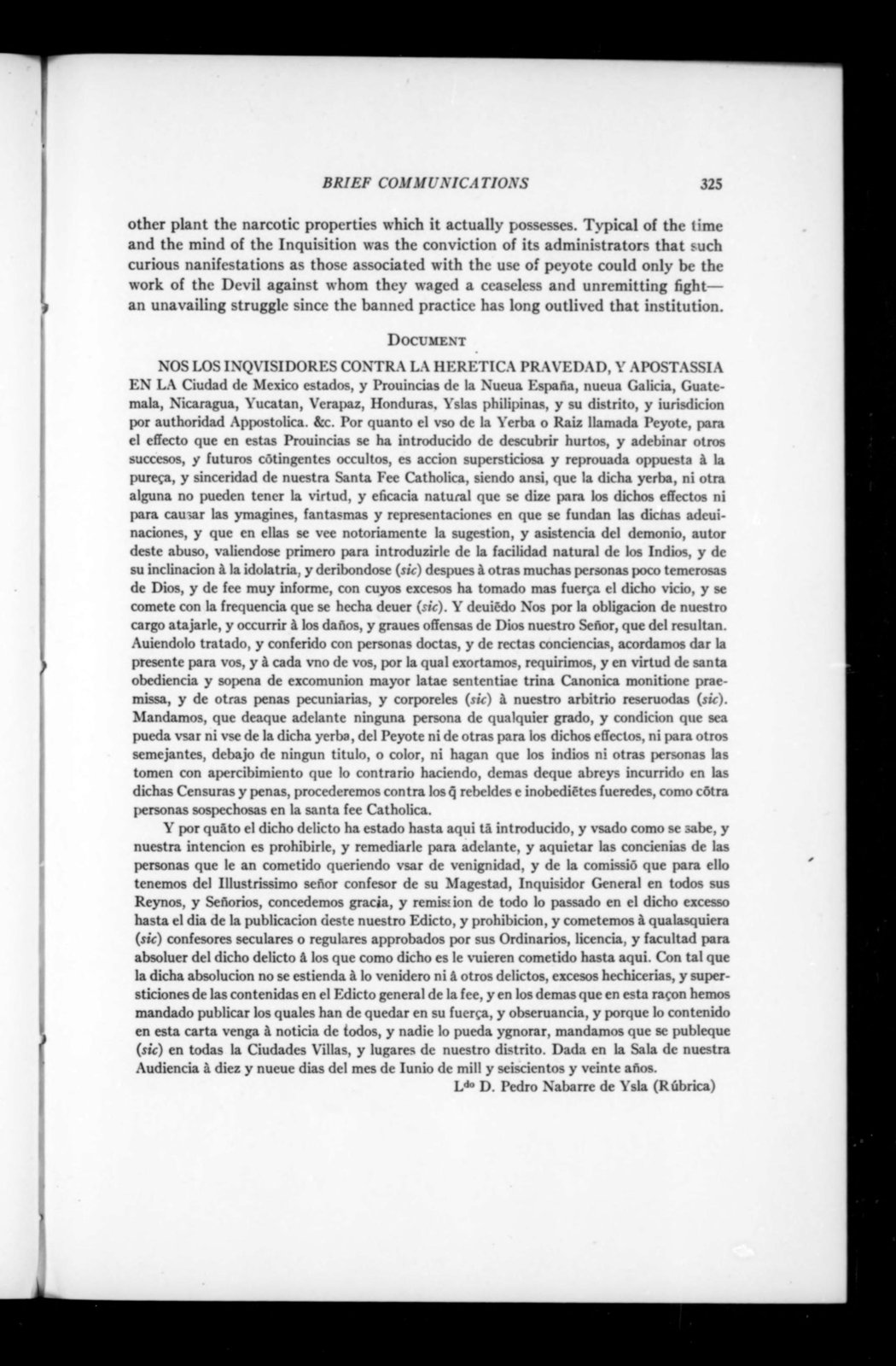
Edict of the Mexican Inquisition Prohibiting the Use of Peyote (1620)
Source, 19 June 1620

Inquisition Edict against Peyote

An edict of the Mexican tribunal of the Holy Office, issued in Mexico City on 19 June 1620 over the signature of Licenciado Pedro Nabarre de Isla, prohibiting the use of peyote to discover thefts and divine hidden or future events. The inquisitors deny the plant any natural power to produce visions, attribute them to the devil, threaten users with excommunication and proceedings as suspects in the faith, and pardon use before the edict's publication. The Spanish text is hosted as printed by Irving A. Leonard (1896–1996) in American Anthropologist in 1942, with a new English translation.

Read more
Ololiuhqui and Peyote in Idolatrías y supersticiones de los indios
Source, 1629-1656; published 1892

Ololiuhqui and Peyote in Idolatrías y supersticiones de los indios

Colonial anti-idolatry texts on divination, healing, and visionary plants

A set of Spanish colonial anti-idolatry excerpts describing ololiuhqui and peyote as oracular substances used in healing, theft investigation, divination, and diagnosis of sorcery. The source preserves rare early descriptions of visionary plant practice while also showing how clerical authorities criminalized and demonized Indigenous ritual knowledge.

Read more
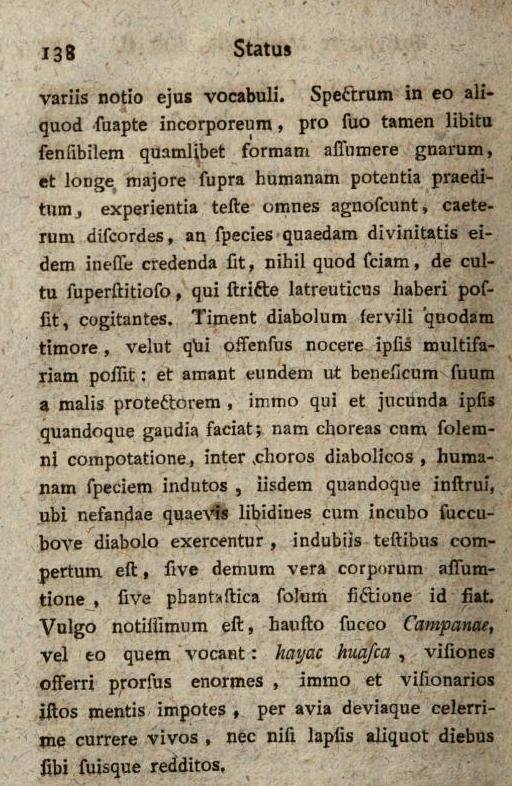
Franz Xaver Veigl on Ayahuasca in Maynas
Source, c. 1768–1785 (exact date unclear)

Franz Xaver Veigl on Ayahuasca in Maynas

Franz Xaver Veigl, a German Jesuit who worked in the mission province of Maynas in the upper Amazon until the Jesuits were expelled in 1768, describes healers and visionary drinks there. He writes that people who drank "hayac huasca" saw "absolutely enormous visions" and seemed to travel far away, and, like other missionaries of his time, he treats this as dealings with the devil. English translation of Latin passages from his account of Maynas.

Read more
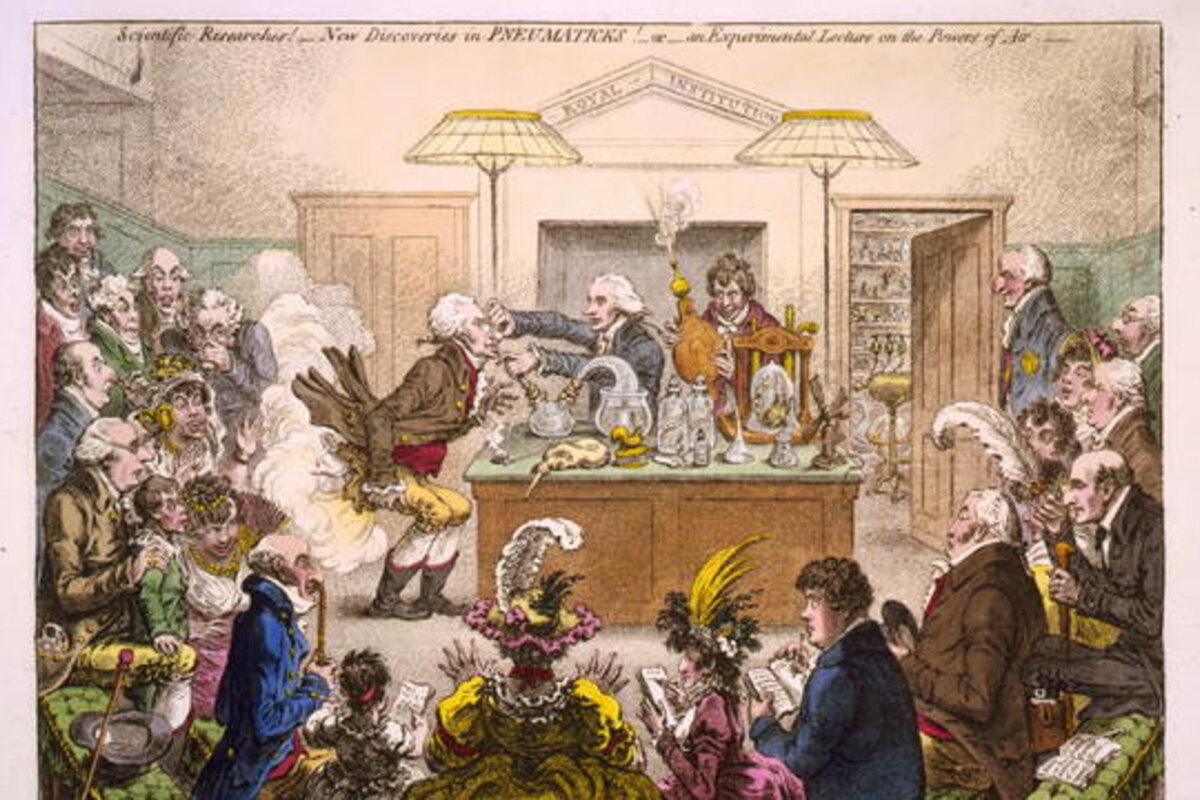
Researches, Chemical and Philosophical; Chiefly Concerning Nitrous Oxide
Source, 1800

Researches, Chemical and Philosophical; Chiefly Concerning Nitrous Oxide

Humphry Davy's account of breathing nitrous oxide at Thomas Beddoes's Pneumatic Institution in Bristol in 1799, from the fourth part of his Researches. The excerpt gives Davy's own experiments, including the session that ended with "Nothing exists but thoughts!", and the reports he collected from Robert Southey, Peter Roget, Samuel Taylor Coleridge, and Thomas Wedgwood.

Read more

Fly Agaric among the Koryaks in Langsdorff's Bemerkungen
Source, 1812

Fly Agaric among the Koryaks in Langsdorff's Bemerkungen

A Kamchatka note on mushroom trade and intoxication

Langsdorff's 1812 German voyage account records fly agaric in Koryak trade with Russians and Kamchadals, noting in a footnote that Koryaks preferred it to brandy as a stupefying or intoxicating substance.

Read more
Paricá among the Mura in Spix and Martius's Reise in Brasilien
Source, 1831

Paricá among the Mura in Spix and Martius's Reise in Brasilien

A German travel account of Amazonian snuff, ceremony, and intoxication

Spix and Martius's 1831 German travel narrative describes paricá among the Mura, including preparation from dried seeds, ceremonial use, insufflation through tubes, and comparison with fly agaric intoxication.

Read more
Hashish and Mental Alienation
Source, 1845

Hashish and Mental Alienation

Moreau de Tours on dawamesc, self-experiment, and experimental psychiatry

Selected passages from Moreau de Tours's 1845 psychiatric treatise on hashish, including his insistence on personal experience, description of dawamesc preparation and dosing, and claim that hashish offered a unique experimental route into the psychology of madness.

Read more
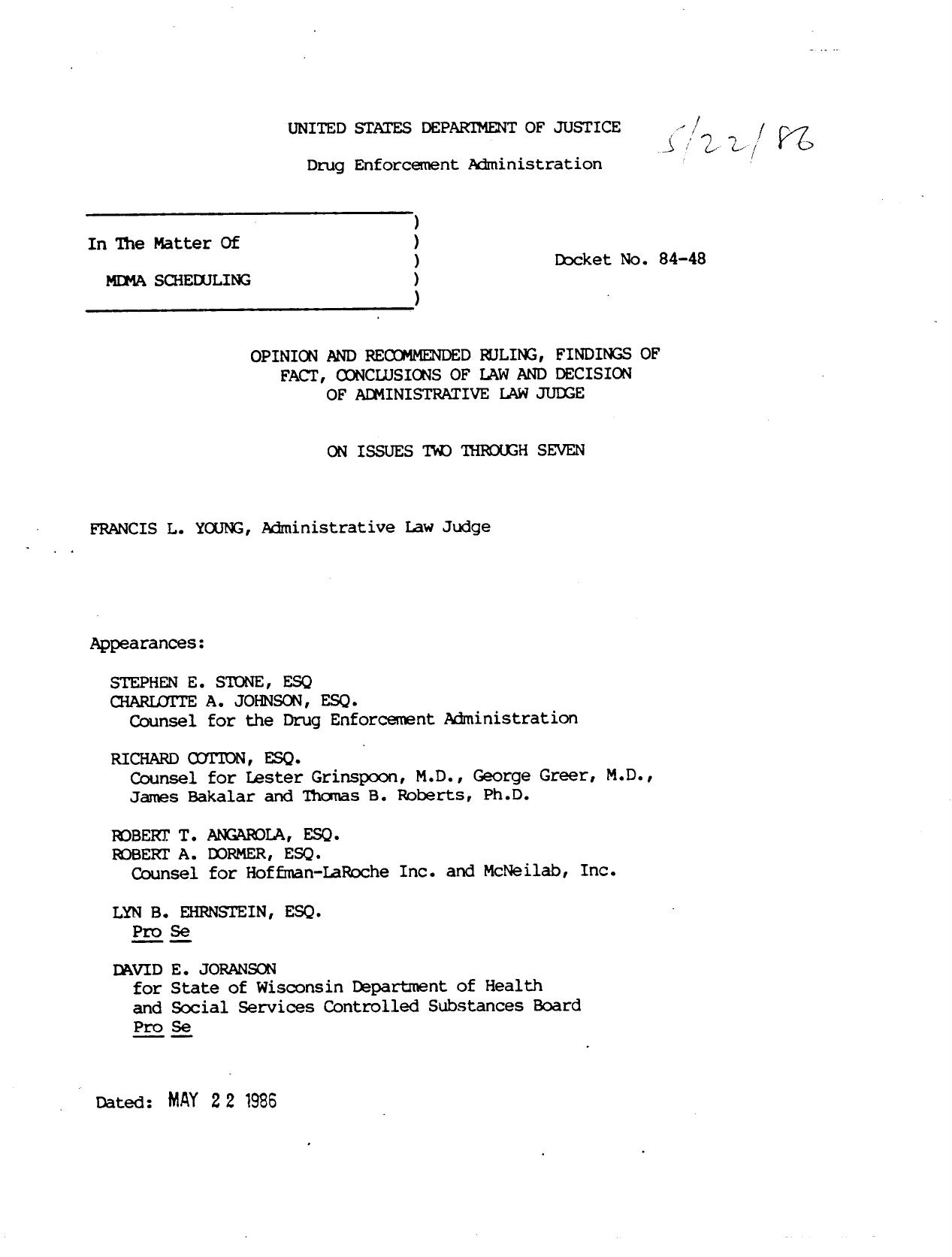
Fly Agaric and Hashish in Die narkotischen Genussmittel
Source, 1855

Fly Agaric and Hashish in Die narkotischen Genussmittel

Ernst von Bibra's German comparative account of Amanita and Cannabis

Selective excerpts from Ernst von Bibra's 1855 German survey of narcotic Genussmittel, focused on fly agaric and hashish. The passages show a mid-century comparative framework linking Amanita, Cannabis, opium, alcohol, travel accounts, chemistry, and differential effects across persons and places.

Read more
The Hasheesh Eater
Source, 1857

The Hasheesh Eater

Fitz Hugh Ludlow's account of his cannabis use as a young man in Poughkeepsie and at Union College, published anonymously in 1857 when he was twenty-one. In this excerpt (pages 18–26) he finds Cannabis indica at a local apothecary's shop, reads about it in the Dispensatory, and takes his first doses.

Read more
Ayahuasca in Villavicencio's Geografía de la República del Ecuador
Source, 1858

Ayahuasca in Villavicencio's Geografía de la República del Ecuador

An 1858 Ecuadorian account of ayahuasca visions and divination

Manuel Villavicencio's 1858 geography gives an early Spanish account of ayahuasca among Indigenous groups of eastern Ecuador, including divination, warfare, illness diagnosis, visionary effects, and a first-person report of his own experience.

Read more
Le Gabon (Deuxième partie)
Source, 1865

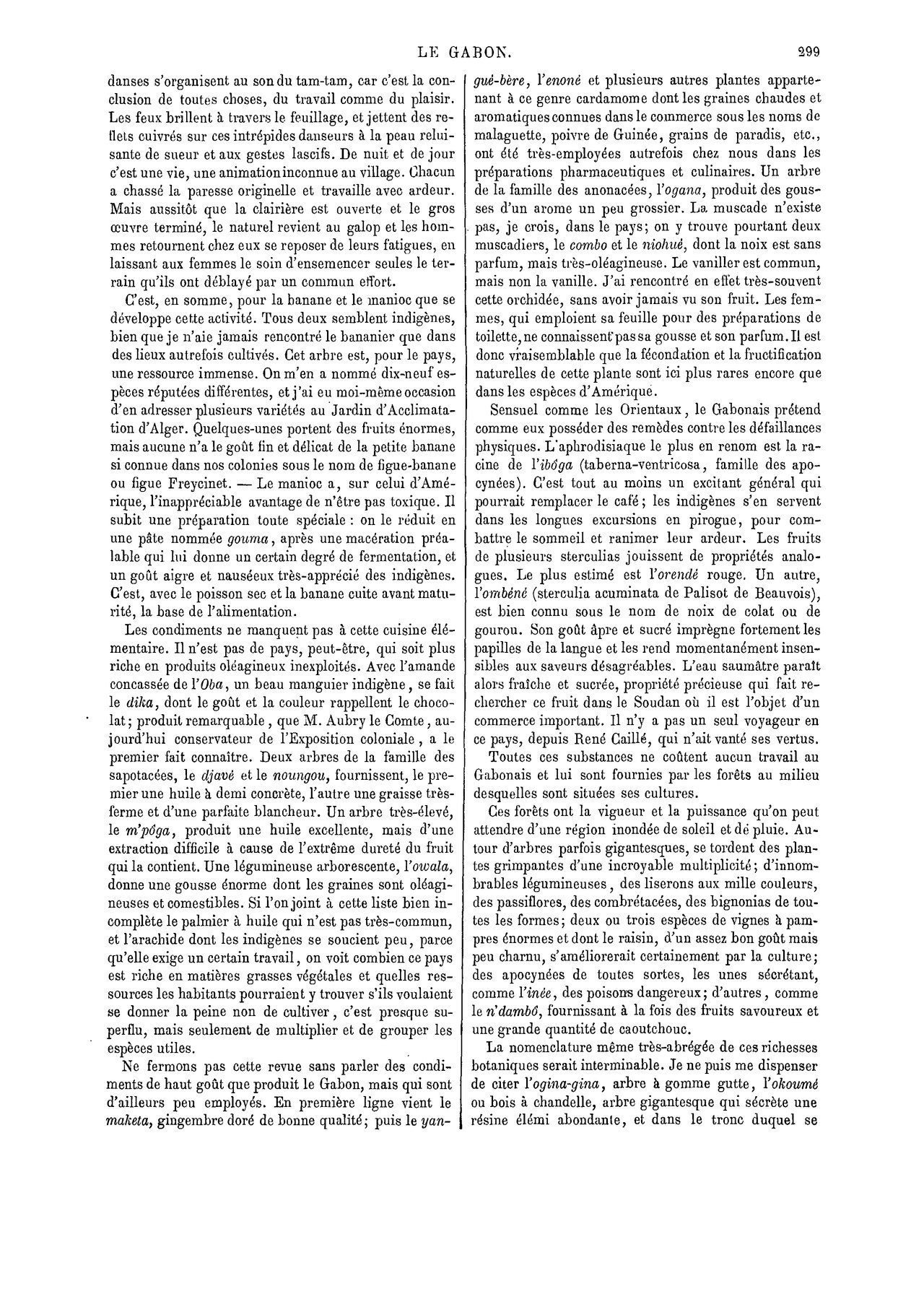
Le Gabon

A French naval physician's 1865 travel account surveys Gabon's food plants and condiments, describing iboga as a stimulant and aphrodisiac used by paddlers on long canoe trips. He gives it the genus name 'taberna-ventricosa,' later corrected by Baillon.

Read more
Caapi and Niopo in “On Some Remarkable Narcotics of the Amazon Valley and Orinoco”
Source, c. 1870; published 1908

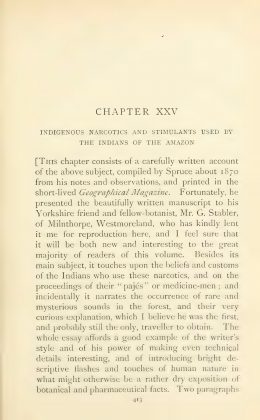
Caapi and Niopo in “On Some Remarkable Narcotics of the Amazon Valley and Orinoco”

Richard Spruce on ayahuasca, yopo/paricá, and Amazonian medicine-men

Richard Spruce's nineteenth-century account of caapi, aya-huasca, niopo, and paricá, based on field observations in the Uaupés, Orinoco, Rio Negro, Napo, and Pastasa regions. The excerpt records plant identifications, preparation methods, visual effects, ceremonial uses, and the role of payes in curing and divination.

Read more
The Anaesthetic Revelation and the Gist of Philosophy
Source, 1874

The Anaesthetic Revelation and the Gist of Philosophy

Benjamin Paul Blood's privately printed 1874 pamphlet, the source of the phrase "anaesthetic revelation." Hosted here is the section in which Blood, after nearly fourteen years of experiments with anaesthetics, describes the insight that comes at the moment of "coming to." William James reviewed the pamphlet that year and later quoted this passage in The Varieties of Religious Experience.

Read more
Review of The Anaesthetic Revelation and the Gist of Philosophy
Source, 1874

Review of The Anaesthetic Revelation and the Gist of Philosophy

William James's unsigned review of Blood's pamphlet, published in the Atlantic Monthly in November 1874, eight years before his own nitrous oxide experiments. James summarizes Blood's claims at length and judges the pamphlet "thoroughly original and very suggestive," if less important than its author believed.

Read more
Nitrous Oxide and the Anaesthetic Revelation in The Varieties of Religious Experience
Source, 1902

Nitrous Oxide and the Anaesthetic Revelation in The Varieties of Religious Experience

From the lecture on mysticism in William James's Gifford Lectures, delivered in Edinburgh in 1901–2. James argues that nitrous oxide and ether show "our normal waking consciousness" to be only one type among many, then quotes Blood and J. A. Symonds's chloroform experience. His notes add Xenos Clark's letter on the revelation and an Englishwoman's ether dream.

Read more
Anaesthetics Antient and Modern: An Historical Sketch of Anaesthesia
Source, Undated (c. 1907–1910)

Anaesthetics Antient and Modern

An Historical Sketch of Anaesthesia

An illustrated history of anaesthesia issued by the London drug firm Burroughs Wellcome & Co., which closes by advertising its own 'Wellcome' brand chloroform. Hosted here are the chapters on nitrous oxide, ether, and chloroform, covering Horace Wells's 1844 self-experiment, the ether demonstrations of William Morton and Charles Jackson, and James Young Simpson's 1847 chloroform trial.

Read more
A Pluralistic Mystic
Source, 1910

A Pluralistic Mystic

William James's last published essay, an appreciation of Benjamin Paul Blood that appeared in the Hibbert Journal in July 1910, weeks before James died. James quotes Blood's pamphlets and letters at length and traces how the anaesthetic revelation, which James first read as monism, became for Blood the basis of a pluralist philosophy.

Read more
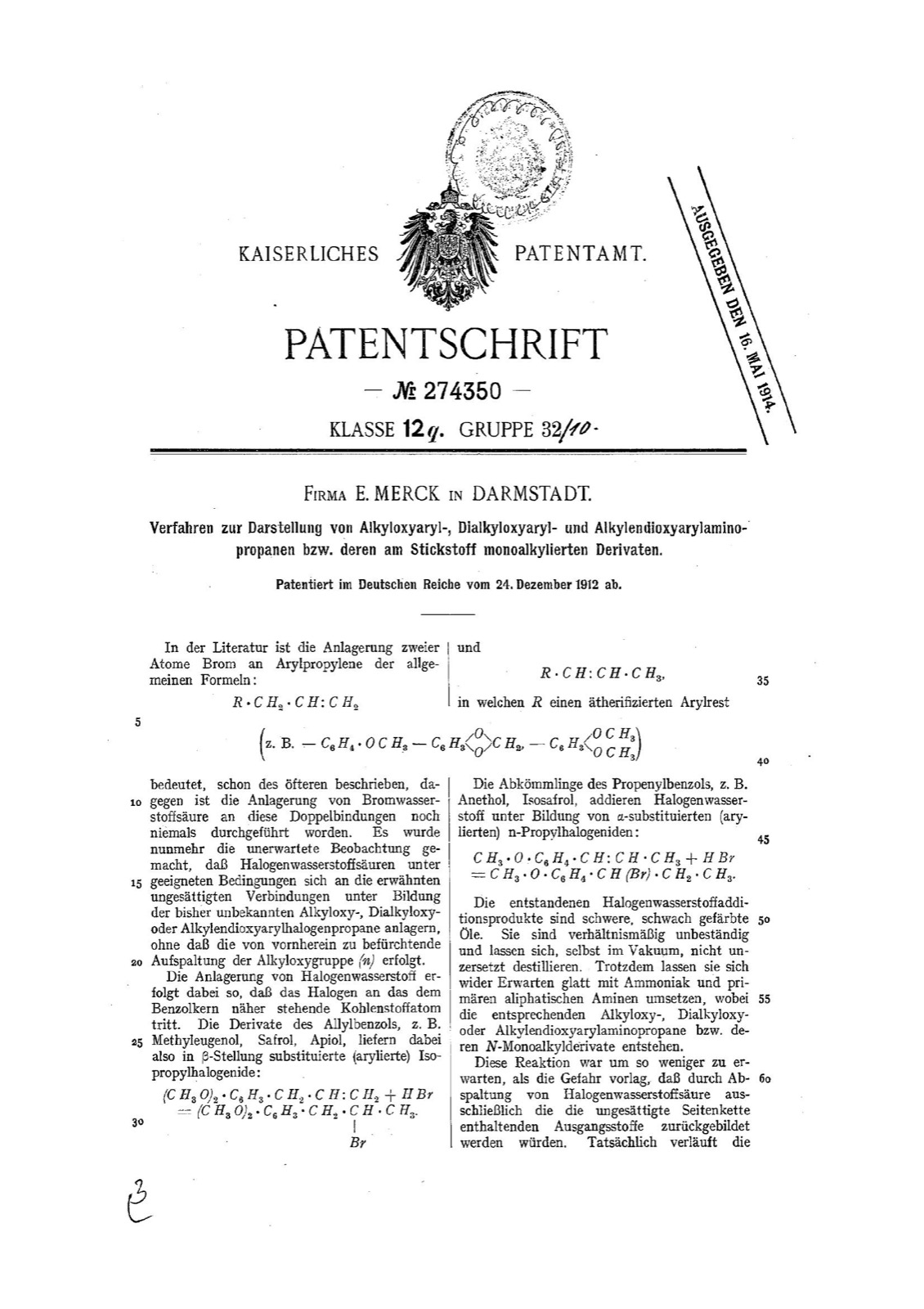
German Reich Patent No. 274350: Process for the Preparation of Alkyloxyaryl-, Dialkyloxyaryl- and Alkylenedioxyarylaminopropanes (Firm E. Merck, Darmstadt)
Source, Patented from 24 December 1912; specification published 1914

Merck Patent DE 274350

Process for the Preparation of Alkyloxyaryl-, Dialkyloxyaryl- and Alkylenedioxyarylaminopropanes (Firm E. Merck, Darmstadt)

German Reich Patent No. 274350 (1912) describes arylaminopropane synthesis from safrole. Example 4 yields MDMA by heating a brominated intermediate with methylamine—the earliest documented synthesis. The patent claims MDMA only as an unnamed chemical intermediate toward unspecified therapeutic compounds, not as a substance of interest itself.

Read more
The Anaesthetic Revelation, from Pluriverse
Source, 1920

The Anaesthetic Revelation, from Pluriverse

Benjamin Paul Blood's last book, published in 1920, the year after his death, with an introduction by Horace Kallen. Hosted here is the opening of the final chapter, "The Anaesthetic Revelation," where Blood compares the anaesthetic insight to the trance cattle fall into at spilled blood and quotes James on the "artificial mystic state of mind."

Read more
State v. Big Sheep
Source, January 26, 1926

State v. Big Sheep

The Montana Supreme Court reverses a Crow man's peyote conviction, finding the state failed to establish jurisdiction over an offense on the Crow Reservation. The court addresses federal Indian law and rejects the defendant's religious-use defense, but does not decide the jurisdictional question, remanding for new trial.

Read more
Native American Church of North America v. Navajo Tribal Council
Source, November 17, 1959

Native American Church v. Navajo Tribal Council

The Tenth Circuit affirms dismissal of a Native American Church suit against the Navajo Tribal Council's 1940 peyote ban, holding that the First Amendment does not apply to tribal governments unless Congress extends it. The court treats tribes as sovereign nations outside the federal Constitution.

Read more
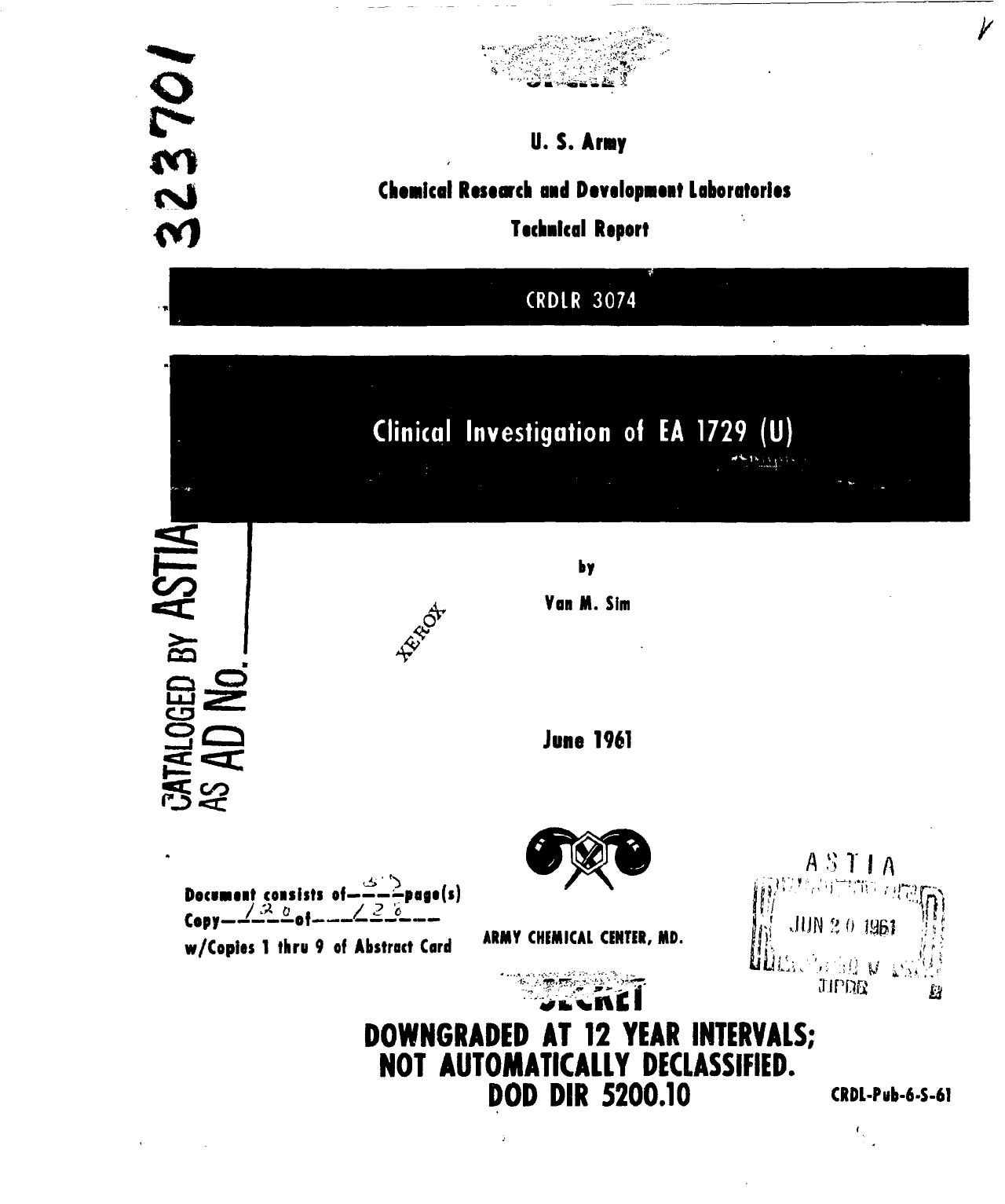
Clinical Investigation of EA 1729
Source, June 1961

Clinical Investigation of EA 1729 (CRDLR 3074)

A declassified Army Chemical Research and Development Laboratories report on EA 1729 (LSD-25) as a non-lethal incapacitating agent. Includes clinical studies from 1955-1960 and September 1958 field tests at Fort Bragg in which whole military units were dosed with LSD and evaluated on operational tasks; all units proved unable to perform their missions.

Read more
People v. Woody
Source, August 24, 1964

People v. Woody

The California Supreme Court reverses the peyote convictions of four Navajo men arrested at a Native American Church meeting near Needles in 1962. Justice Tobriner's opinion describes the all-night ceremony, its officers and its ritual objects before reaching the First Amendment question.

Read more
United States v. Kuch
Source, July 1, 1968

United States v. Kuch

Judge Gesell denies the Neo-American Church's motion to dismiss LSD and marihuana charges against a minister. The court catalogs the church's symbols and regalia, concludes it lacks genuine religious doctrine, and rejects an equal-protection claim based on the Native American Church's peyote exemption.

Read more
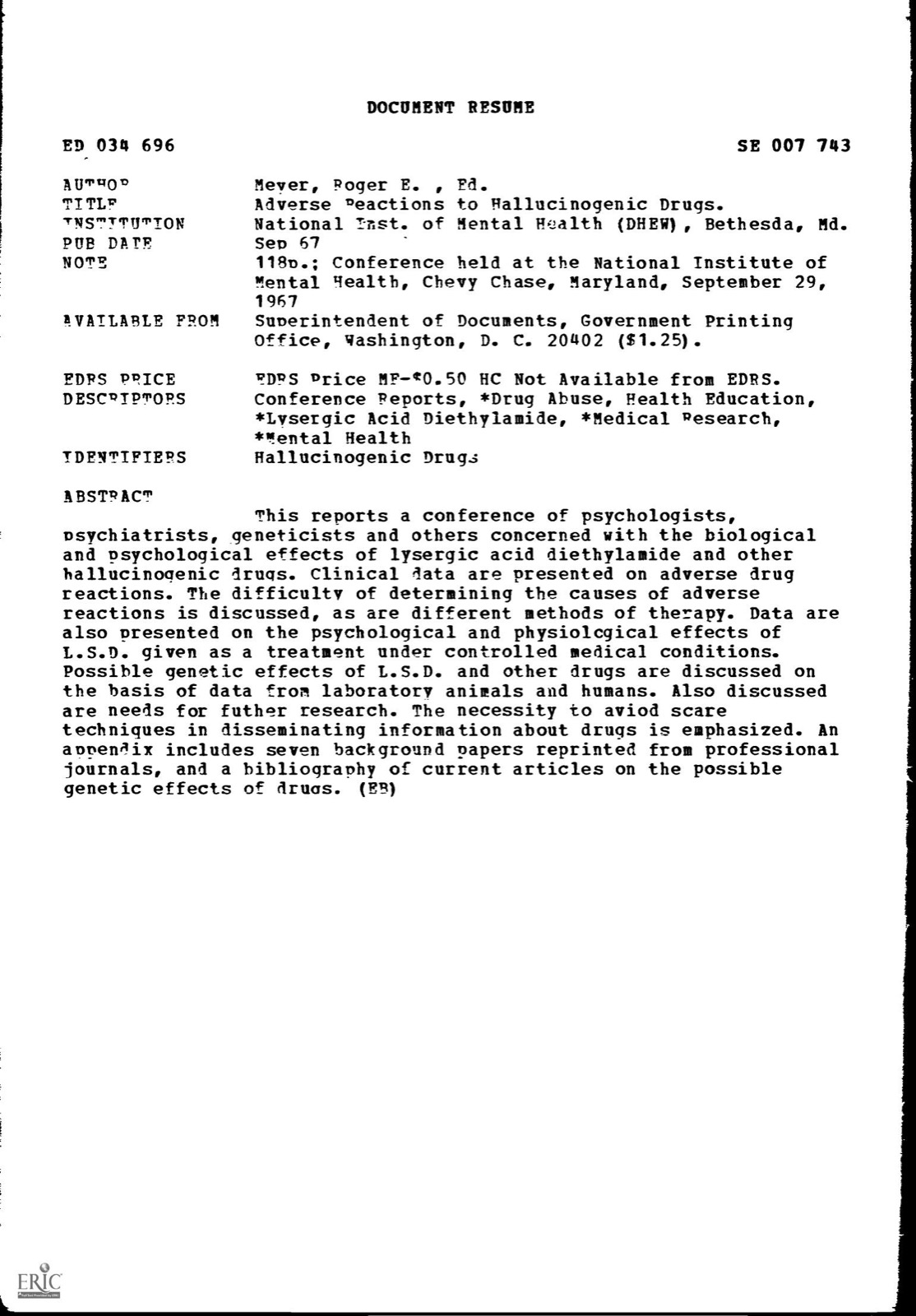
Adverse Reactions to Hallucinogenic Drugs: Proceedings of a Conference Held at the National Institute of Mental Health
Source, 1969 (conference held September 29, 1967)

Adverse Reactions to Hallucinogenic Drugs

Proceedings of a Conference Held at the National Institute of Mental Health

Proceedings of an NIMH conference held September 29, 1967, on adverse reactions to hallucinogenic drugs, published 1969. Addressed LSD's alleged chromosomal and teratogenic effects and the government's challenge in communicating risks to the drug-using public without propaganda.

Read more
PIC Bulletin 33
Source, 1970

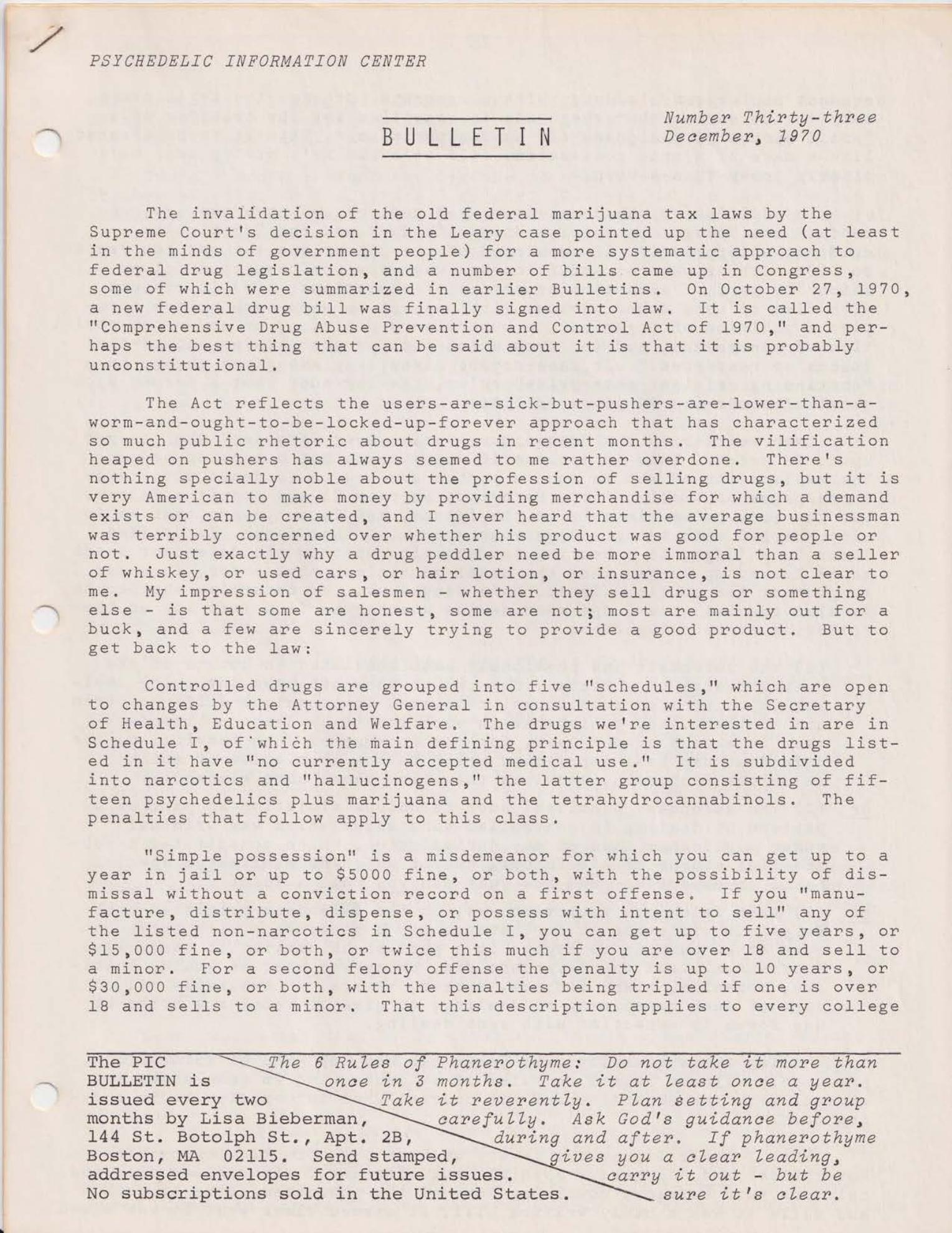
No. 33

Lisa Bieberman's December 1970 bulletin explains the Comprehensive Drug Abuse Prevention and Control Act, signed on October 27, 1970, which placed LSD and other psychedelics in Schedule I. She criticizes its penalties, its "continuing criminal enterprise" and "dangerous special drug offender" provisions, and its no-knock searches, then argues against the claim that drug-induced religious experience is "unnatural."

Read more
PIC Bulletin 32
Source, 1970

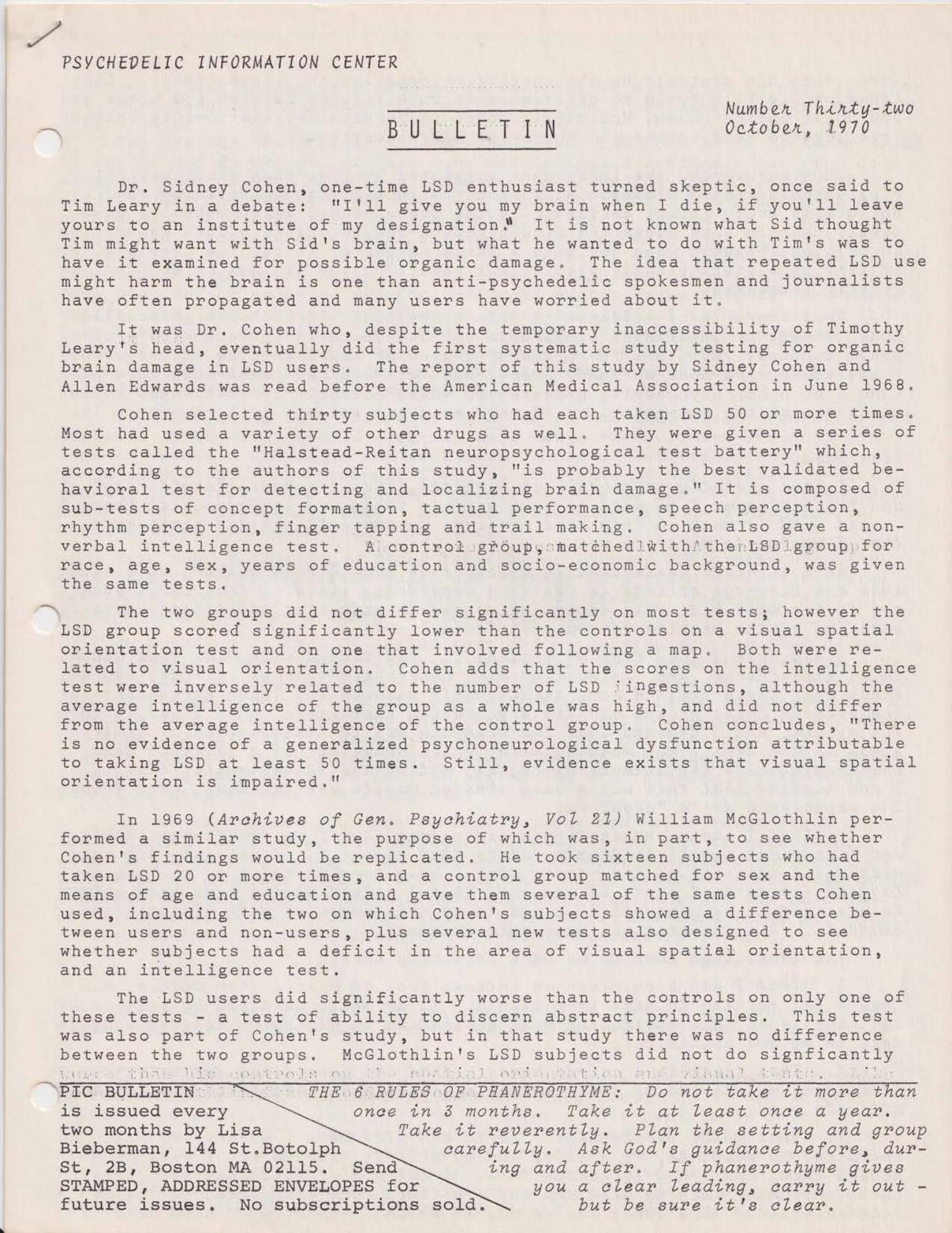
No. 32

Lisa Bieberman's October 1970 bulletin reviews the two studies then available on whether heavy LSD use damages the brain: Sidney Cohen and Allen Edwards's 1968 neuropsychological tests of thirty users, and William McGlothlin's 1969 attempt to replicate them. Because their results disagree, she concludes there is no evidence of general brain damage. The issue also prints a social worker's letter about how taking LSD changed his work with drug-using teenagers.

Read more
How to Guide a Session (from The Boo Hoo Bible)
Source, 1971

How to Guide a Session

Art Kleps's chapter on running an LSD session from The Boo Hoo Bible (1971), the Neo-American Church catechism and handbook. Hosted here is roughly the first half of the chapter: Kleps's advice on the session room, his distinction between 'Ivory' (spiritual) and 'Horny' (psychological) sessions, his view of what a guide needs to know, and his 'Good Answer / Bad Answer' examples for questions a subject might ask during a session.

Read more
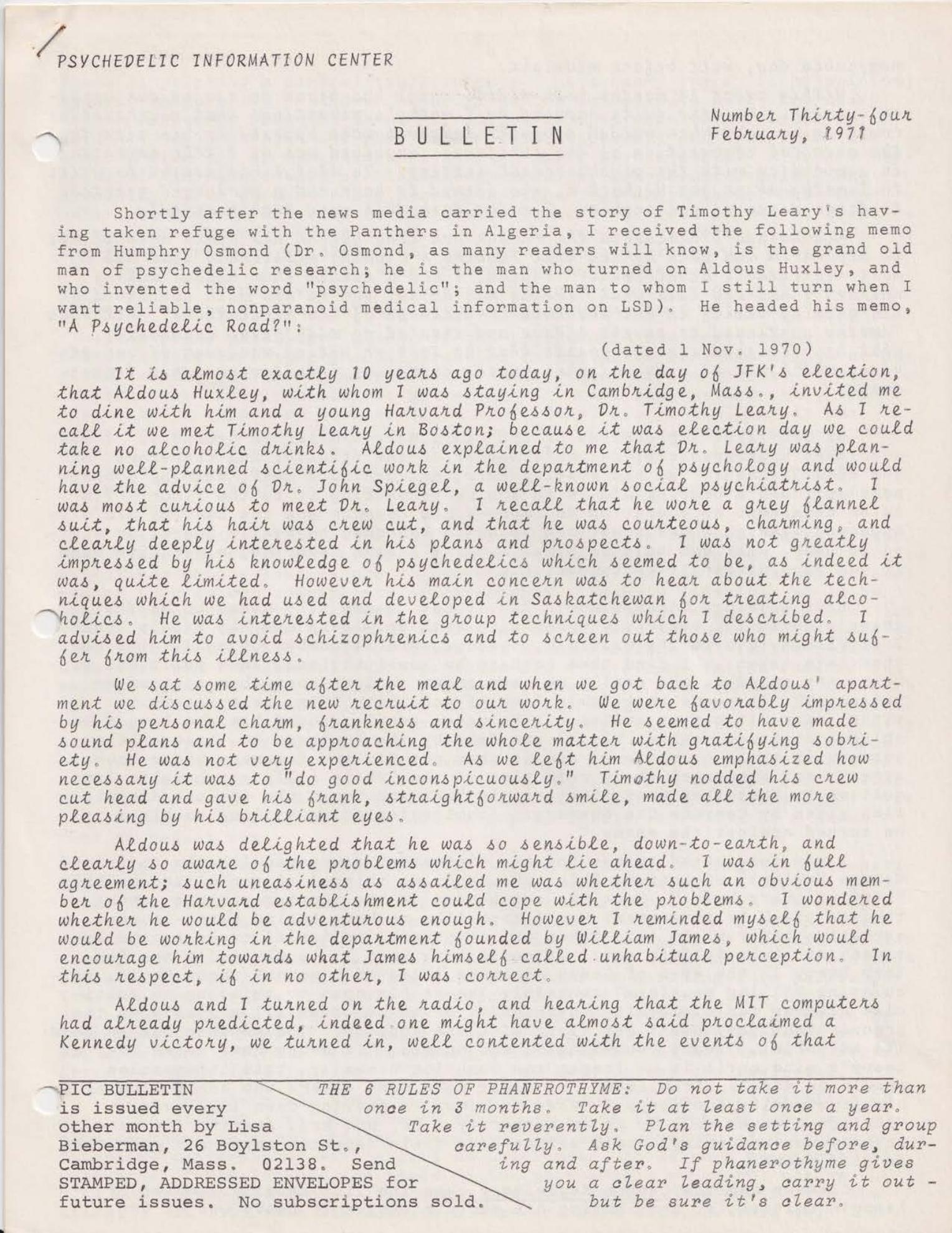
PIC Bulletin 34
Source, 1971

No. 34

Lisa Bieberman's February 1971 bulletin responds to news that the Black Panthers in Algeria had put the escaped Timothy Leary under house arrest. It prints a memo from Humphry Osmond recalling how he and Aldous Huxley met Leary in 1960 and later came to distrust his missionary zeal, followed by Bieberman's own memories of Leary at Harvard and a critique of press claims that LSD had ruined his mind.

Read more
Report to the President by the Commission on CIA Activities within the United States
Source, June 1975

Report to the President by the Commission on CIA Activities within the United States

Rockefeller Commission findings on CIA drug testing and domestic activities

The Rockefeller Commission's 1975 report was the first major presidential inquiry to put CIA drug experiments, including LSD-related episodes and the death of Frank Olson, into an official public account. It became a bridge between the commission investigation, the Church Committee, and the later Senate MKULTRA hearing.

Read more
Foreign and Military Intelligence: Church Committee Final Report, Book I
Source, 1976

Foreign and Military Intelligence

Full Senate report including the chapter on chemical and biological agents

Book I of the Church Committee final report, Foreign and Military Intelligence, includes the committee's findings on CIA testing and use of chemical and biological agents. The full volume places MKULTRA and LSD-related experimentation within broader findings on covert action, intelligence oversight, and congressional accountability.

Read more
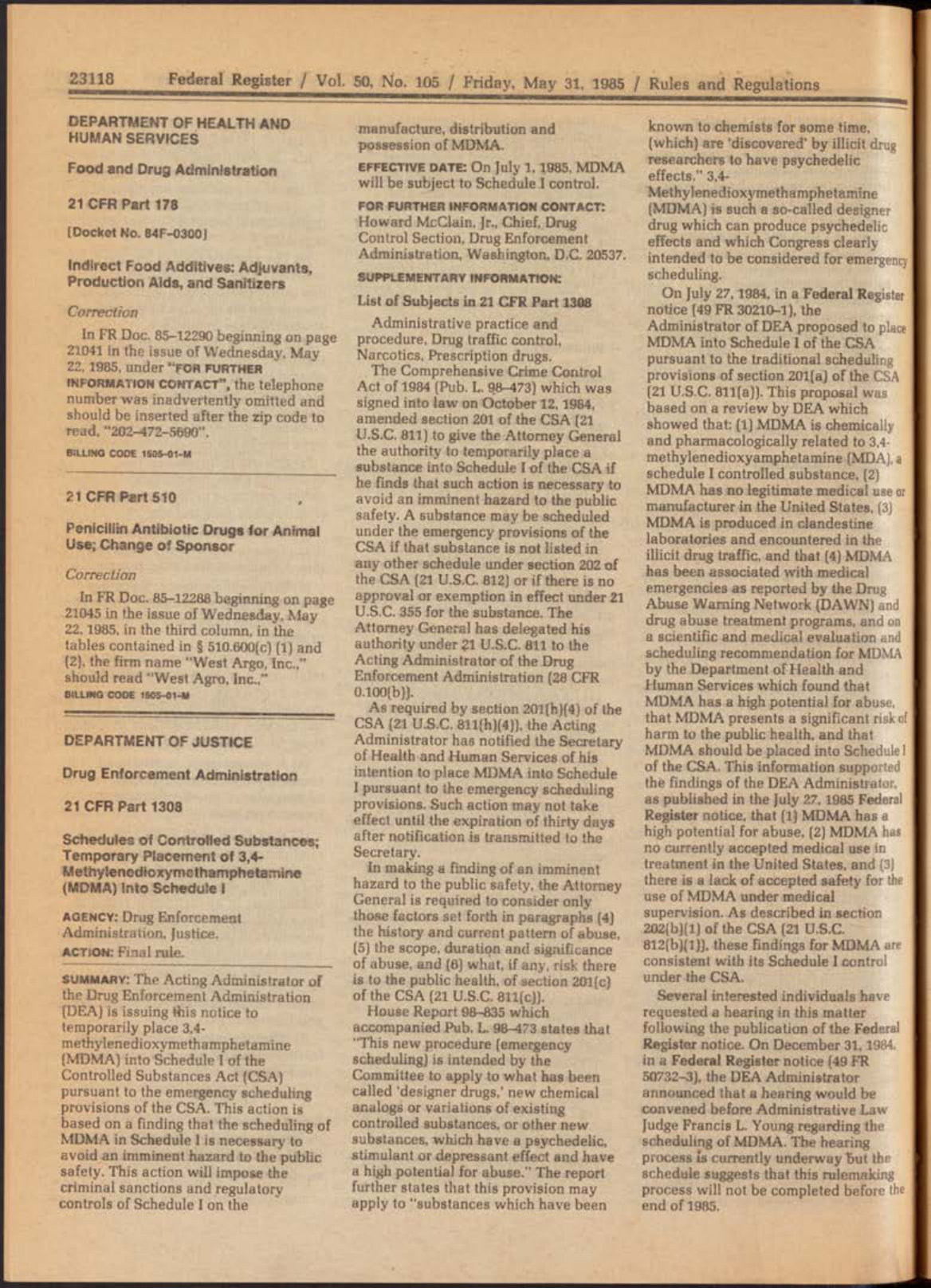
Schedules of Controlled Substances; Temporary Placement of 3,4-Methylenedioxymethamphetamine (MDMA) Into Schedule I
Source, May 31, 1985 (effective July 1, 1985)

DEA emergency scheduling of MDMA

The Drug Enforcement Administration's order placing MDMA in Schedule I on an emergency basis from July 1, 1985, using powers Congress had given it the year before for so-called designer drugs. The notice cites rising recreational use, promotional parties, and a new rat study showing that the related drug MDA destroyed serotonin nerve terminals. It was issued while Judge Francis L. Young's hearings on permanent scheduling were still under way. Full text of the notice.

Read more
Opinion and Recommended Ruling, Findings of Fact, Conclusions of Law, and Decision of Administrative Law Judge (MDMA Scheduling)
Source, May 22, 1986

In re MDMA Scheduling (ALJ Young opinion)

After seventeen days of hearings, Administrative Law Judge Francis L. Young recommends placing MDMA in Schedule III rather than Schedule I. He finds currently accepted medical use and accepted safety for medical supervision based on psychiatrists' testimony, animal lethality studies, and clinical experience with supervised psychotherapy.

Read more
Grinspoon v. Drug Enforcement Administration
Source, September 18, 1987

Grinspoon v. DEA

The First Circuit vacates the DEA's rule placing MDMA in Schedule I, holding the Administrator's interpretation of 'accepted medical use' was contrary to Congress's intent. Dr. Grinspoon, a Harvard psychiatrist seeking to research MDMA therapeutically, brought the appeal after the Administrator overruled the ALJ's Schedule III recommendation.

Read more
Employment Division, Department of Human Resources of Oregon v. Smith
Source, April 17, 1990

Employment Division v. Smith

The Supreme Court holds that Oregon may deny unemployment benefits to two Native American Church members dismissed for sacramental peyote use, since a neutral criminal drug law requires no religious exemption. Blackmun dissents.

Read more
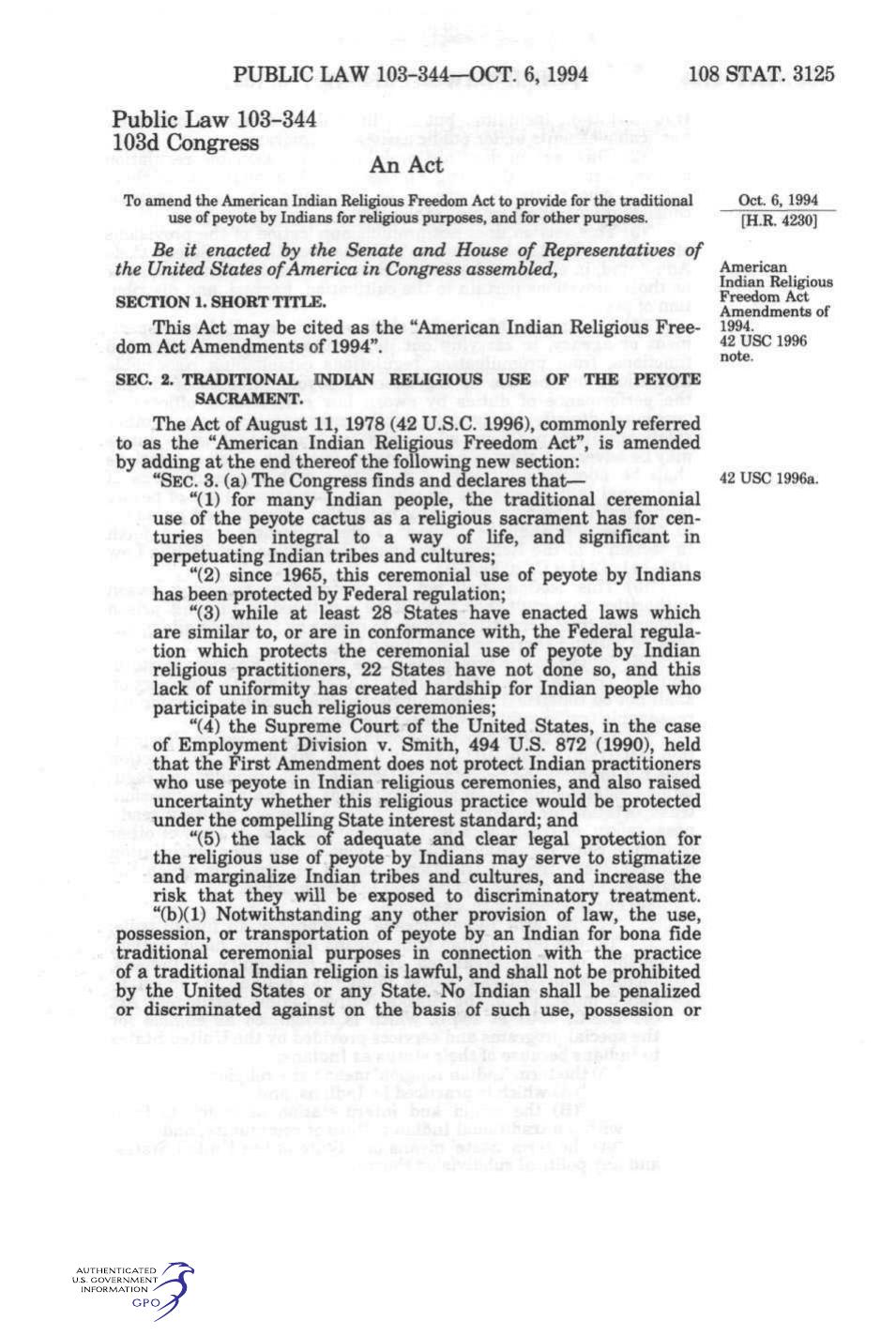
American Indian Religious Freedom Act Amendments of 1994 (Public Law 103-344)
Source, Approved October 6, 1994

AIRFA Amendments of 1994

Congress restored a nationwide exemption for the ceremonial use of peyote by Indians in connection with traditional religions. The statute carves out exceptions for prison, military, and safety-sensitive positions.

Read more
Gonzales v. O Centro Espirita Beneficente Uniao do Vegetal
Source, February 21, 2006

Gonzales v. O Centro

Chief Justice Roberts holds the federal government failed to show a compelling interest justifying its ban on the Uniao do Vegetal church's sacramental use of hoasca (ayahuasca tea with DMT) under the Religious Freedom Restoration Act. The Court rejects the UN Convention argument and upholds the peyote precedent for religious exemptions to the Controlled Substances Act.

Read more
Church of the Holy Light of the Queen v. Mukasey
Source, March 18, 2009

Church of the Holy Light of the Queen v. Mukasey

A federal court ruling applying Gonzales v. O Centro to the Santo Daime church in Oregon, granting the right to import and drink ayahuasca under RFRA. Judge Panner's findings describe the religion's origins, ritual, physiological effects, and the government's health and diversion evidence.

Read more
Oregon Psilocybin Services Act (Ballot Measure 109)
Source, Approved by voters November 3, 2020; codified as Oregon Laws 2021, chapter 1

Oregon Measure 109

Oregon's 2020 ballot measure created the first US state-licensed psilocybin services program. The findings cite FDA's breakthrough-therapy designation for depression, and the statute establishes licensed service centers and facilitators rather than unsupervised legalization.

Read more
Psychedelic Drugs: Considerations for Clinical Investigations (Guidance for Industry)
Source, July 2026 (finalizing a June 2023 draft)

FDA Psychedelic Drugs Guidance

Considerations for Clinical Investigations (Guidance for Industry)

FDA guidance (July 2026) for sponsors developing psychedelics—5-HT2A agonists including psilocybin and LSD, plus MDMA—as approved medicines. It addresses the regulatory pathway for Schedule I drugs in clinical trials and identifies methodological challenges: perceptual effects complicate blinding ('functional unblinding'), and the independent contribution of psychotherapy paired with dosing remains uncharacterized.

Read more