Psychotropic Properties of the Harmala Alkaloids
A Chilean psychiatrist's report on harmala alkaloids, ayahuasca-related beta-carbolines, and comparative human experiments with harmaline and mescaline at the University of Chile.
Topic
Mescaline, the alkaloid of peyote, in self-experiments, pharmacology, and psychiatric research.

A Chilean psychiatrist's report on harmala alkaloids, ayahuasca-related beta-carbolines, and comparative human experiments with harmaline and mescaline at the University of Chile.

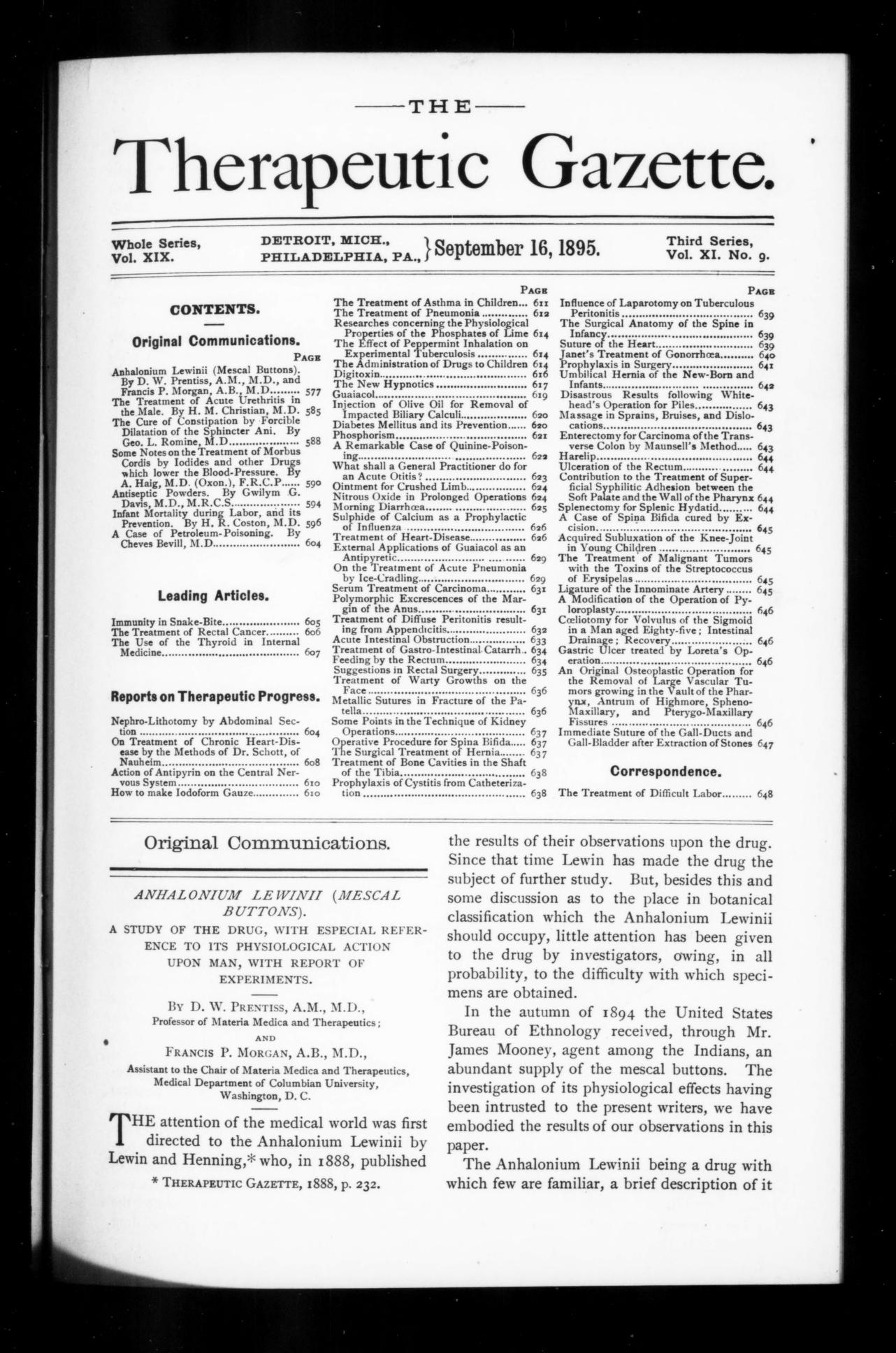
A Study of the Drug, with Especial Reference to its Physiological Action upon Man, with Report of Experiments
Prentiss and Morgan conducted the first American clinical study of peyote at Columbian University on buttons supplied by ethnologist James Mooney. They recorded physiological effects alongside subjects' first-person accounts of visions, including kaleidoscopic colors and dissociative experiences.

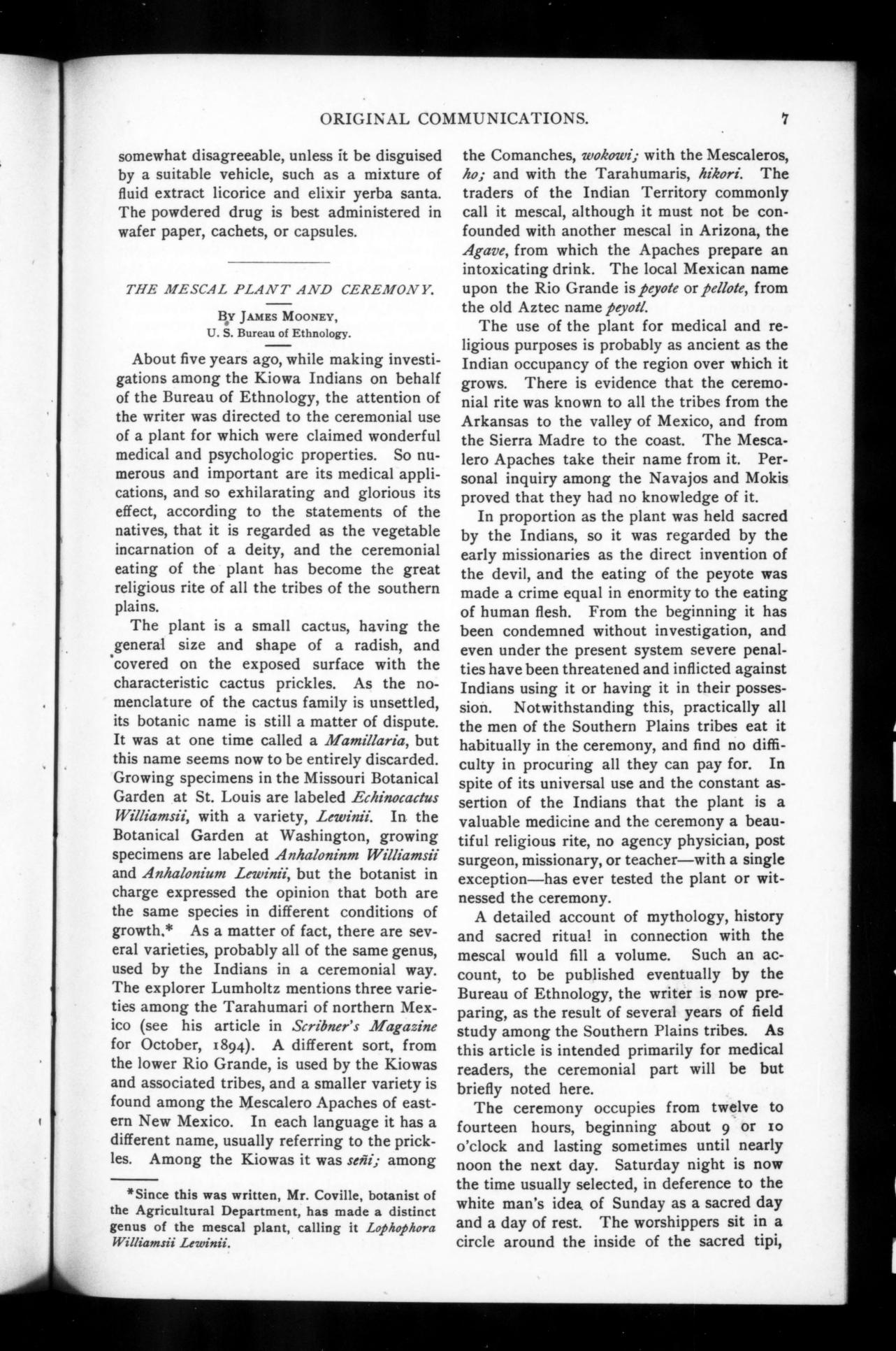
An account of the Kiowa and Comanche peyote ceremony by ethnologist James Mooney, published in the Therapeutic Gazette in 1896. Drawing on field observation and participation since 1891, Mooney describes the all-night rite, dosages, and cases including his interpreter Paul Setkopti and leader Quanah Parker.

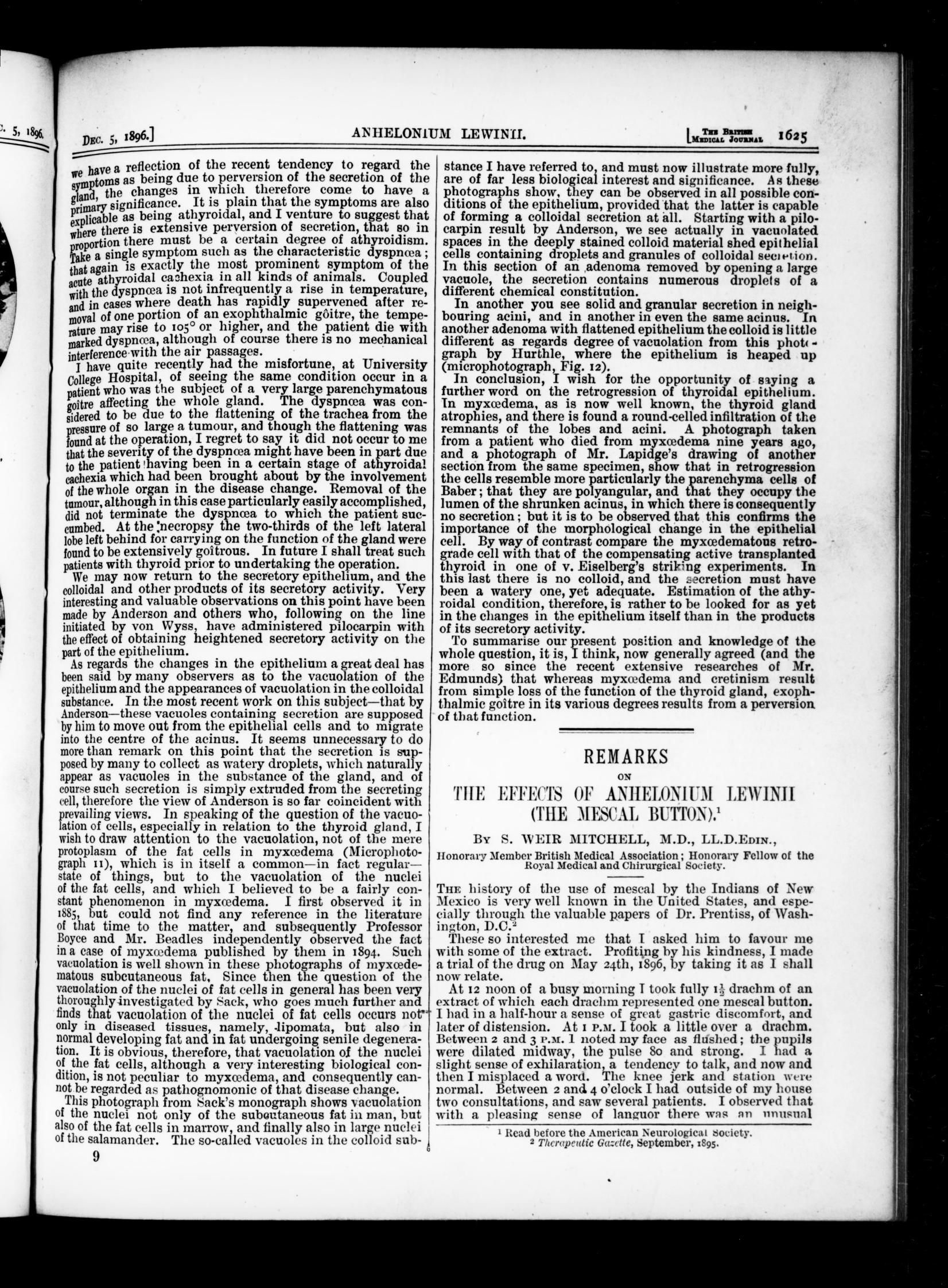
S. Weir Mitchell's account of his own peyote self-experiment on May 24, 1896, read before the American Neurological Society. Mitchell describes detailed visions and includes a second self-experiment by a colleague, Dr. Eshner, with physiological notes and subjective observations.

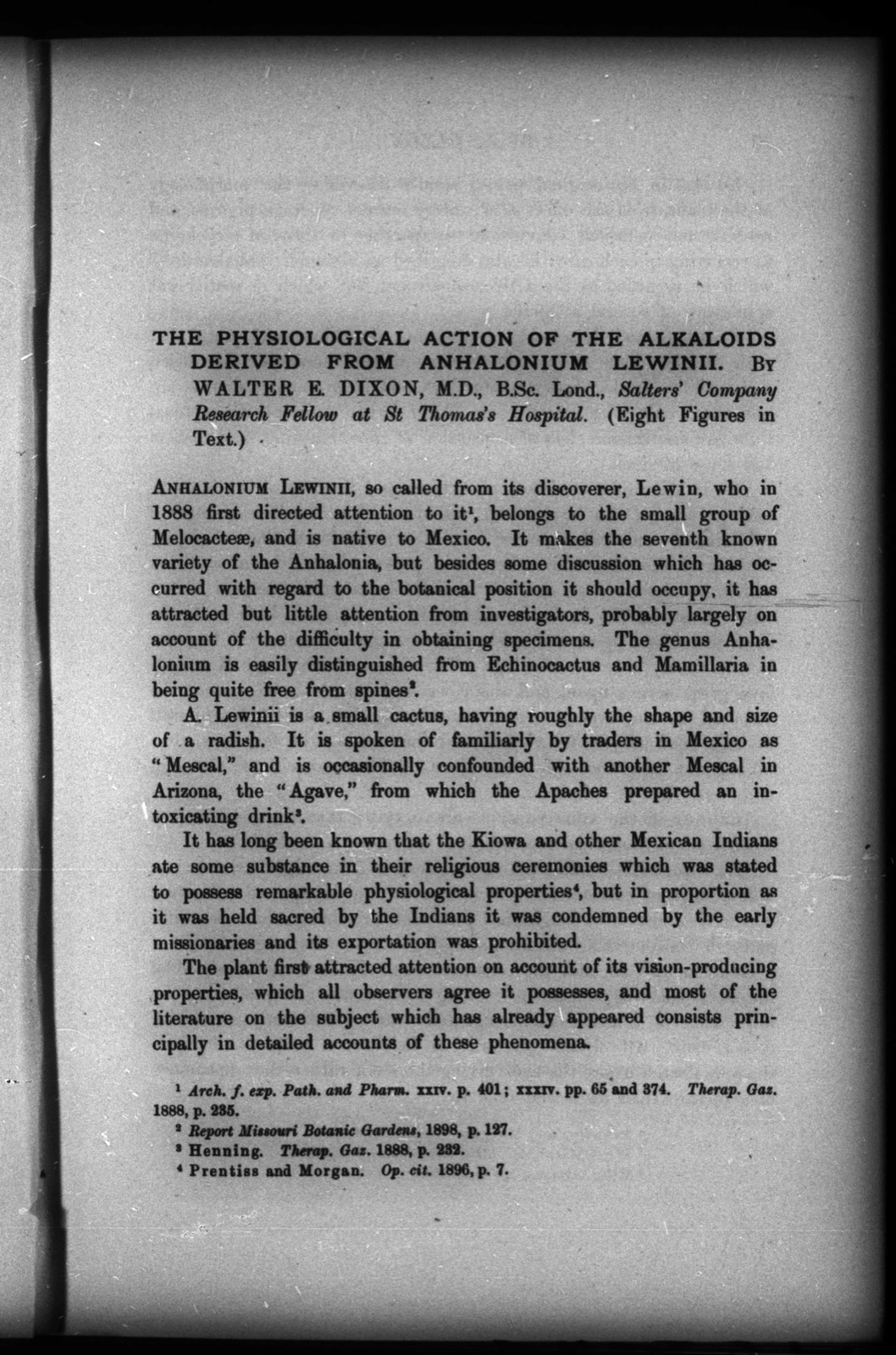
A pharmacologist at St Thomas's Hospital reports systematic experiments on Anhalonium alkaloids using frogs, cats, dogs, and rabbits, combined with self-experimentation. Dixon's account is more clinically restrained than Weir Mitchell's or Ellis's but adds music-color synaesthesia and comparisons to cannabis and strychnine.

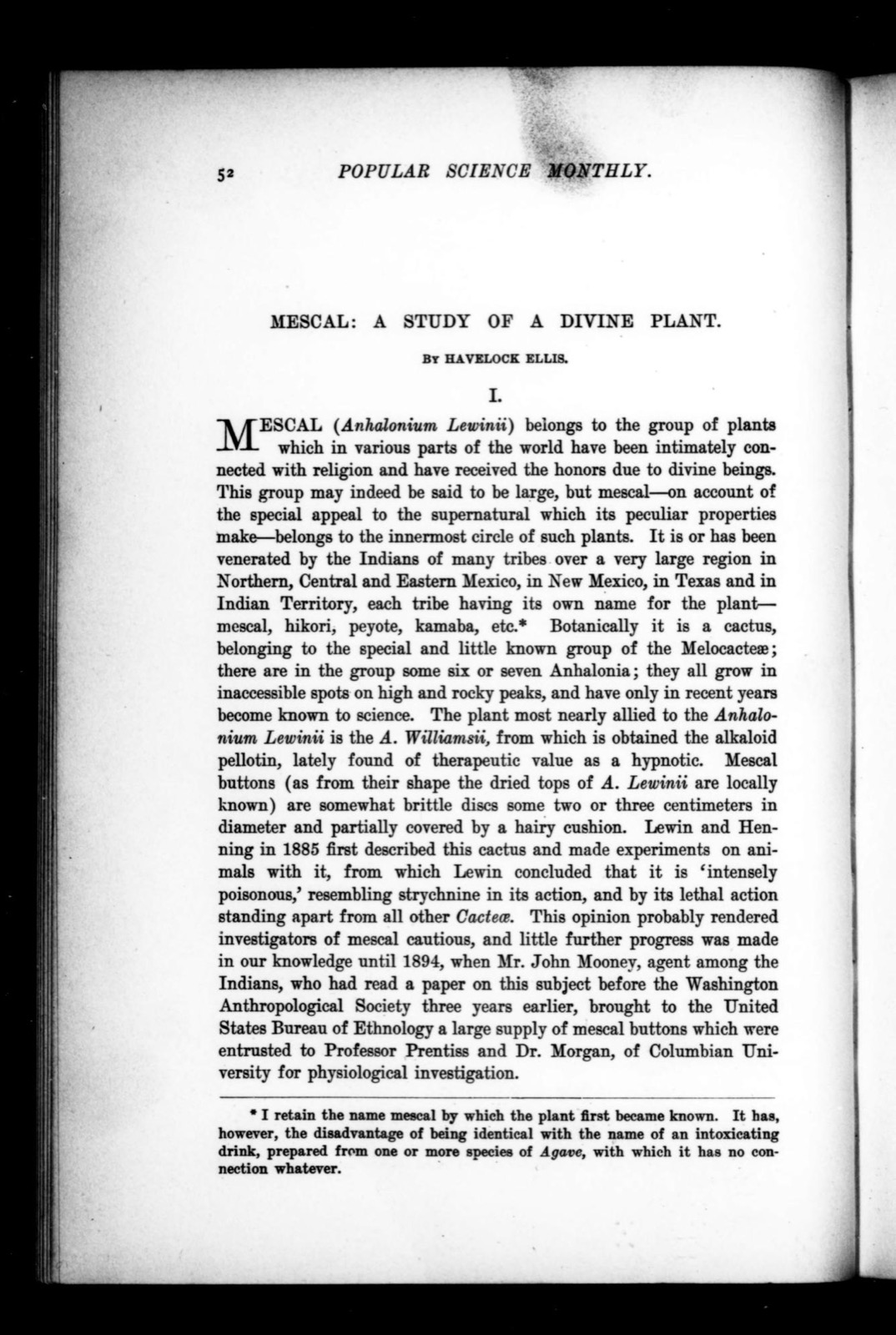
A Study of a Divine Plant
Havelock Ellis's account of his own peyote self-experiment, conducted on Good Friday 1897 in his London chambers. Written for a general scientific audience, it situates his diary of jewel-like visions within the clinical work of Prentiss, Morgan, and Weir Mitchell, alongside Indigenous religious use of the plant.

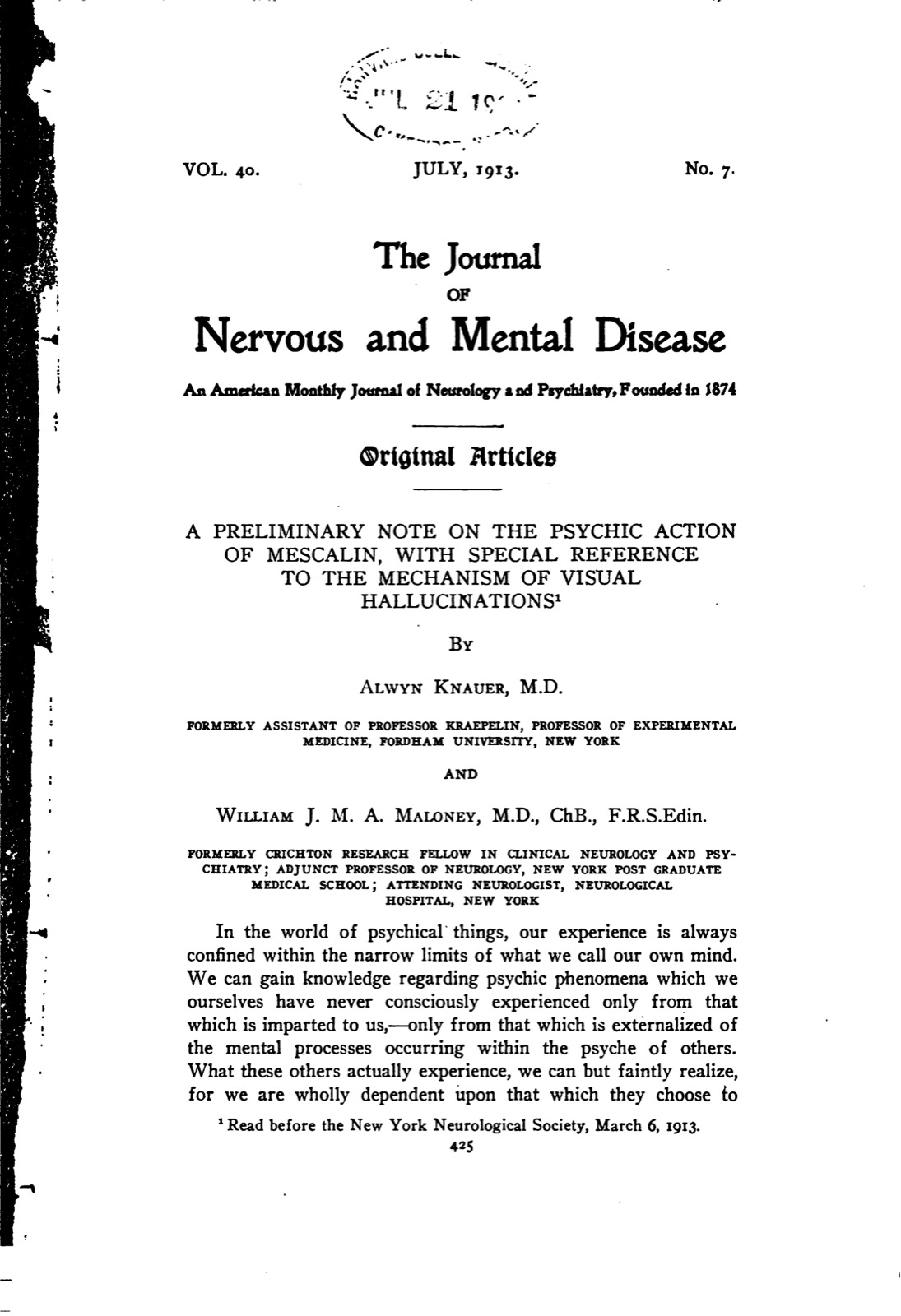
New York psychiatrists inject themselves and colleagues with pure mescaline sulphate in twenty-three experiments to model insanity's visual hallucinations. Subjects' reports include specifics—a glass-screen head, the 'mosque of Omar'—and the authors propose a five-level theory of hallucinations versus images.

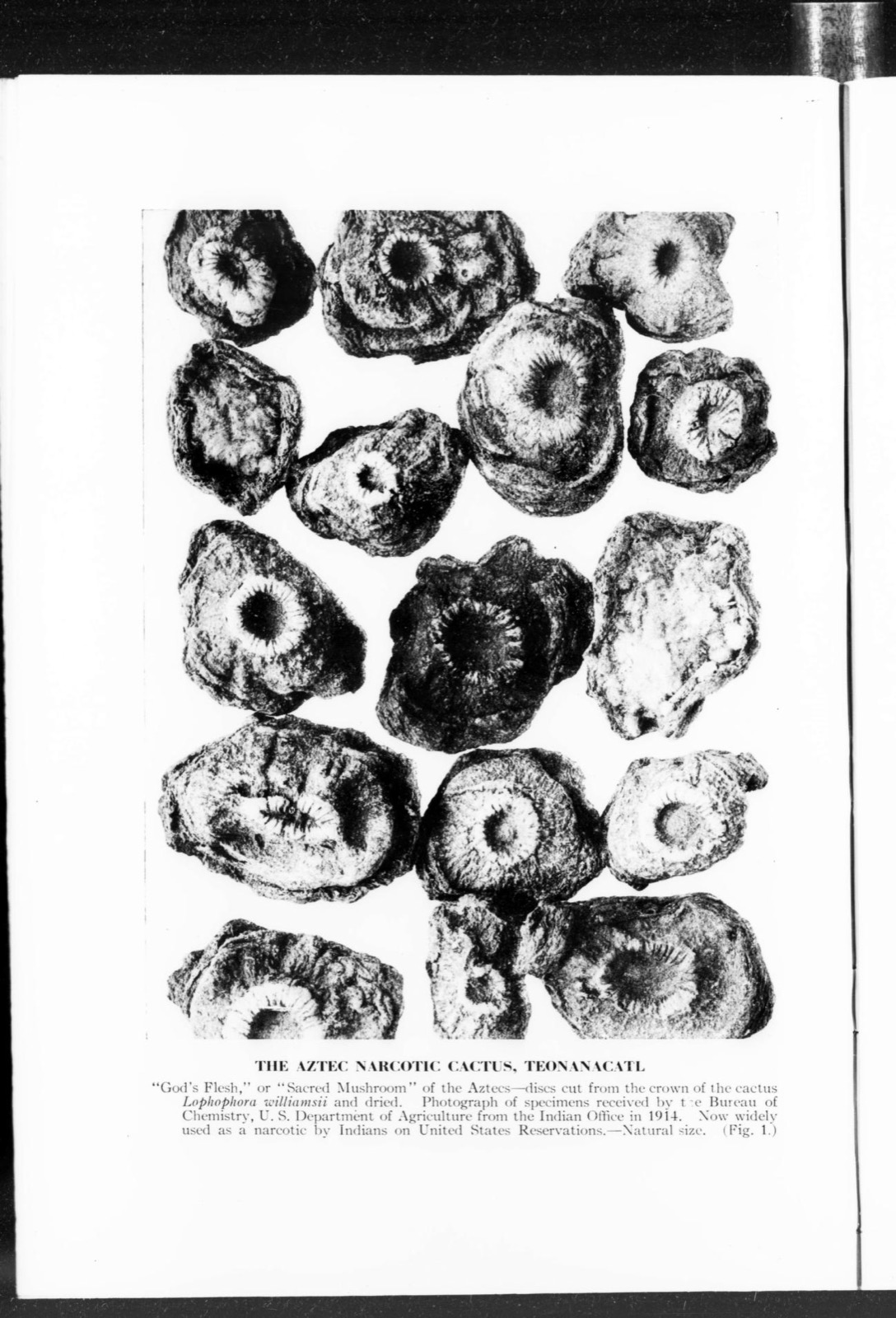
Safford, a USDA botanist, analyzes peyote's physiological effects and Native American ceremonial use in 1915. The article incorporates sworn testimony from Menominee, Omaha, and Winnebago members of the Sacred Peyote Society.

Filed with the Oklahoma Secretary of State on October 10, 1918, these articles incorporated the Native American Church as a religious and benevolent association. The purpose sections frame peyote as a Christian sacrament, giving the pan-tribal peyote religion legal standing.

Hearings Before a Subcommittee of the Committee on Indian Affairs, House of Representatives, on H.R. 2614
A subcommittee of the House Committee on Indian Affairs held February-March 1918 hearings on H.R. 2614, a bill to prohibit peyote use in Indian Country. Witnesses included ethnologist James Mooney, Osage chief Fred Lookout, Omaha ethnographer Francis La Flesche, Arapaho delegate Cleaver Warden, and Cheyenne-Arapaho Paul Boynton.

The Montana Supreme Court reverses a Crow man's peyote conviction, finding the state failed to establish jurisdiction over an offense on the Crow Reservation. The court addresses federal Indian law and rejects the defendant's religious-use defense, but does not decide the jurisdictional question, remanding for new trial.

A New Approach
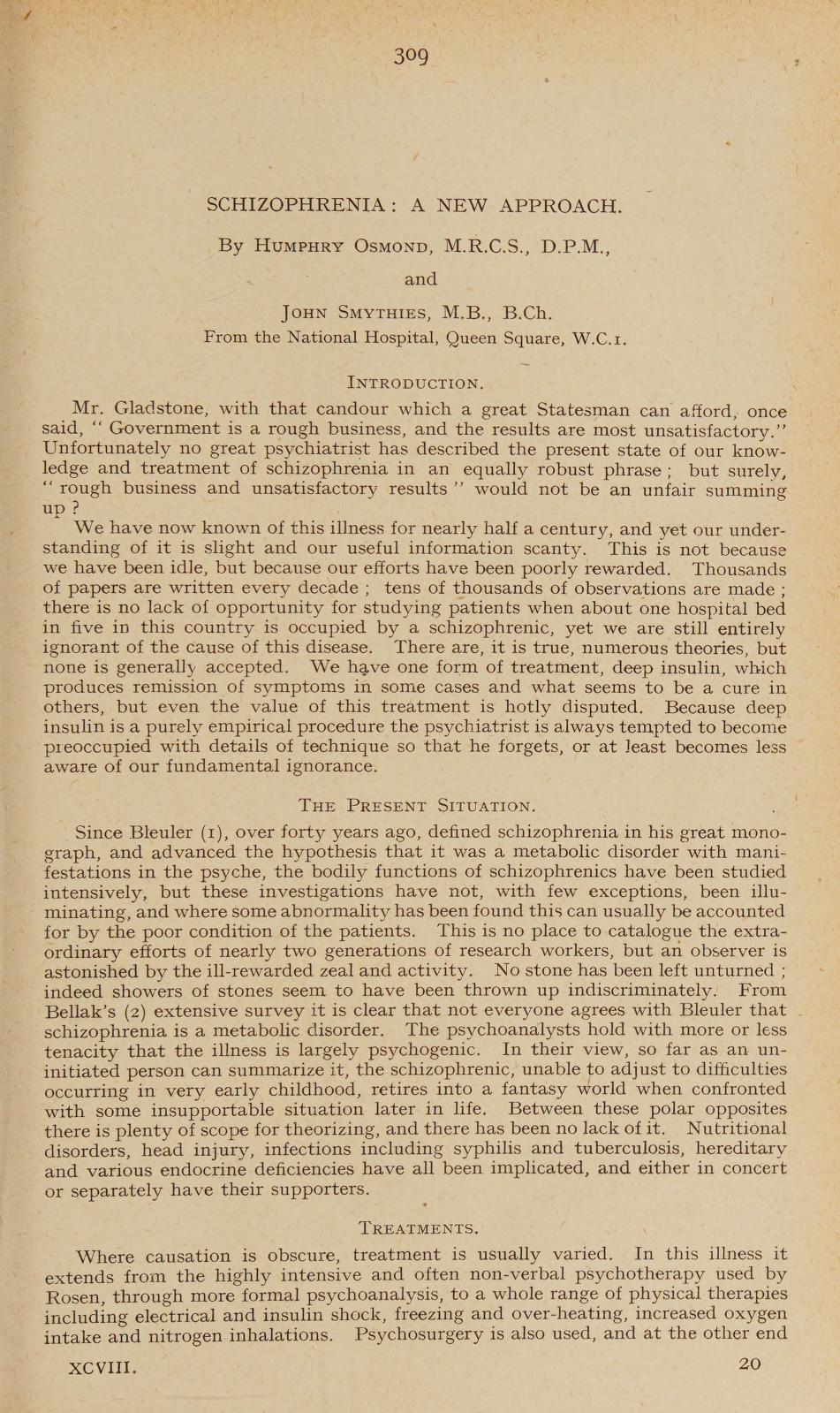
Osmond and Smythies argue that schizophrenia involves a naturally occurring adrenaline derivative chemically close to mescaline. Hosted here is a fair-use excerpt: their case that mescaline intoxication reproduces the symptoms of acute schizophrenia, the biochemical note on how a disorder of adrenaline's transmethylation could form such a compound, and their resulting hypothesis and discussion.
External source
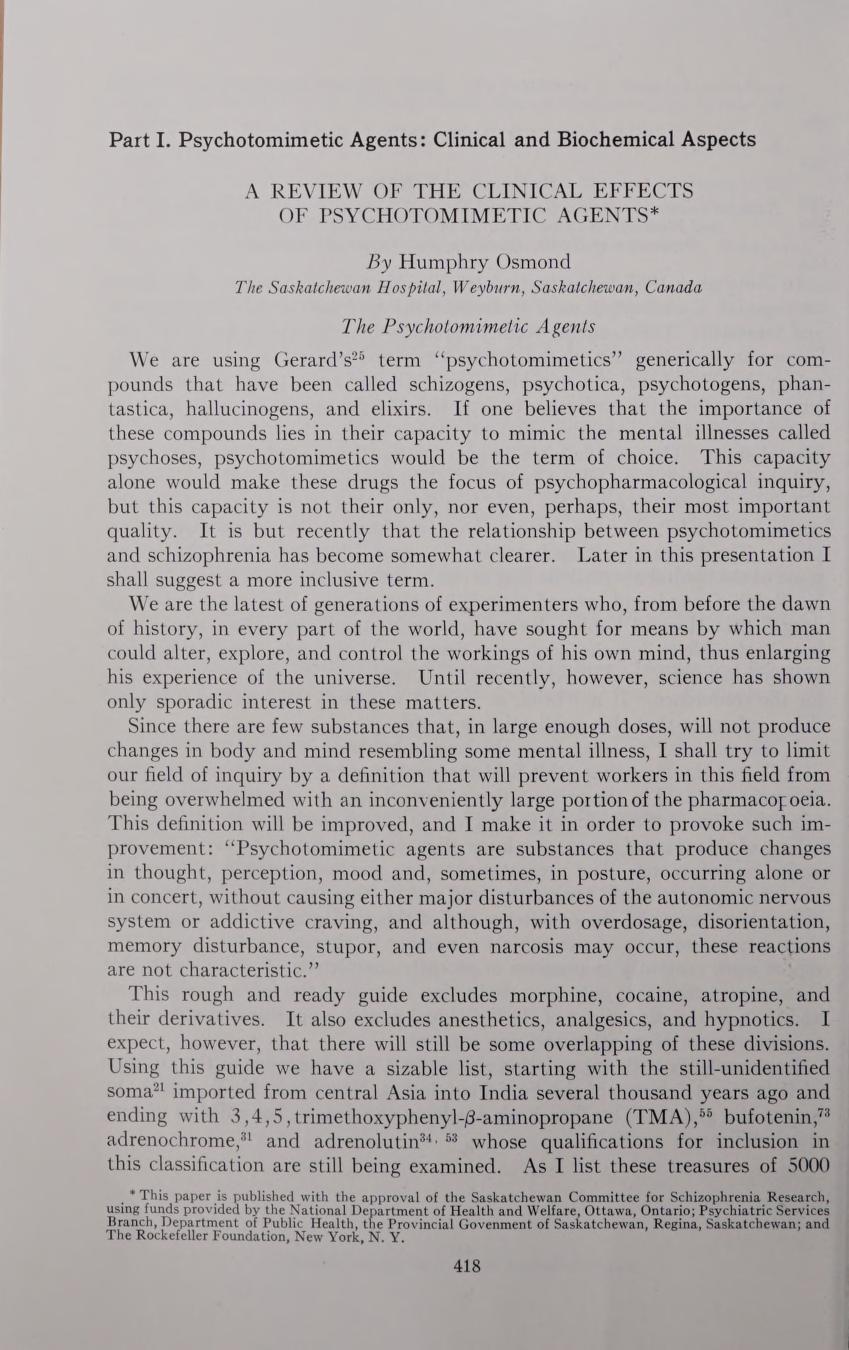
Osmond surveyed psychotomimetic agents and proposed new terminologies, settling on "psychedelic, mind-manifesting" as his choice. This paper put the word into circulation among psychiatrists, coining the term still used today.
External source
The Tenth Circuit affirms dismissal of a Native American Church suit against the Navajo Tribal Council's 1940 peyote ban, holding that the First Amendment does not apply to tribal governments unless Congress extends it. The court treats tribes as sovereign nations outside the federal Constitution.

Side Effects and Complications
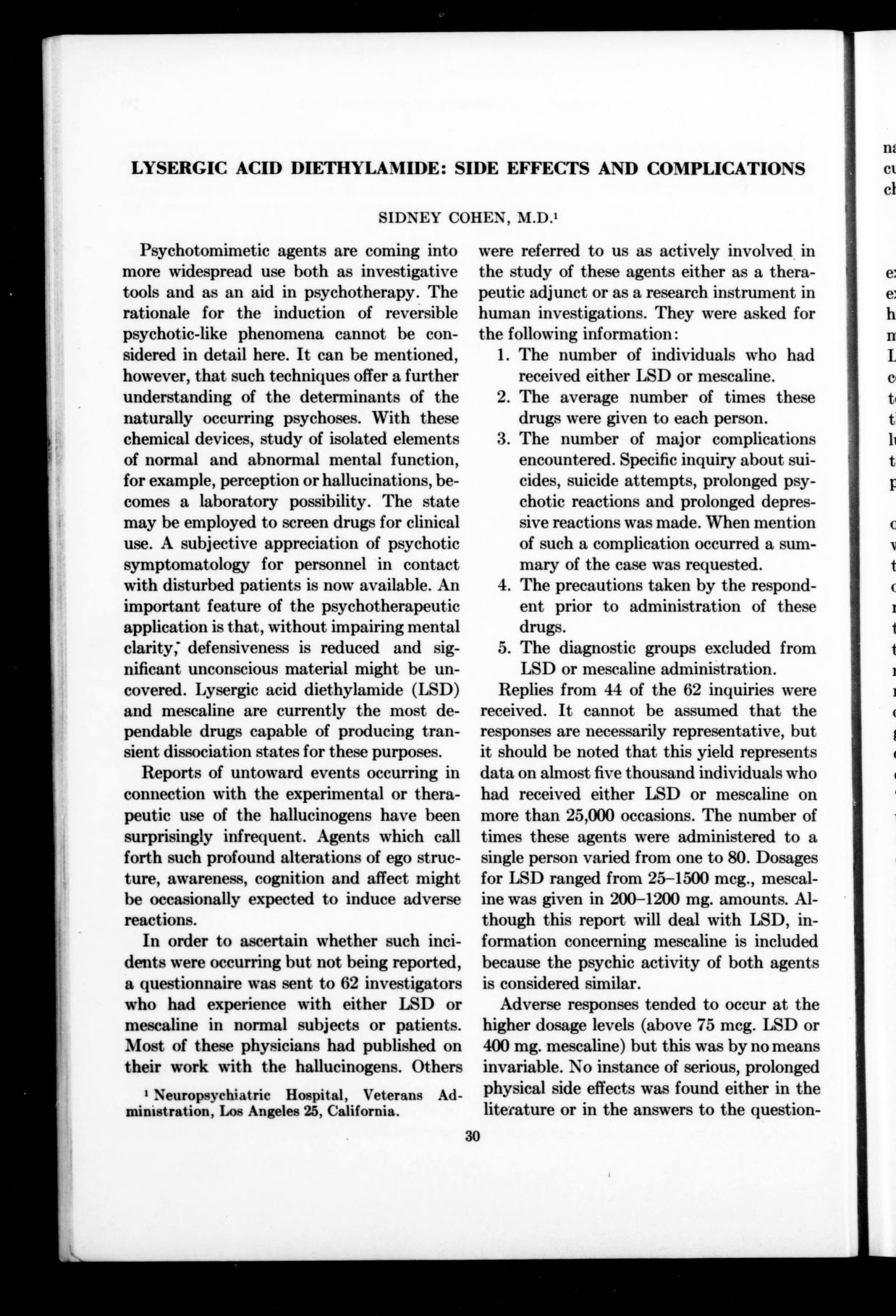
Sidney Cohen surveyed researchers at the VA Neuropsychiatric Hospital who had administered LSD or mescaline to nearly 5,000 subjects across more than 25,000 doses. He found no cases of serious prolonged physical harm and quantified low rates of suicide attempts, psychotic breaks over 48 hours, and other adverse effects.

Drugs Open New Life: In a Drug-Filled Chalice, Total Love
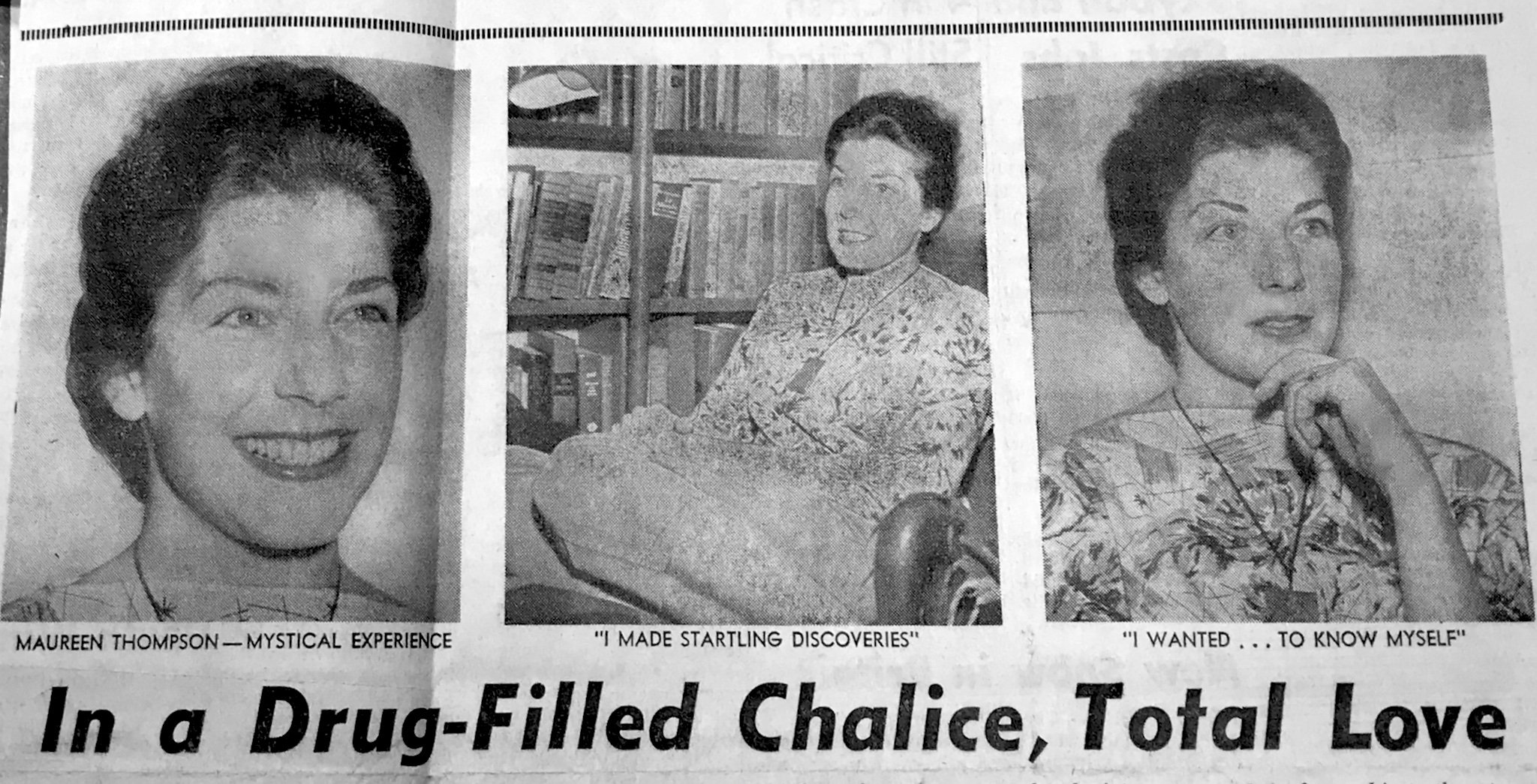
George Draper's front-page story about Maureen Thompson, a Menlo Park mother of four who took LSD and mescaline in August 1961 at Myron Stolaroff's International Foundation for Advanced Study, which charged $500. She describes the session as a turning point in her life, and her husband Bill took the same treatment a week later.

The founding issue of The Psychedelic Review, published in June 1963 by Timothy Leary and Ralph Metzner's International Federation for Internal Freedom. Hosted here are the issue's unsigned Editorial and Statement of Purpose, which set out the journal's program and explain its choice of the word 'psychedelic.' The issue's bylined articles, by Gerald Heard, R. Gordon Wasson, and Alan Watts, are described in the front matter but not reproduced.

A Manual Based on the Tibetan Book of the Dead
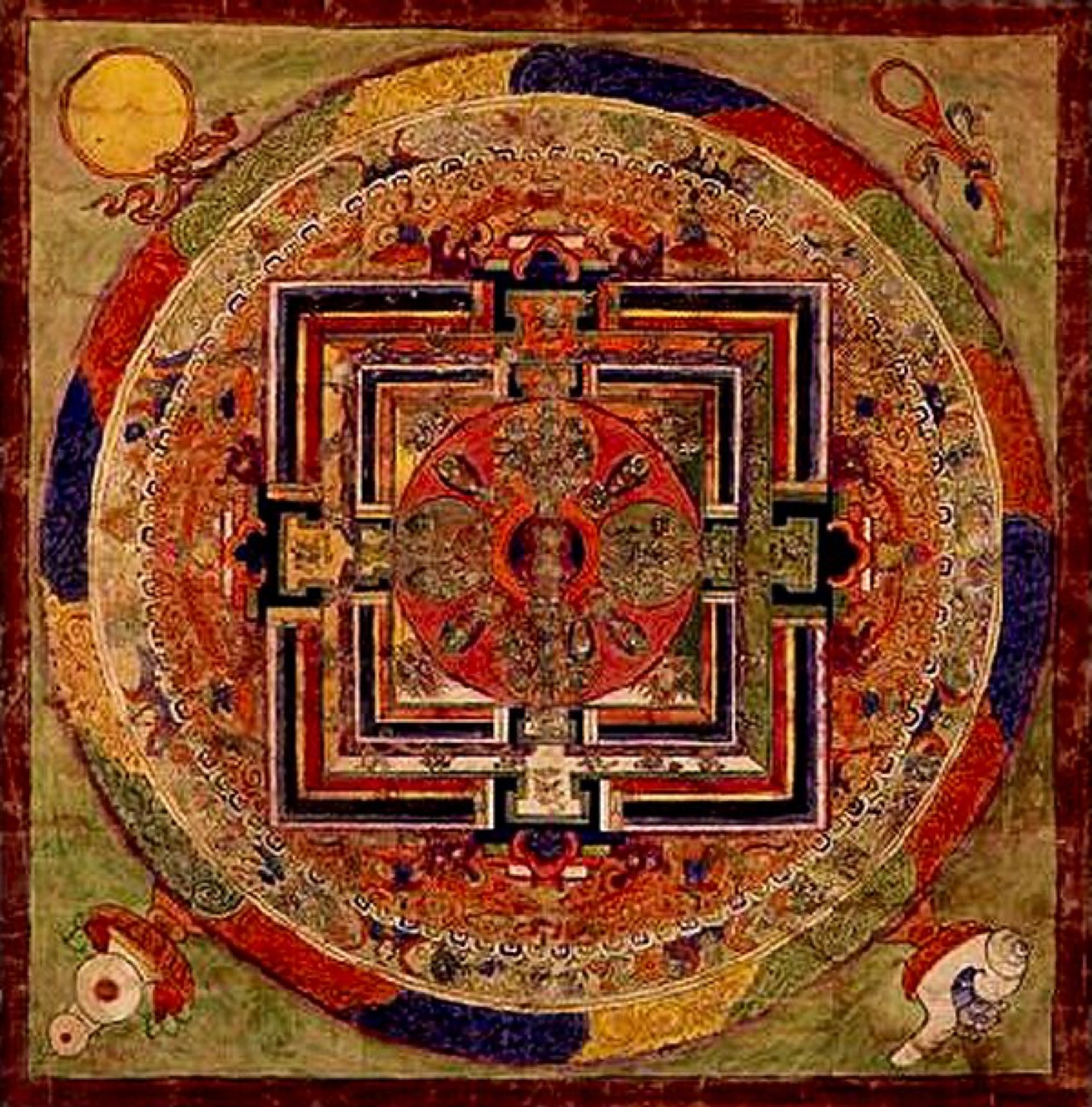
Leary, Metzner and Alpert recast the Tibetan Book of the Dead as a manual for LSD, psilocybin and mescaline sessions. Hosted here is a fair-use excerpt: the book's opening definition of 'set and setting,' and the full 'Preparation' and 'The Setting' sections, which give that idea its practical, session-by-session form.
External source
The California Supreme Court reverses the peyote convictions of four Navajo men arrested at a Native American Church meeting near Needles in 1962. Justice Tobriner's opinion describes the all-night ceremony, its officers and its ritual objects before reaching the First Amendment question.

The Supreme Court holds that Oregon may deny unemployment benefits to two Native American Church members dismissed for sacramental peyote use, since a neutral criminal drug law requires no religious exemption. Blackmun dissents.

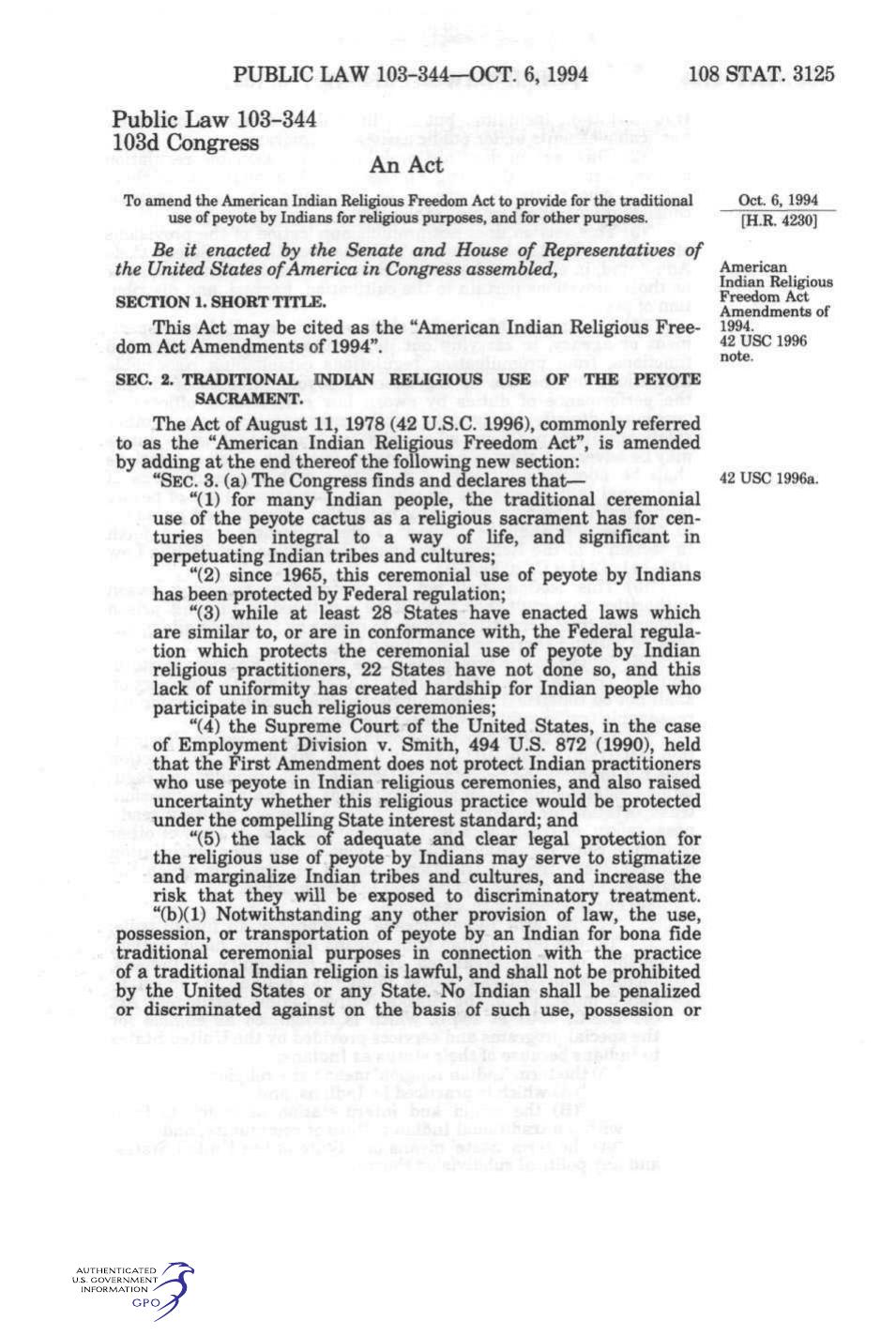
Congress restored a nationwide exemption for the ceremonial use of peyote by Indians in connection with traditional religions. The statute carves out exceptions for prison, military, and safety-sensitive positions.

An Update (NIDA Research Monograph 146)
Proceedings of a 1992 NIDA technical review on hallucinogen research, prompted by rising LSD use among teenagers. Includes Rick Strassman's account of the regulatory process (IRB, DEA, FDA) for his DMT study, the first human hallucinogen study approved since the early 1970s.

Berlin pharmacologist Louis Lewin (1850–1929) reports on "Muscale Buttons" received from Parke, Davis & Co. during a visit to the United States in 1887. The botanist Paul Hennings identified the dried cactus as a new species and named it Anhalonium Lewinii after him, and Lewin describes a crude base he called anhalonine and its strychnine-like convulsant effects in frogs, pigeons and rabbits. Hosted here are the introduction, the preliminary chemistry, and the full section on the drug's effects, with the historical survey of cacti omitted.

Leipzig pharmacologist Arthur Heffter (1859–1925) reports his separation of five alkaloids from mescal buttons, among them mescaline ("Mezcalin"), and a series of self-experiments made between June and November 1897. Testing the whole drug, its resin, the mixed alkaloids and each isolated base in turn, he found that 0.15 g of mescaline hydrochloride alone reproduced the visions, slowed pulse, dilated pupils and loss of time sense produced by the cactus. Hosted here are the description of mescaline and its salts and the whole of section VI on the drug's action in humans.