Texts

Browse filters
Active filters:Text xClear all
Blood Revenge, War, and Victory Feasts among the Jibaro Indians of Eastern Ecuador
Field Notes, 1923

Blood Revenge, War, and Victory Feasts among the Jibaro Indians

Anthropologist Rafael Karsten's account of a Jívaro victory feast describes the natéma ceremony, in which the vision-inducing drink made from Banisteria caapi and tobacco is prepared ritually and drunk communally. The passage covers preparation, the emetic effect, and beliefs that the visions foretell prosperity.

Read more
Estudio sobre el principio activo del Yagé
Academic Article, 1923

Study on the Active Principle of Yagé

A 1923 doctoral thesis reporting Fischer Cárdenas's isolation of the yagé alkaloid that Rafael Zerda Bayón had named telepathine (telepatina) decades earlier without isolating it. Seven case reports detail effects on human subjects, including the author's self-experiment, describing vivid dreams, visual hallucinations, and euphoria at low doses, followed by a systematic summary of physiological action.

Read more
State v. Big Sheep
Source, January 26, 1926

State v. Big Sheep

The Montana Supreme Court reverses a Crow man's peyote conviction, finding the state failed to establish jurisdiction over an offense on the Crow Reservation. The court addresses federal Indian law and rejects the defendant's religious-use defense, but does not decide the jurisdictional question, remanding for new trial.

Read more
Documents pour servir à l'étude du yagé
Academic Article, April 1926

Documents Toward a Study of Yagé

Rouhier's two-part dossier for Bulletin des Sciences Pharmacologiques: a translation of Barriga Villalba's 1923 paper on alkaloid yagéine, followed by Rouhier's ethnographic and pharmacological notes. Rouhier catalogues dose-dependent effects and includes chemical analysis of a Jívaro preparation.

Read more
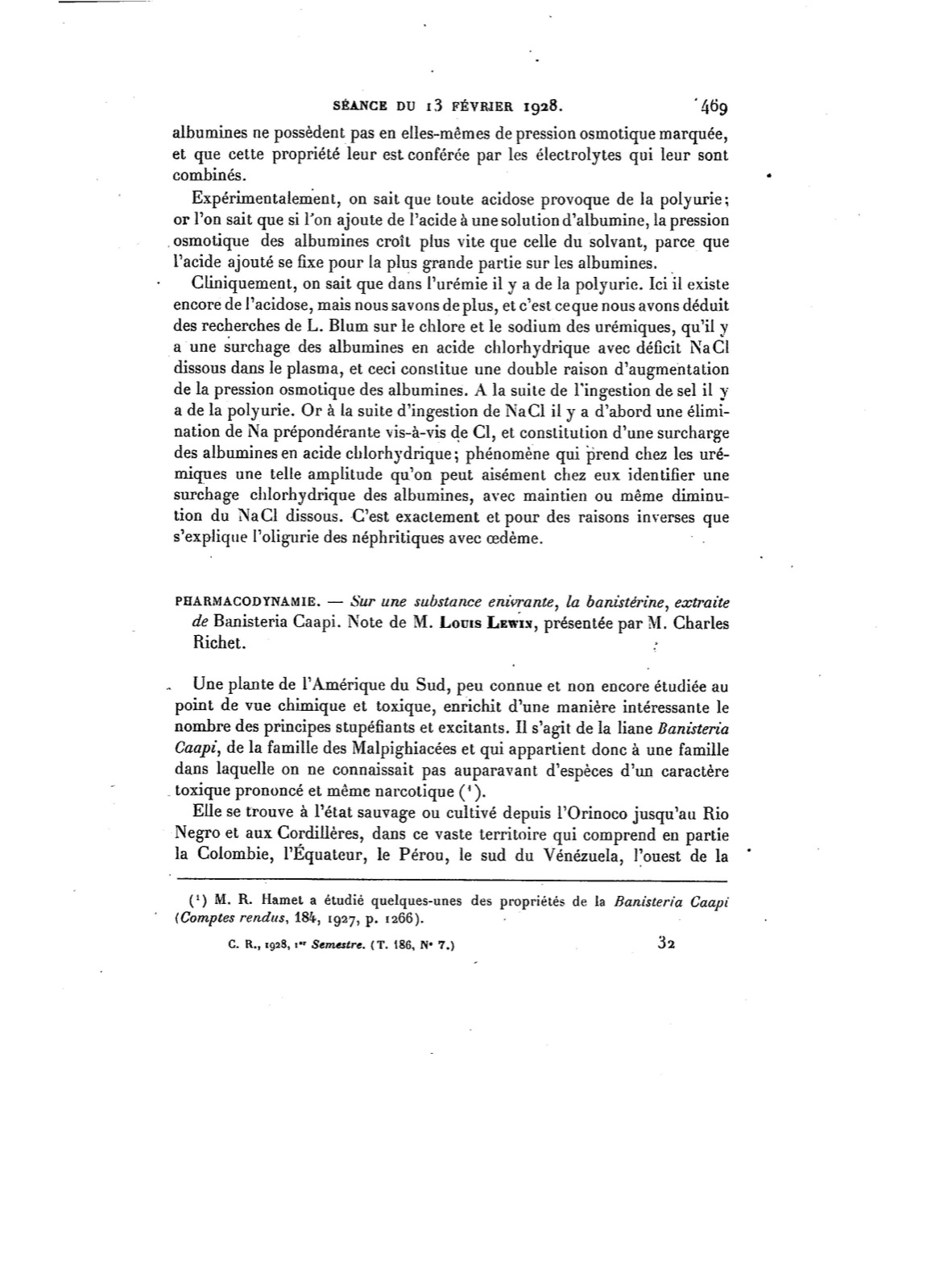
Sur une substance enivrante, la banistérine, extraite de Banisteria Caapi
Academic Article, 1928

On Banisterine, an Intoxicating Substance from Banisteria Caapi

Berlin pharmacologist Louis Lewin announces his isolation of banisterine from Banisteria caapi and its identity to harmine. He describes animal experiments and preliminary human trials showing that banisterine relieved the muscular rigidity of encephalitis lethargica (post-influenza sleeping sickness).

Read more

The Elements of Mazatec Witchcraft
Academic Article, 1939

The Elements of Mazatec Witchcraft

A Berkeley anthropologist's field survey of Mazatec witchcraft from a 1938 expedition to Huautla de Jiménez, Oaxaca. Hosted here is a fair-use excerpt: Johnson's eyewitness account of a curing ceremony he and his party attended on July 16, 1938 -- the first outsider-witnessed session involving the sacred mushrooms -- along with his description of the mushroom species and their ritual use among Mazatec brujos.

Read more
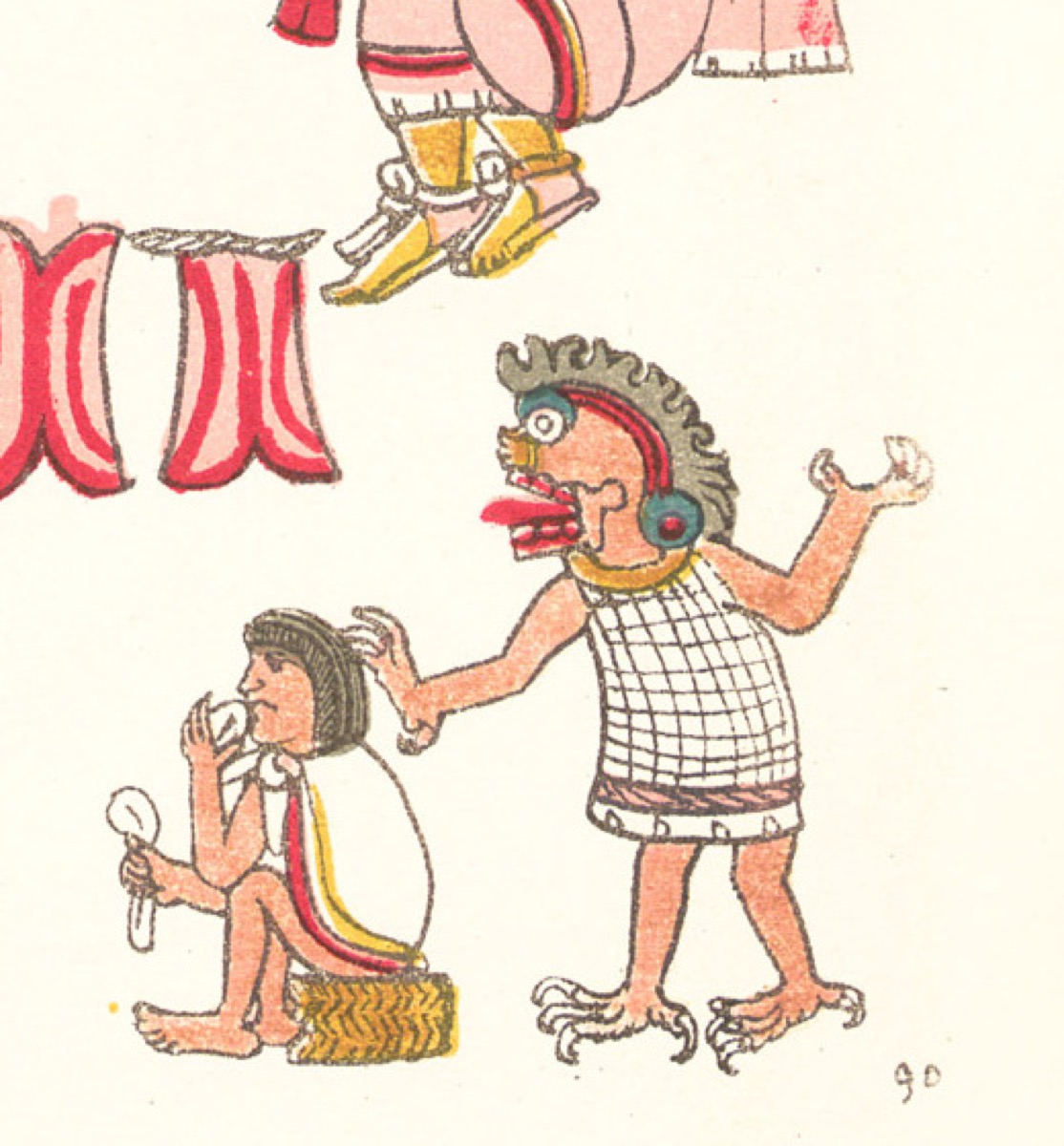
Teonanacatl: The Narcotic Mushroom of the Aztecs
Academic Article, July-September 1940

Teonanacatl

The Narcotic Mushroom of the Aztecs

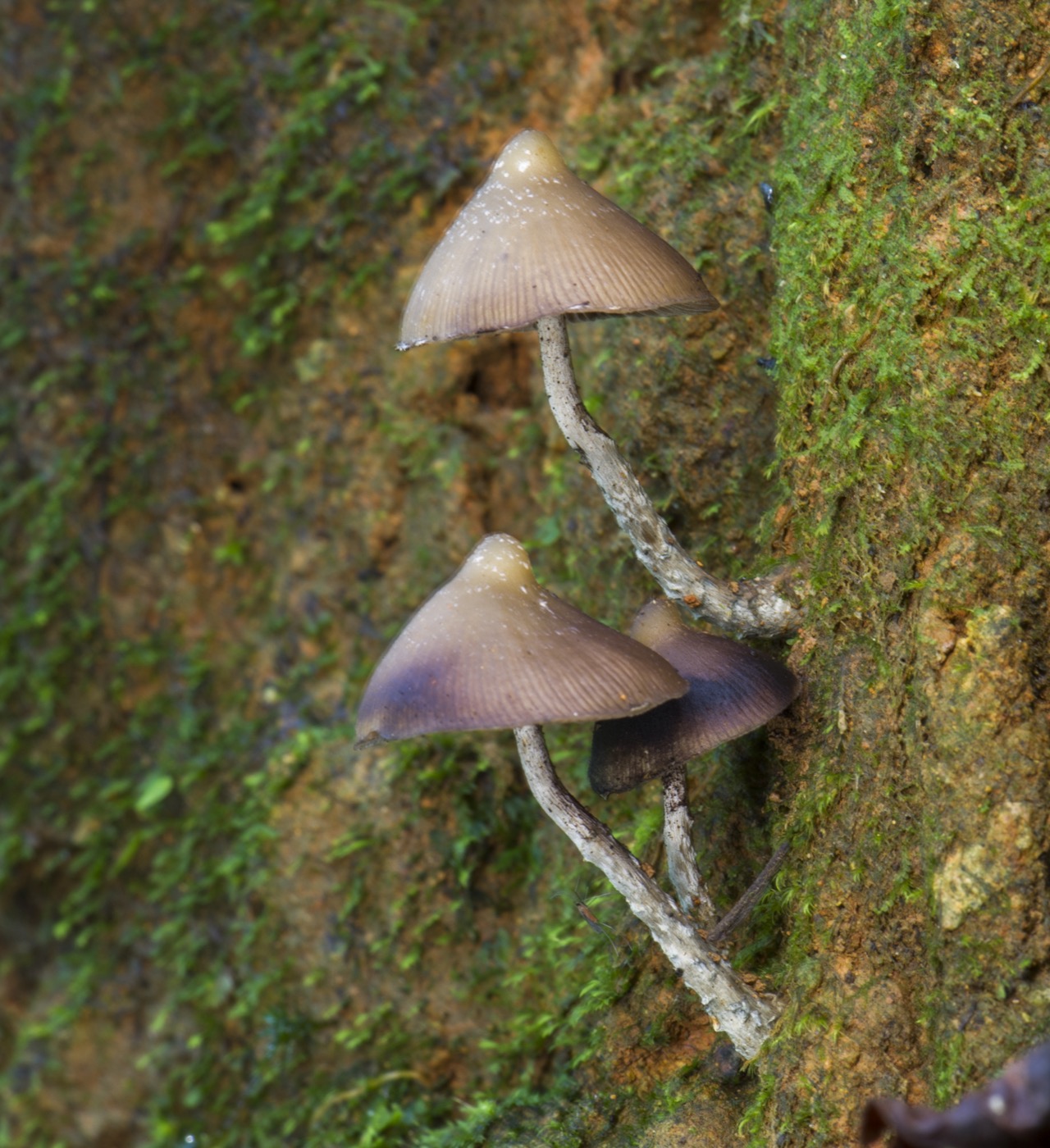
Schultes's botanical account of his 1938-39 fieldwork with Blas Pablo Reko among the Mazatec, tracing the teonanácatl rediscovery from Reko's 1923 letter through Robert Weitlaner's 1936 visit to Huautla de Jiménez. Schultes identifies the mushroom as Paneolus campanulatus var. sphinctrinus.

Read more
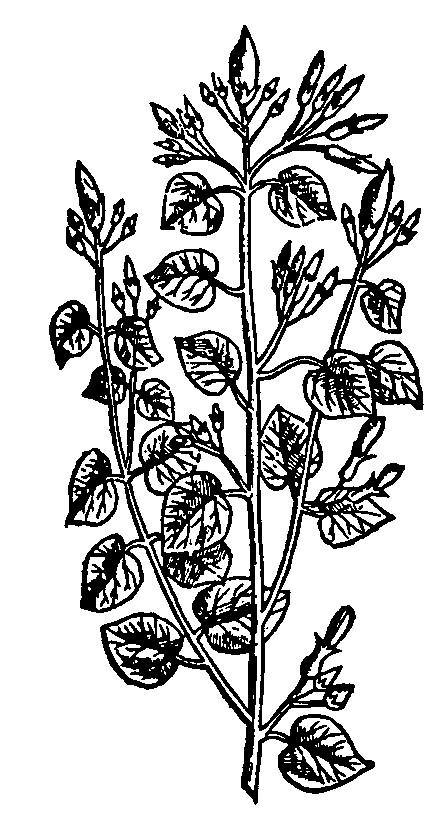
A Contribution to Our Knowledge of Rivea Corymbosa: The Narcotic Ololiuqui of the Aztecs
Academic Article, 1941

A Contribution to Our Knowledge of Rivea Corymbosa

The Narcotic Ololiuqui of the Aztecs

Schultes's botanical monograph settling the identity of ololiuqui, the Aztec morning-glory narcotic. He credits Urbina's 1897 identification as Rivea corymbosa, corrects Safford's 1915 misidentification as jimsonweed, and surveys continued ritual and medicinal use among the Chinantec, Mazatec, Mixtec, and Zapotec of Oaxaca.

Read more
Lysergsäure-diäthylamid, ein Phantastikum aus der Mutterkorngruppe
Academic Article, 1947

LSD, a Phantasticum from the Ergot Group

Werner Stoll's first systematic clinical study of LSD, examining sixteen healthy volunteers and six schizophrenic patients, plus Stoll's own self-experiment. Published in 1947 following Hofmann's 1943 discovery at Sandoz, it established key vocabulary for psychiatric LSD research.

Read more
Schizophrenia: A New Approach
Academic Article, April 1952

Schizophrenia

A New Approach

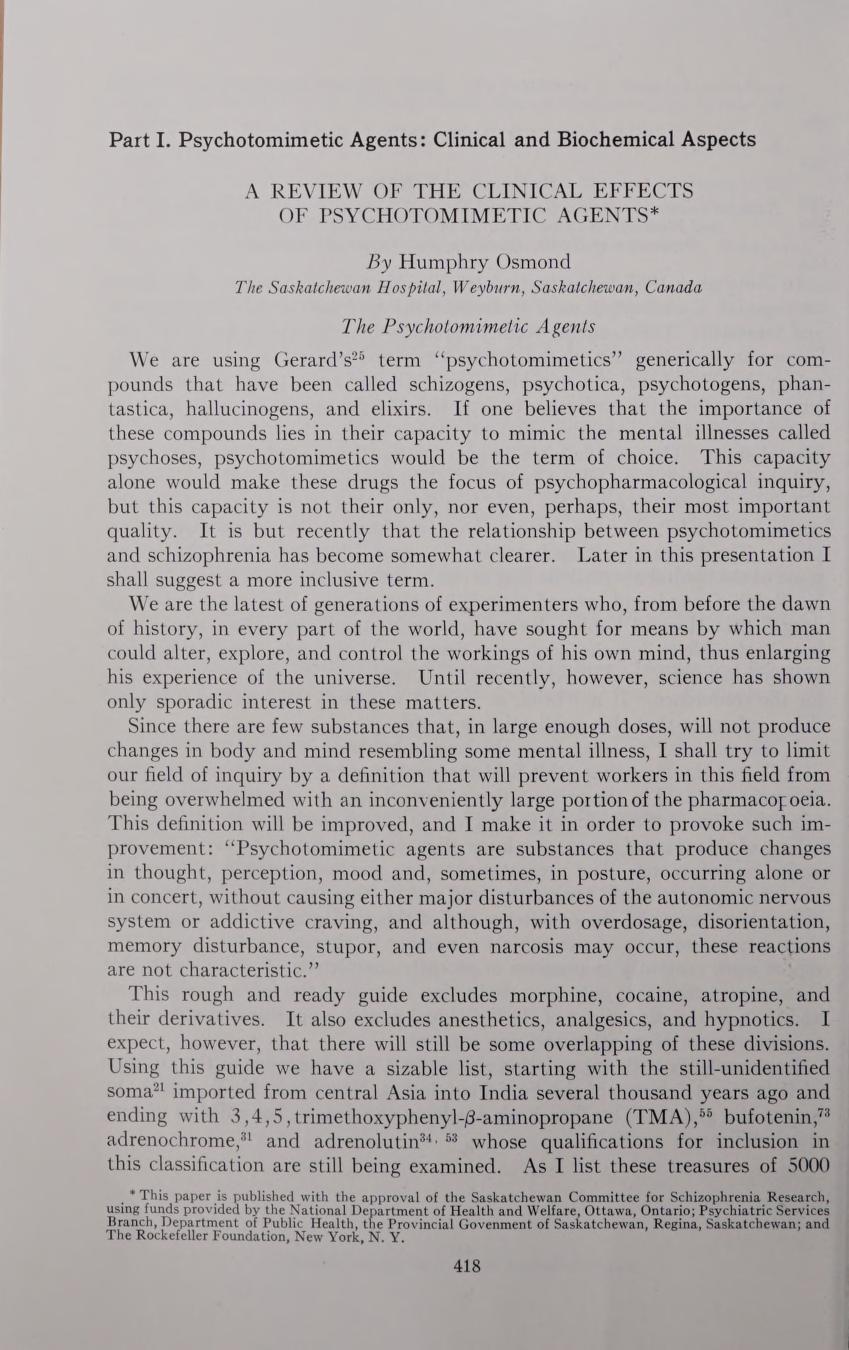
Osmond and Smythies argue that schizophrenia involves a naturally occurring adrenaline derivative chemically close to mescaline. Hosted here is a fair-use excerpt: their case that mescaline intoxication reproduces the symptoms of acute schizophrenia, the biochemical note on how a disorder of adrenaline's transmethylation could form such a compound, and their resulting hypothesis and discussion.

Read more
Experimental Schizophrenia-Like Symptoms
Academic Article, February 1952

Experimental Schizophrenia-Like Symptoms

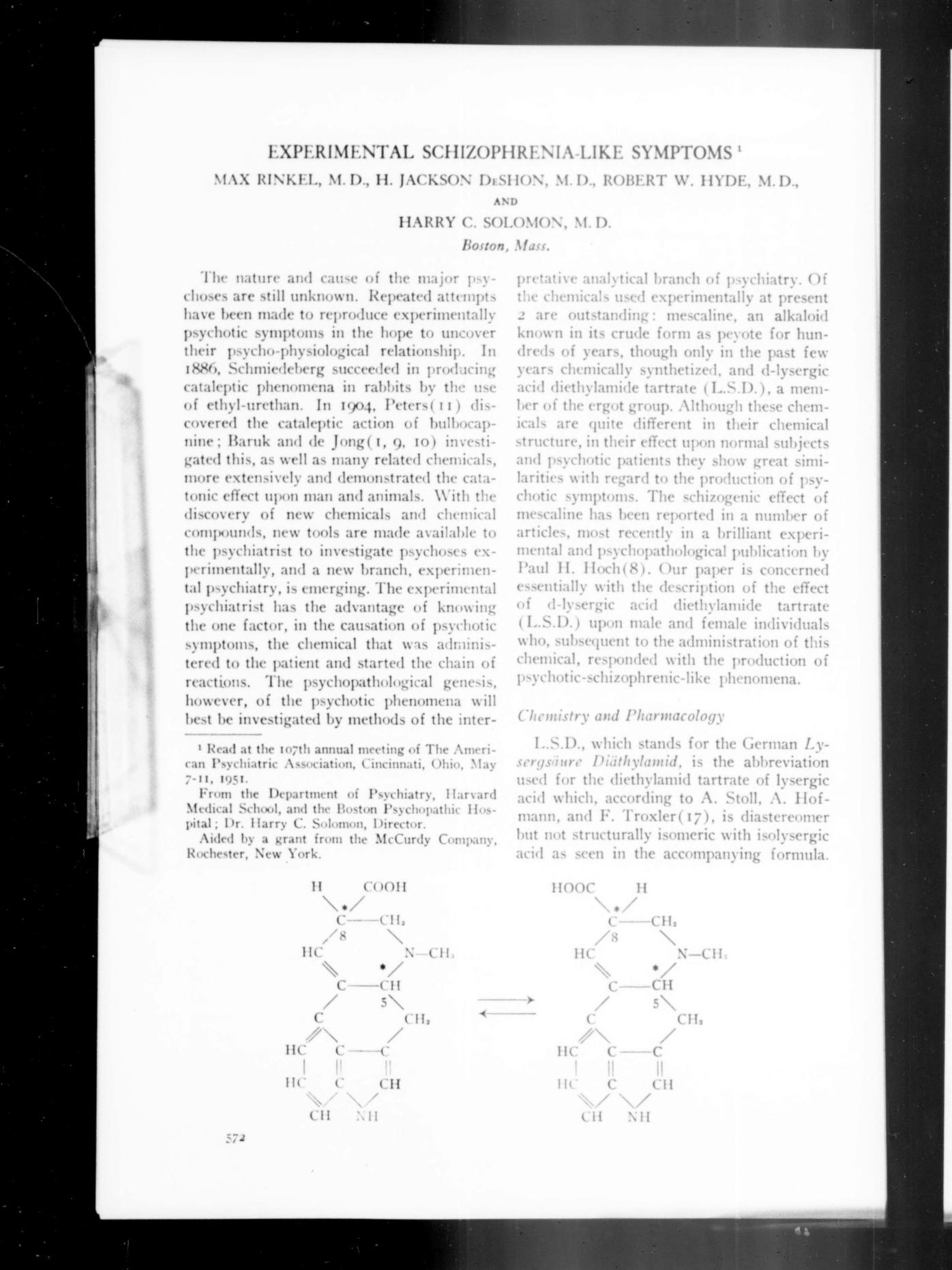
Rinkel and colleagues at Boston Psychopathic Hospital administered microgram doses of LSD tartrate to normal volunteers and schizophrenic, depressive, and paranoid patients. They reported the drug reliably produced thought disorder, hallucination, and depersonalization resembling clinical schizophrenia.

Read more
Margaret Mead’s LSD Memo
Manuscript, September 23-25, 1954

Margaret Mead’s LSD Memo

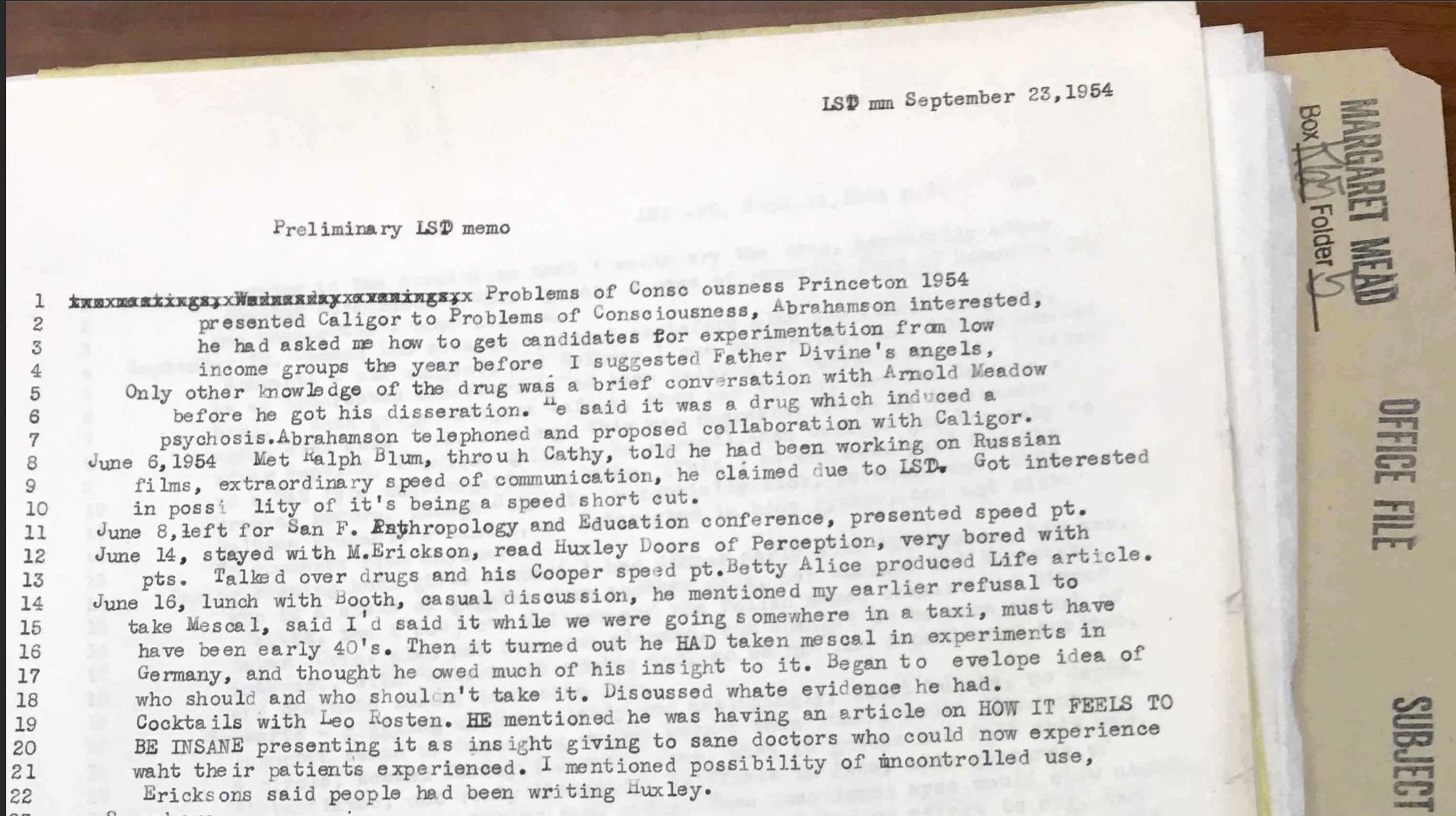
A memo from anthropologist [Margaret Mead](/biographies/margaret-mead)'s papers at the Library of Congress, recording her interest in LSD and other psychedelics in the summer of 1954 and her work with [Harold Abramson](/biographies/harold-abramson)'s research team, including [Conan Kornetsky](/biographies/conan-kornetsky) and [Murray Jarvik](/biographies/murray-jarvik).

Read more
Studies on Lysergic Acid Diethylamide (LSD-25): I. Effects in Former Morphine Addicts and Development of Tolerance During Chronic Intoxication
Academic Article, November 1956

Studies on LSD-25: Tolerance in Former Morphine Addicts

I. Effects in Former Morphine Addicts and Development of Tolerance During Chronic Intoxication

Harris Isbell and colleagues at the NIMH Addiction Research Center in Lexington, Kentucky, gave LSD daily for up to eighty-five days to former morphine addicts to measure tolerance and compare effects to psychosis. They found rapid tolerance to both physiological and mental effects, which disappeared upon discontinuation.
Read more
Seeking the Magic Mushroom
Newspaper Article, May 13, 1957

Seeking the Magic Mushroom

R. Gordon Wasson's photo-essay in Life magazine announcing that he and photographer Allan Richardson had participated in a Mazatec mushroom ceremony near Huautla de Jiménez in June 1955. The article, illustrated with color photographs and watercolor plates, named Roger Heim as Wasson's collaborator.

Read more
Psychoanalysis and LSD-25: Foundations for a Combined Therapeutic Technique
Academic Article, September 10, 1957

Psychoanalysis and LSD-25

Foundations for a Combined Therapeutic Technique

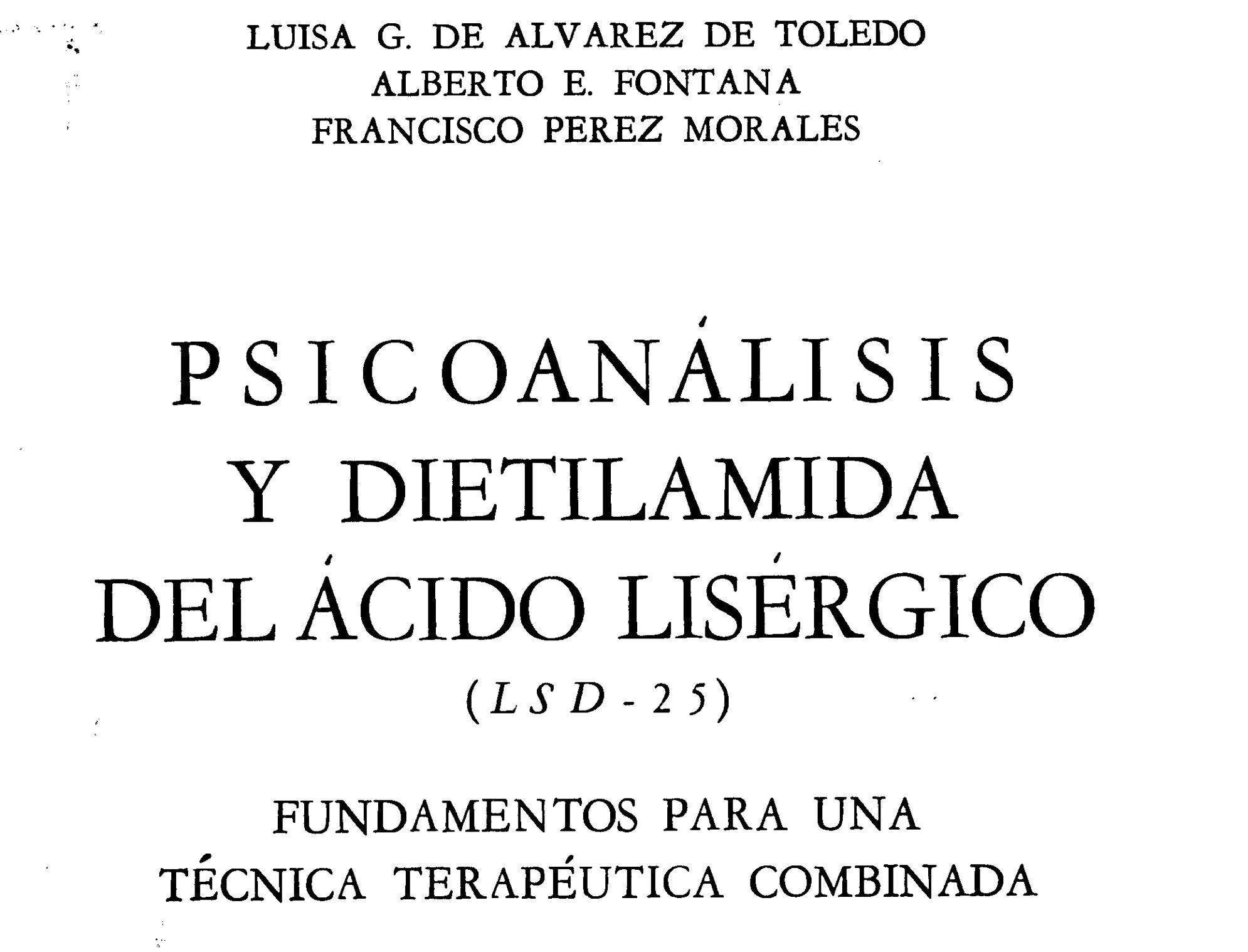
Luisa G. de Álvarez de Toledo's paper to the Argentine Psychoanalytic Association in Buenos Aires on September 10, 1957, setting out a method for combining LSD sessions with psychoanalysis. Case reports by Alberto E. Fontana and Francisco Pérez Morales follow. It is one of the earliest attempts in Latin America to fit LSD into psychoanalytic treatment.

Read more
Native American Church of North America v. Navajo Tribal Council
Source, November 17, 1959

Native American Church v. Navajo Tribal Council

The Tenth Circuit affirms dismissal of a Native American Church suit against the Navajo Tribal Council's 1940 peyote ban, holding that the First Amendment does not apply to tribal governments unless Congress extends it. The court treats tribes as sovereign nations outside the federal Constitution.

Read more
Lysergic Acid Diethylamide: Side Effects and Complications
Academic Article, January 1960

Lysergic Acid Diethylamide

Side Effects and Complications

Sidney Cohen surveyed researchers at the VA Neuropsychiatric Hospital who had administered LSD or mescaline to nearly 5,000 subjects across more than 25,000 doses. He found no cases of serious prolonged physical harm and quantified low rates of suicide attempts, psychotic breaks over 48 hours, and other adverse effects.

Read more
Clinical Investigation of EA 1729
Source, June 1961

Clinical Investigation of EA 1729 (CRDLR 3074)

A declassified Army Chemical Research and Development Laboratories report on EA 1729 (LSD-25) as a non-lethal incapacitating agent. Includes clinical studies from 1955-1960 and September 1958 field tests at Fort Bragg in which whole military units were dosed with LSD and evaluated on operational tasks; all units proved unable to perform their missions.

Read more
“Dolphin’s Voice May Be Key to Communications”
Newspaper Article, September 17, 1962

“Dolphin’s Voice May Be Key to Communications”

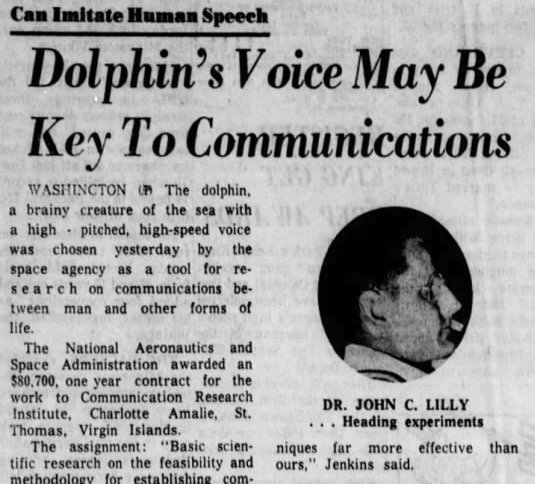
A newspaper report that NASA had given John C. Lilly's Communication Research Institute an $80,700 contract to study communication between humans and dolphins. It shows the space-age funding behind the dolphin research that later included Lilly's LSD experiments.

Read more
A New Mexican Psychotropic Drug from the Mint Family
Academic Article, 1962

A New Mexican Psychotropic Drug

The first scientific identification of Salvia divinorum, published in Harvard's Botanical Museum Leaflets. Wasson reports ingesting the Mazatec 'leaves of the Shepherdess' at two ceremonies in Oaxaca in 1961-62, attended on the second occasion by Albert Hofmann and his wife.

Read more
Psilocybin, Senate Race Highlight Harvard Year
Newspaper Article, July 9, 1963

Psilocybin Highlights Harvard Year

The Harvard Crimson's July 1963 year-in-review covers Richard Alpert's May dismissal for giving psilocybin to an undergraduate and Timothy Leary's suspension. The article traces the dispute from March 1962 through the November 1962 warning by Dean Monro and Dr. Farnsworth.

Read more
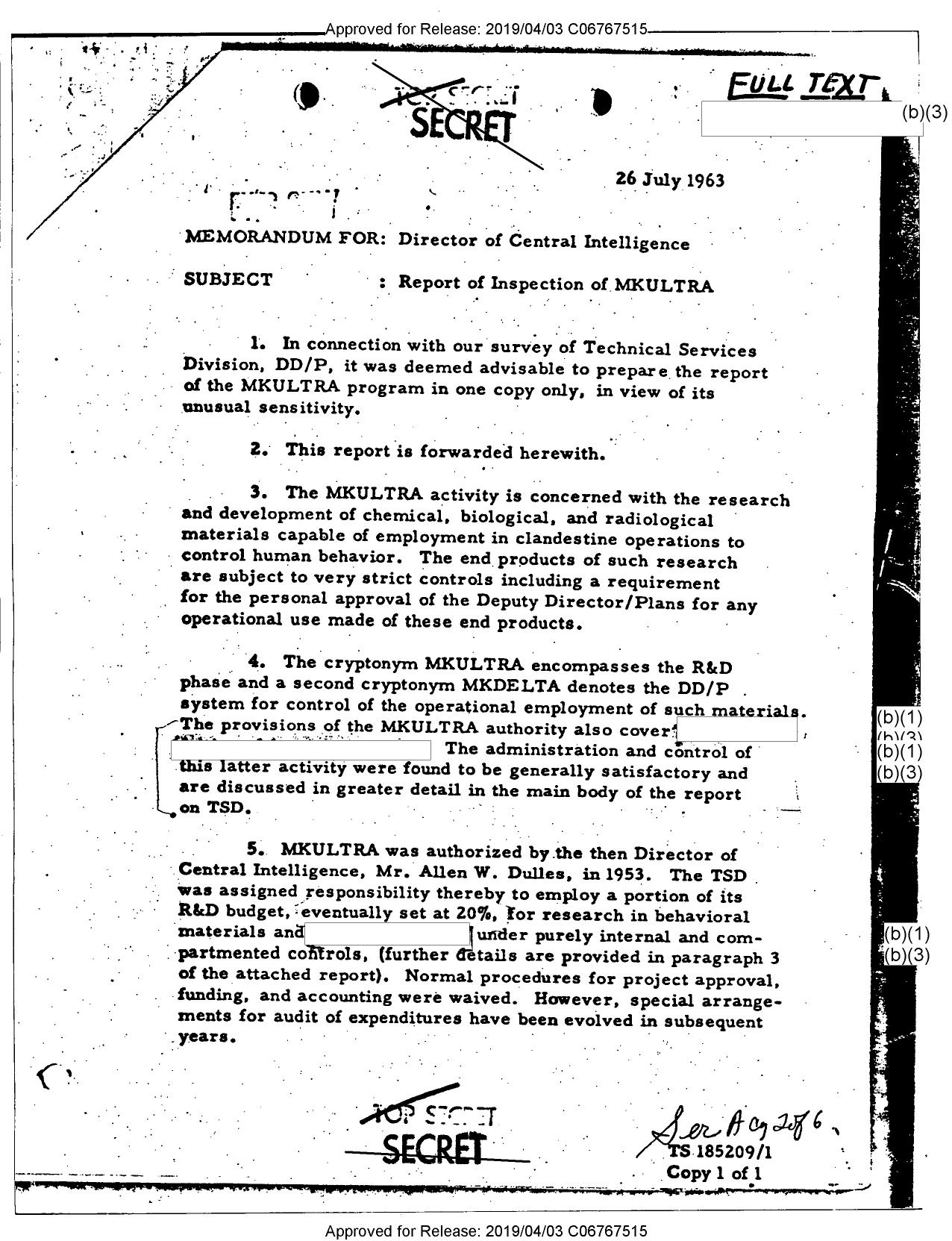
Report of Inspection of MKULTRA
Testimony, 26 July 1963

CIA Inspector General MKULTRA Report

The CIA Inspector General's internal audit of MKULTRA, documenting covert LSD and drug testing on unwitting American citizens through a Bureau of Narcotics safehouse arrangement. The Inspector General finds safeguards inadequate and recommends terminating unwitting testing on Americans.

Read more
The Psychedelic Review, Vol. I, No. 1
Academic Article, June 1963

Psychedelic Review, No. 1

The founding issue of The Psychedelic Review, published in June 1963 by Timothy Leary and Ralph Metzner's International Federation for Internal Freedom. Hosted here are the issue's unsigned Editorial and Statement of Purpose, which set out the journal's program and explain its choice of the word 'psychedelic.' The issue's bylined articles, by Gerald Heard, R. Gordon Wasson, and Alan Watts, are described in the front matter but not reproduced.

Read more
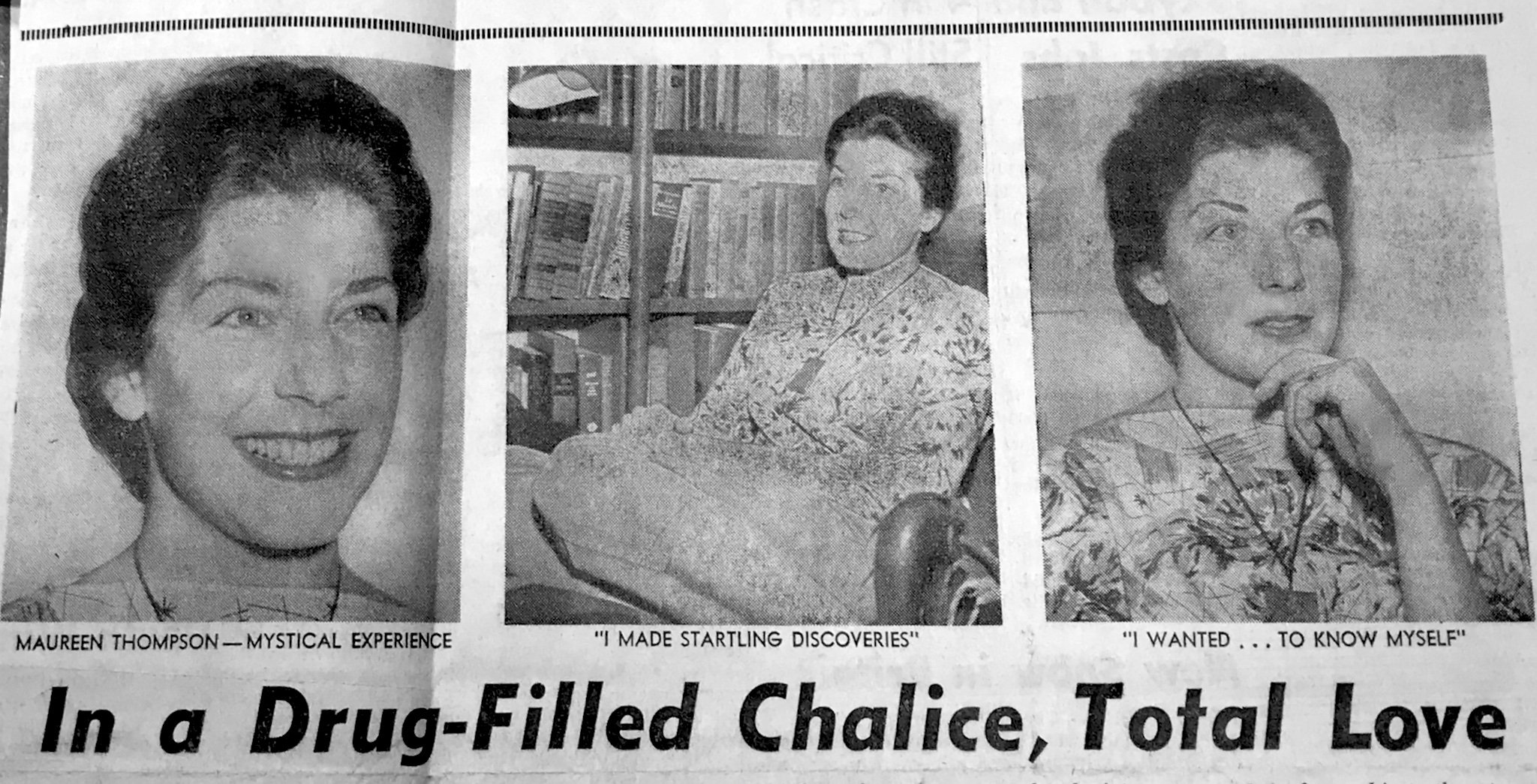
Menlo Wife’s Story: Drugs Open New Life: In a Drug-Filled Chalice, Total Love
Newspaper Article, January 3, 1963

Menlo Wife’s Story

Drugs Open New Life: In a Drug-Filled Chalice, Total Love

George Draper's front-page story about Maureen Thompson, a Menlo Park mother of four who took LSD and mescaline in August 1961 at Myron Stolaroff's International Foundation for Advanced Study, which charged $500. She describes the session as a turning point in her life, and her husband Bill took the same treatment a week later.

Read more
The Psychedelic Experience: A Manual Based on the Tibetan Book of the Dead
Book, 1964

The Psychedelic Experience

A Manual Based on the Tibetan Book of the Dead

Leary, Metzner and Alpert recast the Tibetan Book of the Dead as a manual for LSD, psilocybin and mescaline sessions. Hosted here is a fair-use excerpt: the book's opening definition of 'set and setting,' and the full 'Preparation' and 'The Setting' sections, which give that idea its practical, session-by-session form.

Read more
People v. Woody
Source, August 24, 1964

People v. Woody

The California Supreme Court reverses the peyote convictions of four Navajo men arrested at a Native American Church meeting near Needles in 1962. Justice Tobriner's opinion describes the all-night ceremony, its officers and its ritual objects before reaching the First Amendment question.

Read more
Testimony of Allen Ginsberg on LSD before a Special Subcommittee of the Senate Committee on the Judiciary
Testimony, June 14, 1966

Ginsberg Senate Testimony on LSD (1966)

The poet Allen Ginsberg (1926–1997) testified on June 14, 1966, before the special Senate Judiciary subcommittee holding hearings on narcotic rehabilitation and LSD on college campuses, with Quentin N. Burdick (1908–1992) presiding. He read a long prepared statement describing his visionary experience of 1948 and his use of peyote, mescaline, LSD, and ayahuasca, then argued from newspaper coverage and the medical literature that LSD's dangers had been exaggerated and that research should be expanded. The record hosts the full printed text, pp. 487–509, including his questioning by Burdick and Jacob K. Javits (1904–1986), his list of proposed research topics (Exhibit No. 76), and the references he put into the record.

Read more
Testimony of Timothy Leary on LSD before a Special Subcommittee of the Senate Committee on the Judiciary
Testimony, May 13, 1966

Leary Senate Testimony on LSD (1966)

Timothy Leary (1920–1996), then president of the Castalia Foundation at Millbrook, New York, testified on May 13, 1966, before the special Senate Judiciary subcommittee chaired by Thomas J. Dodd (1907–1971) that was holding hearings on narcotic addict rehabilitation and on LSD use on college campuses. Leary proposed licensing adults to use psychedelics and offering supervised university courses, and he sparred at length with Senator Edward M. Kennedy (1932–2009) over control, possession, and danger. The record hosts the full printed exchange, pp. 238–258, from Dodd's introduction to the recess.

Read more
The Houseboat Summit
Newspaper Article, February 1967

Houseboat Summit

A conversation among Leary, Ginsberg, Snyder, and Watts, taped aboard Watts's houseboat and published in San Francisco Oracle no. 7 (February 1967). Hosted here is the opening run of the conversation, in which the four debate dropping out of mainstream society versus working within it, and trace the psychedelic movement's lineage back through earlier utopian and religious dissent. The full conversation continues on to LSD, utopian withdrawal, and post-drop-out economics.

Read more
United States v. Kuch
Source, July 1, 1968

United States v. Kuch

Judge Gesell denies the Neo-American Church's motion to dismiss LSD and marihuana charges against a minister. The court catalogs the church's symbols and regalia, concludes it lacks genuine religious doctrine, and rejects an equal-protection claim based on the Native American Church's peyote exemption.

Read more
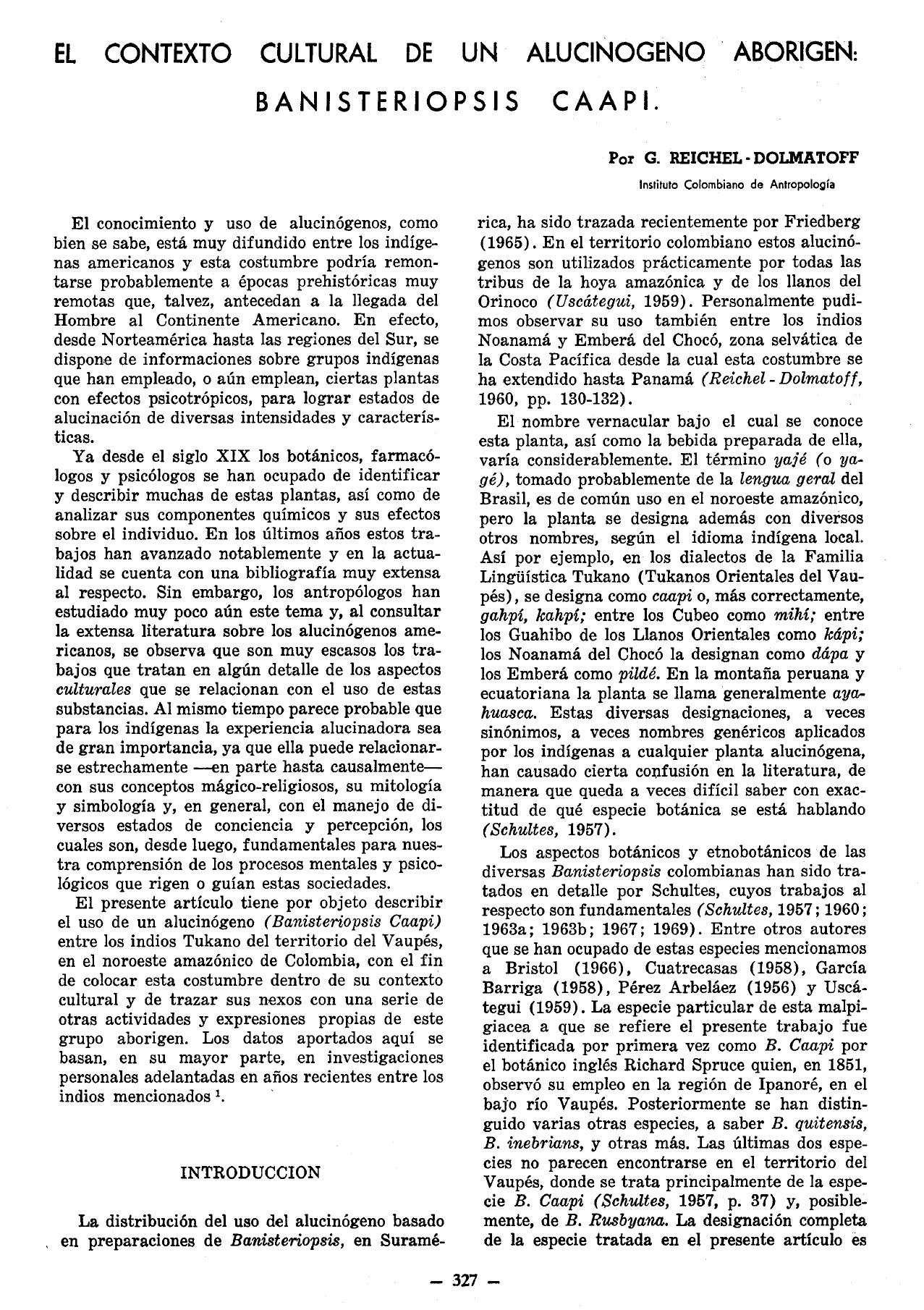
El contexto cultural de un alucinógeno aborigen: Banisteriopsis caapi
Academic Article, 1969

El contexto cultural de un alucinógeno aborigen

Banisteriopsis caapi

A Colombian Amazon ethnographic study placing Tukano use of Banisteriopsis caapi, or yajé, within a wider cultural system of mythology, ritual, symbolism, perception, and social knowledge.

Read more
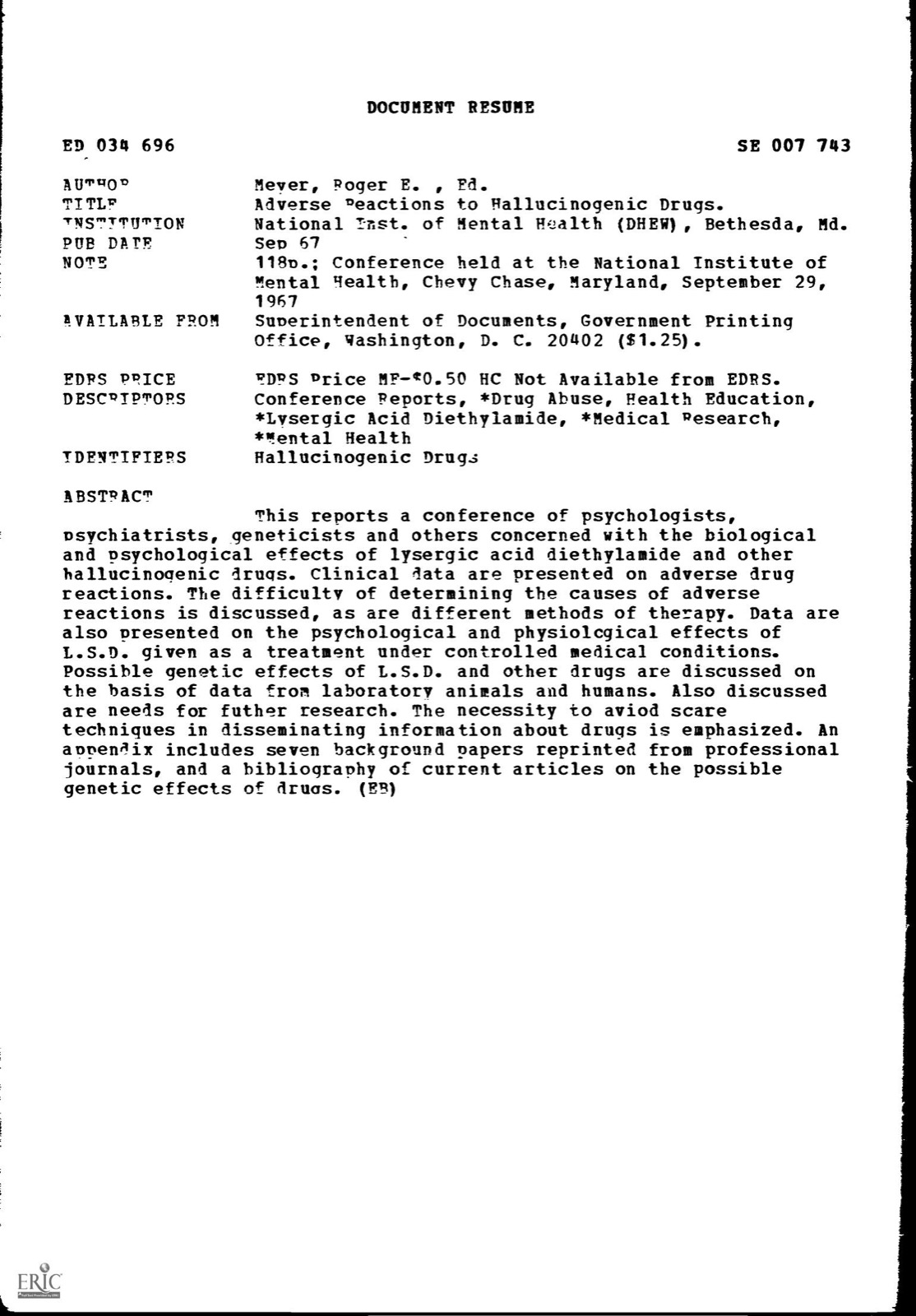
Adverse Reactions to Hallucinogenic Drugs: Proceedings of a Conference Held at the National Institute of Mental Health
Source, 1969 (conference held September 29, 1967)

Adverse Reactions to Hallucinogenic Drugs

Proceedings of a Conference Held at the National Institute of Mental Health

Proceedings of an NIMH conference held September 29, 1967, on adverse reactions to hallucinogenic drugs, published 1969. Addressed LSD's alleged chromosomal and teratogenic effects and the government's challenge in communicating risks to the drug-using public without propaganda.

Read more
Timothy Leary’s Testimony at the Chicago Seven Trial
Testimony, December 19, 1969

Timothy Leary’s Testimony at the Chicago Seven Trial

Timothy Leary's testimony for the defense at the Chicago conspiracy trial in December 1969, questioned by William Kunstler and cross-examined by prosecutor Thomas Foran. Leary describes his career and his 1968 meetings with Abbie Hoffman and Jerry Rubin about the planned convention protests, and says the young people coming to Chicago feared violence from the police and National Guard.

Read more
PIC Bulletin 33
Source, 1970

No. 33

Lisa Bieberman's December 1970 bulletin explains the Comprehensive Drug Abuse Prevention and Control Act, signed on October 27, 1970, which placed LSD and other psychedelics in Schedule I. She criticizes its penalties, its "continuing criminal enterprise" and "dangerous special drug offender" provisions, and its no-knock searches, then argues against the claim that drug-induced religious experience is "unnatural."

Read more
PIC Bulletin 32
Source, 1970

No. 32

Lisa Bieberman's October 1970 bulletin reviews the two studies then available on whether heavy LSD use damages the brain: Sidney Cohen and Allen Edwards's 1968 neuropsychological tests of thirty users, and William McGlothlin's 1969 attempt to replicate them. Because their results disagree, she concludes there is no evidence of general brain damage. The issue also prints a social worker's letter about how taking LSD changed his work with drug-using teenagers.

Read more
How to Guide a Session (from The Boo Hoo Bible)
Source, 1971

How to Guide a Session

Art Kleps's chapter on running an LSD session from The Boo Hoo Bible (1971), the Neo-American Church catechism and handbook. Hosted here is roughly the first half of the chapter: Kleps's advice on the session room, his distinction between 'Ivory' (spiritual) and 'Horny' (psychological) sessions, his view of what a guide needs to know, and his 'Good Answer / Bad Answer' examples for questions a subject might ask during a session.

Read more
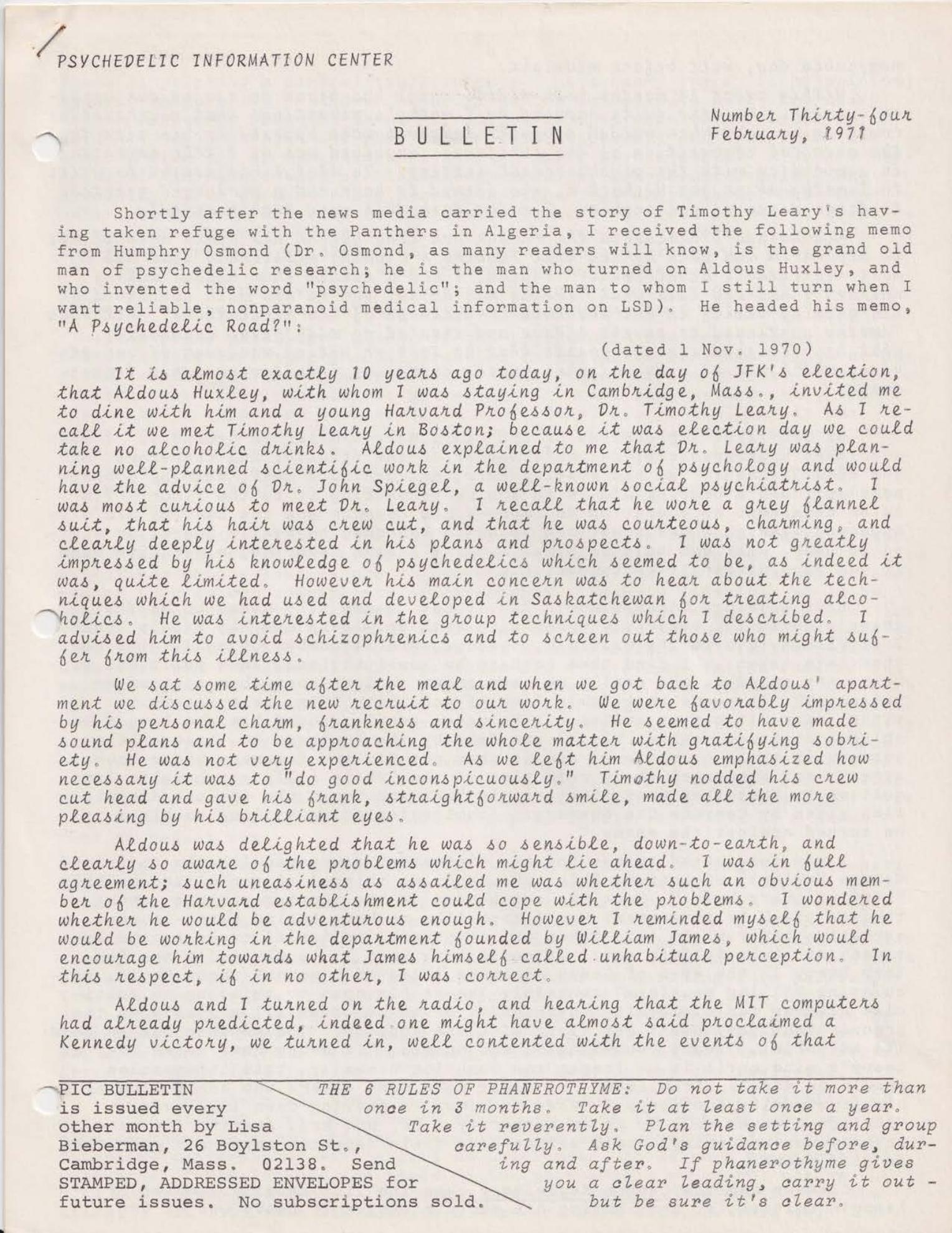
PIC Bulletin 34
Source, 1971

No. 34

Lisa Bieberman's February 1971 bulletin responds to news that the Black Panthers in Algeria had put the escaped Timothy Leary under house arrest. It prints a memo from Humphry Osmond recalling how he and Aldous Huxley met Leary in 1960 and later came to distrust his missionary zeal, followed by Bieberman's own memories of Leary at Harvard and a critique of press claims that LSD had ruined his mind.

Read more
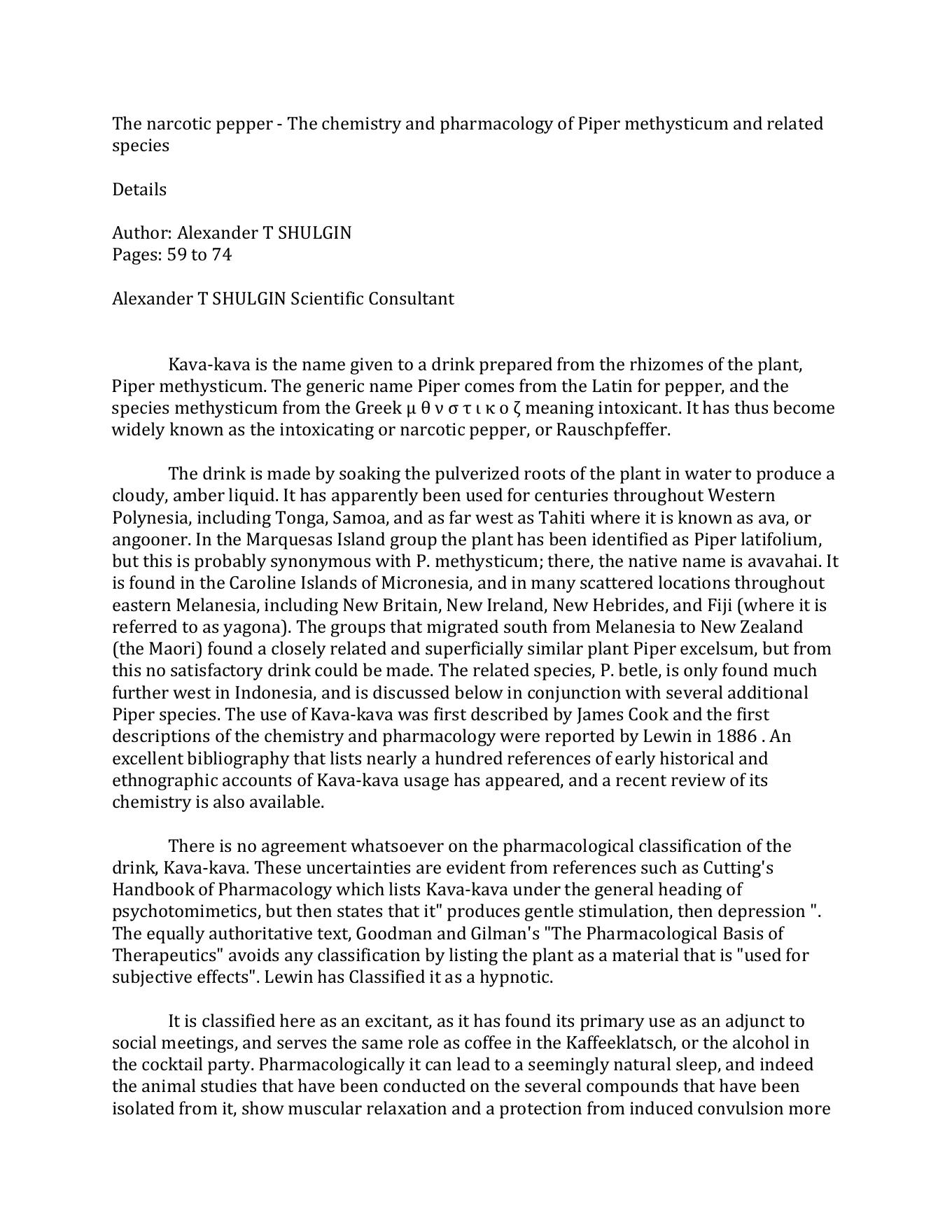
The Narcotic Pepper: The Chemistry and Pharmacology of Piper methysticum and Related Species
Academic Article, 1973

The Narcotic Pepper

The Chemistry and Pharmacology of Piper methysticum and Related Species

Alexander Shulgin's review of kava, Piper methysticum, covering Pacific preparation practices, pharmacological classification, and the chemistry of kavalactones and related Piper species.

Read more
FBI Interview of Timothy Leary on His 1970 Prison Escape and the Brotherhood of Eternal Love
Testimony, 17 July 1974 (interview); 12 August 1974 (transmittal airtel)

FBI File: Leary's Escape Network

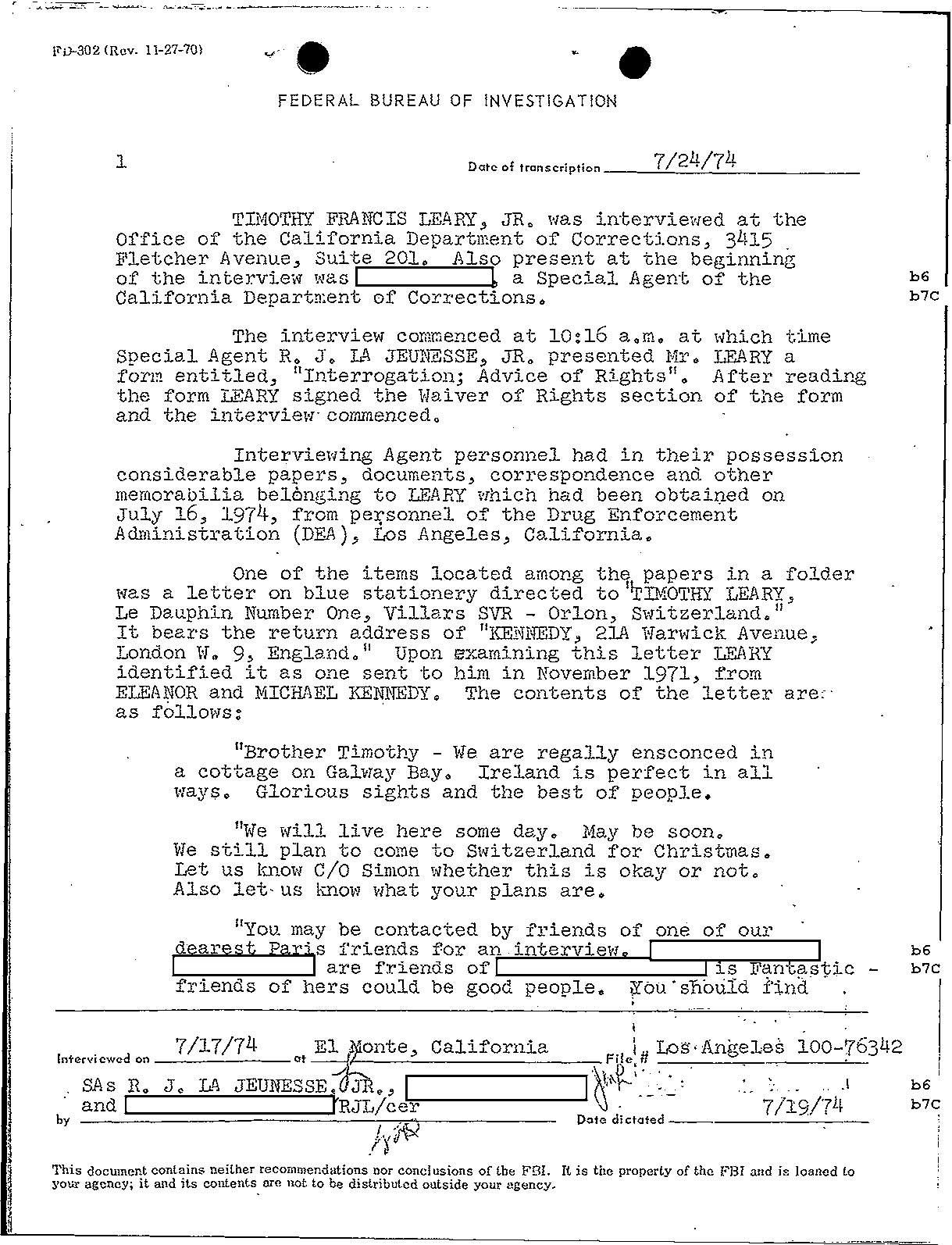
An FBI FD-302 interview (July 1974) in which recaptured Timothy Leary decodes the coded correspondence from his September 1970 prison escape. Leary identifies the Brotherhood of Eternal Love as the Laguna Beach LSD collective 'Group', Michael Randall as 'M', attorney Michael Kennedy, fellow inmate William Bellinger, and the Weathermen as 'Consultants' who staged the escape.

Read more
Virola theiodora como alucinógena e tóxica
Academic Article, 1974

Virola theiodora como alucinógena e tóxica

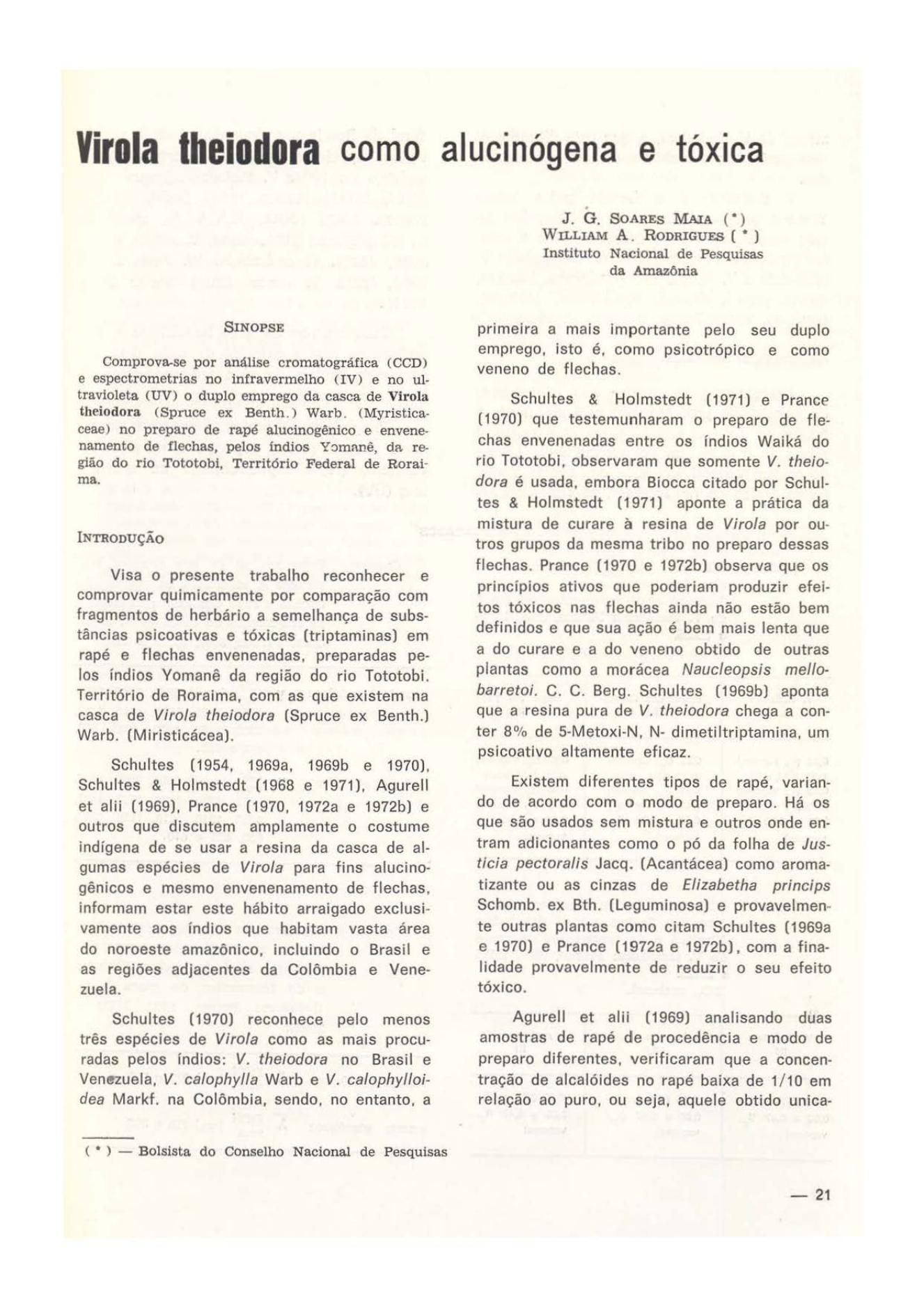
A short Brazilian natural-products chemistry article confirming the double use of Virola theiodora bark in Yomanê hallucinogenic snuff and arrow poison from the Tototobi River region of Roraima.

Read more
CIA R&D and Testing of Behavioral Drugs
Testimony, 5 February 1975

CIA R&D and Testing of Behavioral Drugs (1975)

An Inspector General memorandum and attached summary paper on CIA behavioral-drug programs from BLUEBIRD (1949) through OFTEN/CHICKWIT (1967-1973). It includes the Agency's account of Frank Olson's death after being surreptitiously dosed with LSD at Deep Creek Lake in November 1953.

Read more
Report to the President by the Commission on CIA Activities within the United States
Source, June 1975

Report to the President by the Commission on CIA Activities within the United States

Rockefeller Commission findings on CIA drug testing and domestic activities

The Rockefeller Commission's 1975 report was the first major presidential inquiry to put CIA drug experiments, including LSD-related episodes and the death of Frank Olson, into an official public account. It became a bridge between the commission investigation, the Church Committee, and the later Senate MKULTRA hearing.

Read more
Testimony of Sidney Gottlieb before the Senate Select Committee on Intelligence Activities
Testimony, 15 October 1975

Sidney Gottlieb Church Committee Testimony (1975)

Staff testimony by CIA chemist Sidney Gottlieb before the Church Committee on MKULTRA. Gottlieb discusses LSD training for intelligence officers and contract research, and confirms TSS had no informed-consent policy for contracted experiments.

Read more
Foreign and Military Intelligence: Church Committee Final Report, Book I
Source, 1976

Foreign and Military Intelligence

Full Senate report including the chapter on chemical and biological agents

Book I of the Church Committee final report, Foreign and Military Intelligence, includes the committee's findings on CIA testing and use of chemical and biological agents. The full volume places MKULTRA and LSD-related experimentation within broader findings on covert action, intelligence oversight, and congressional accountability.

Read more
Use of Volunteers in Chemical Agent Research
Testimony, March 1976

Army Inspector General Report on LSD Volunteers

An Army Inspector General review of volunteer drug testing at Edgewood Arsenal and in Intelligence Corps LSD trials (1958-1960). It finds that volunteers in the Intelligence Corps LSD program did not receive informed consent before their first dose.

Read more
Project MKULTRA, the CIA's Program of Research in Behavioral Modification
Testimony, August 3, 1977

Project MKULTRA, the CIA's Program of Research in Behavioral Modification

1977 Senate joint hearing on LSD, behavioral research, and CIA records

A joint Senate hearing on Project MKULTRA after CIA director Stansfield Turner informed Congress that financial records had surfaced for previously destroyed behavioral-research files. The hearing and appendices document LSD-related projects, agency recordkeeping, and congressional oversight of CIA human-subjects research.

Read more
Schedules of Controlled Substances; Temporary Placement of 3,4-Methylenedioxymethamphetamine (MDMA) Into Schedule I
Source, May 31, 1985 (effective July 1, 1985)

DEA emergency scheduling of MDMA

The Drug Enforcement Administration's order placing MDMA in Schedule I on an emergency basis from July 1, 1985, using powers Congress had given it the year before for so-called designer drugs. The notice cites rising recreational use, promotional parties, and a new rat study showing that the related drug MDA destroyed serotonin nerve terminals. It was issued while Judge Francis L. Young's hearings on permanent scheduling were still under way. Full text of the notice.

Read more